These are hung for ringing, though not all are ringable, even if stated so – John Adam’s visit may have been some time ago.
Data from http://www.homepages.ucl.ac.uk/~ccaajpa/1and2.html
Durham
Crook, Our Lady Immaculate & St Cuthbert, 1 bell, 9.25 cwt in A. RC. 7th of Chime of 8. (q.v.) 1897 Warner.
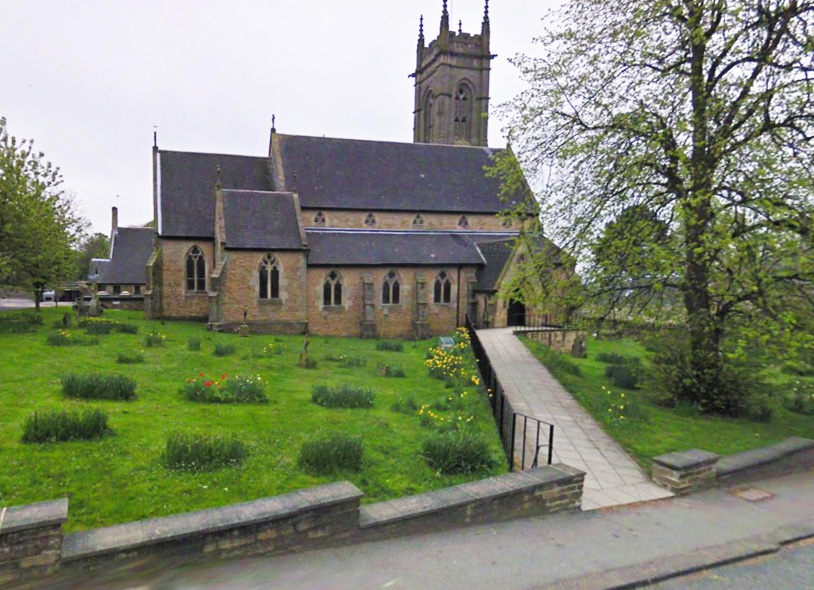
Darlington, St Paul 1 bell 5-3-15, 37.88″ 1921 Taylors (church demolished in 1974)
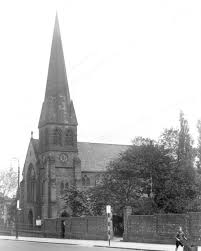
The church was badly damaged by fire in 1973 and demolished in 1974. The bell, taken from stock, was hung with ringing fittings at a cost of £142/0/0. It replaced a cracked steel bell by Naylor Vickers with a diameter of c.24.0″. It was noted that the tower was large enough to hold a chime of bells.
Durham, St Mary le Bow 1 bell 6¼cwt 31.00″ 1759 George Dalton – unringable
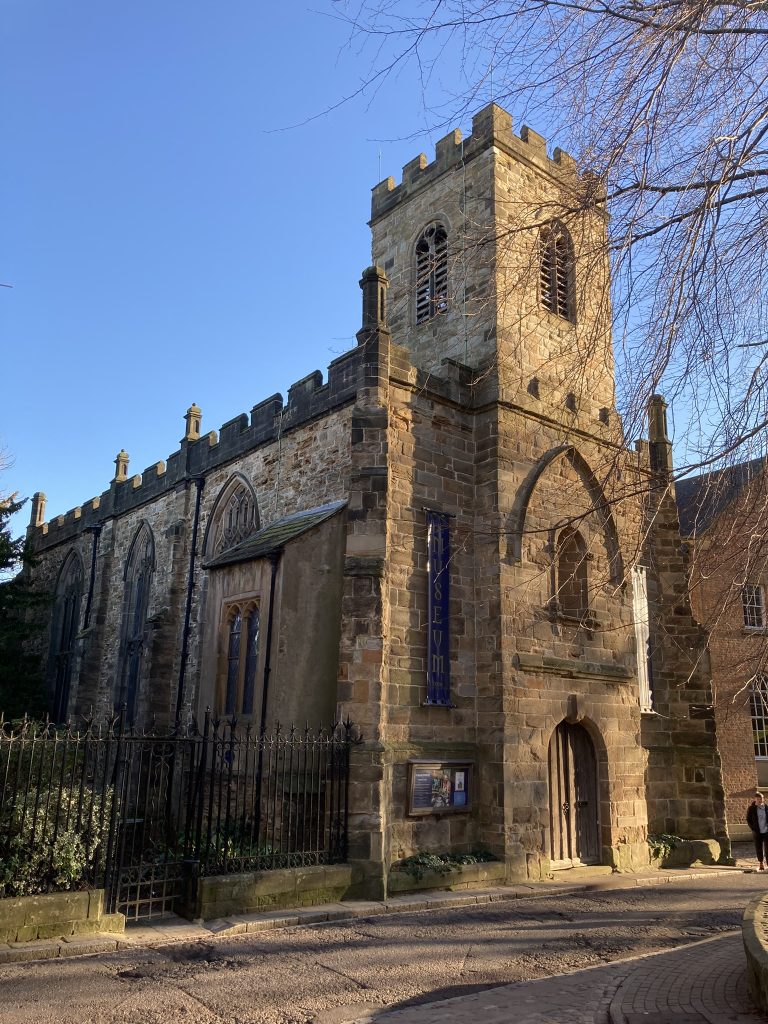
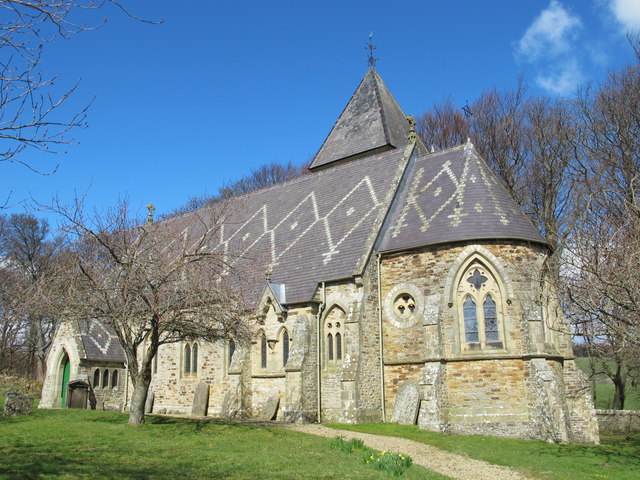
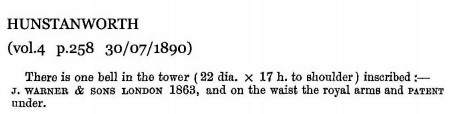
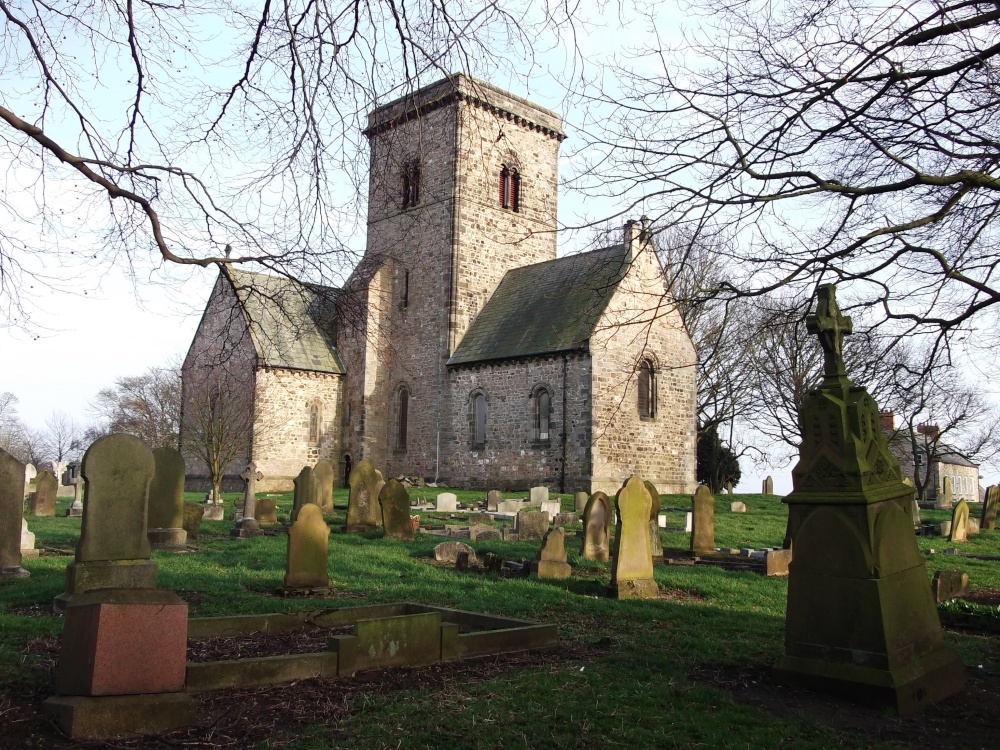
Hunstanworth, St James, 1 bell, 2-2-11 in C. 1863 Warner.
Photograph from here taken in 2015 shows that the bell wheel is in a very poor condition

The present church was built in 1862-3 and is the work of the prolific Victorian architect Samuel Sanders Teulon. It was a gift to the parish by its then incumbent Daniel Capper. Toulon also built the vicarage, school and other buildings in the village, which because of lead mining, had a population of around 800 when the church was built. It replaced a church rebuilt in 1781 on the site of a medieval building. The foundations of what is interpreted as a pele tower, thought to be sixteenth century, a scheduled historic monument, can be seen in the churchyard to the west of the present building.
The building has a broad north aisle, an apsidal chancel and a rather squat tower in the north-east corner. It includes fine glass by Kempe, Lavers and Barraud and some very high quality iron-work. The hand-blown organ is by Gray and Davison is said to have been shown in the Great Exhibition of 1851.
An alabaster plaque beneath the window in the east wall records the safe delivery of all Hunstanworth men from the First World War. Hunstanworth is thus a ‘Thankful Village’
The church has been very little altered since it was built, although extensive roofing work was carried out a few years ago. (church website)
The Society of Antiquaries of Newcastle reports:
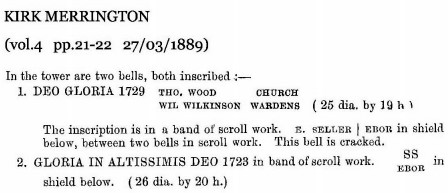
Kirk Merrington, St John the Evangelist: Unringable. 2 bells – 1. 3½ cwt 25.38″ 1729 Samuel II Smith (cracked) 2. 4½ cwt 27.00″ 1160.0Hz D-22c 1723 Samuel II Smith
Lanchester, All Saints, (R.C) 2 bells 5-3-17
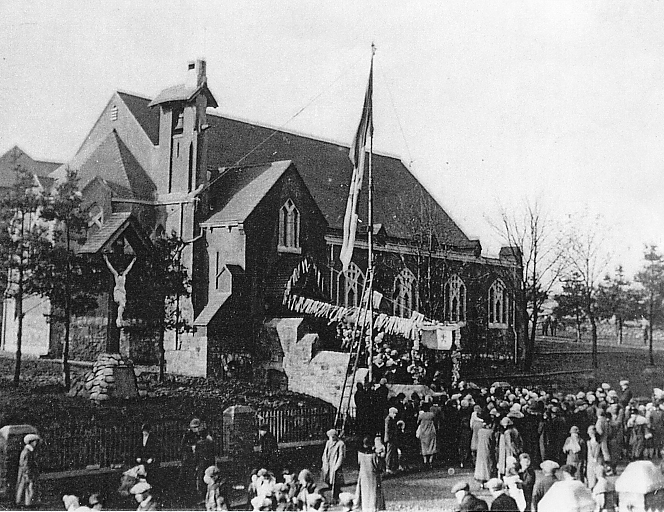
All Saints parish was founded in 1901 from St Michael’s, Esh. The first church was a tin building which had previously served as a chapel at St Nicholas Asylum, Cox Lodge, Gosforth. The present church was opened in 1926, at a cost of £4,500..
As seen in this photograph of the opening of the church, the tower had not yet been built.
There are two bells here, hung for ringing. They were recasts of previous bells, cast in 1955 and hung as 1 and 6 of a ring of 6. The previous tenor was cast for Newcastle on Tyne St Andrew (R.C.) in 1880 (in fact it was cast for Rostrevor, Ireland as the 3rd, but came out too flat). As originally sent out was 6-2-5.
1 2-2-26 22.68″ 1955 John Taylor & Co
2 5-3-17 31.88″ 1955 John Taylor & Co
The inscription on the treble is
|
JOHN TAYLOR & CO. * FOUNDERS * LOUGHBOROUGH * 1955 Waist: |
Previous Bells
1 2-0-2 21.68″ 1902 Charles Carr Ltd 1637.0Hz G#-25c
2 6-2-5 31.88″ 1880 John Taylor & Co 1049.0Hz C+4c
Inscriptions
- .AMDG.
.CREDO.
.ECCLESIAM CATHOLICAM
A.D. 1902Opposite:
CAST. BY.
CHARLES. CARR LTD:
SMETHWICK. - J : TAYLOR & CO.. FOUNDERS LOUGHBOROUGH 1880.Waist:
(cross)
PRESENTED BY
M. PELEGRIN
A.D. 1880
(cross);
Norton, St. Michael 1 bell 6-0-15 31.75″ 1022.0Hz C-41c John Taylor & Co 1913
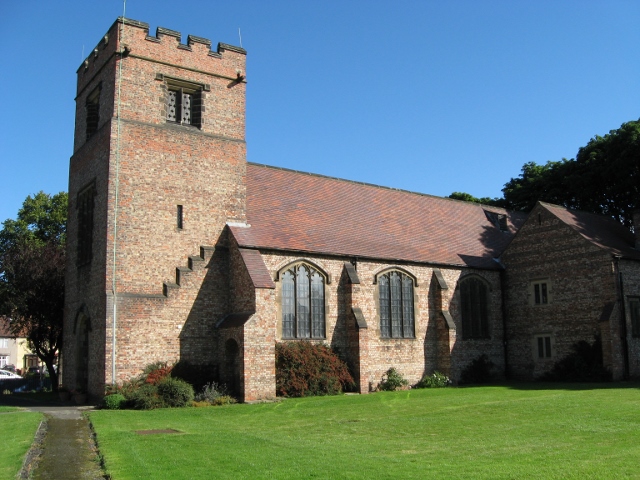
The church, in Imperial Avenue, Norton, was designed by Temple Lushington Moore, an English architect based in London, who designed in the Gothic Revival tradition. It is a Grade 2 listed building of brick with stone dressings and a west tower, seating 100. It has a fine pipe organ, one of the best in the area. It has a lady chapel, high altar and a nave altar and is set in its own grounds. It is located in an area of Victorian housing to the north of Stockton town centre.
Taylor’s Job Book notes on 23rd June 1913. “Bell 31½” 1022 [C] 6-0-15. Ringing fittings with cast iron headstock and wheel. Completed 23 August 1913; The Daybook notes – Rev. Canon Scott, Norton Vicarage, Stockton on Tees. New bell for St.Michael’s church, Norton, 6-0-15 £45.1.8., Inscription (145 letters) £2.8.4., Fittings, framework and carriage £15.0.0., Fixing £6.0.0., [Total] £68.10.0.”. The bell is hung in a lowside frame for full circle ringing.
I am unaware if it is currently ringable or not.
1 6-0-15 31.75″ John Taylor & Co 1022.0Hz C-41c
Inscription
| S. MICHAEL’S AND ALL ANGELS, NORTON 1913 T. ERRINGTON SCOTT, M.A., VICAR HON: CAN: OF DURHAM T. HENRY FABER } GEORGE BROWN } CHURCHWARDENS OF THE PARISH CHURCH SONGS : OF : PRAISE : THE : ANGELS : SANG |
Seaham, St Mary the Virgin, 2 bells, 1 cwt. (both 1 & 2)
C13th unknown. 1. 16.75″, 2. 17.50″
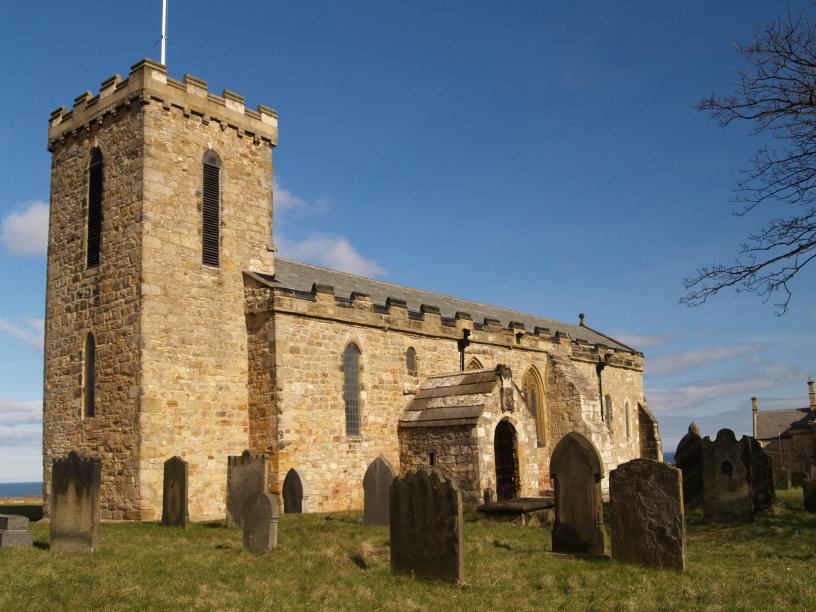
“The Bells are of considerable interest; a note in Proc.Soc.Antiq.Newcastle 2nd series III (1889) describes them as of the ‘long-waisted’ type. A 1971 note in the DAC file records them as being of 13th century date, and both by the same founder; one is 16.75″ in diameter and the other 17.5″. Both are uninscribed.” (Diocesan Architectural Asssment)
The church has a late 7th century Anglo Saxon nave and is one of the 20 oldest surviving churches in the UK. There were additions and alterations between 11th and 16th centuries. It was restored in 1913 and is Grade I listed.
Spennymoor, St Andrew, Tudhoe Grange 1 bell 9-1-21 in G#, 36.75″
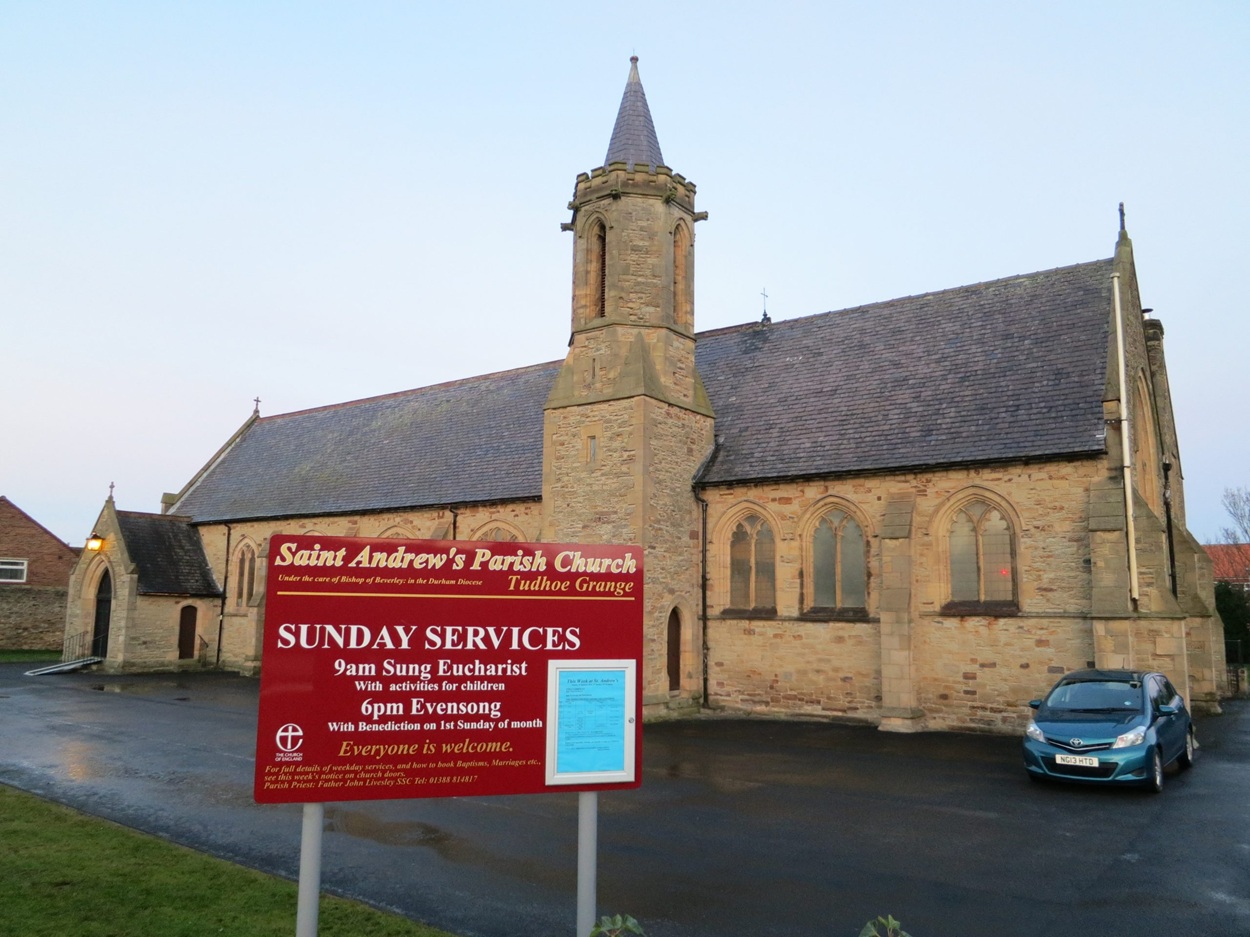
The church was built close to Spennymoor town centre in 1883/4 on a site given by The Weardale Iron and Coal Company. The architect was C. H. Fowler. It was extended in the 1890s.
The bell was cast with a flat head. The hangings with are a stock, wheel etc, and cast iron A-shaped frame in the octagonal turret. Taylors, who cast the bell in 1884, forwarded it on 15 July 1884 to Spennymoor Station; The daybook entry on 26th July 1884 states: !John C.O. Hanlon Esq, M.D., One new bell 9-2-21 £58.15.5., Fittings £16.0.0., Fixing £4.1.3, Carriage £3.15.., [Total] £82.11.9. The invoice was settled on 2 October 1884.
Stockton on Tess, St Mary (R.C.) 1 bell 14-3-15 in F#
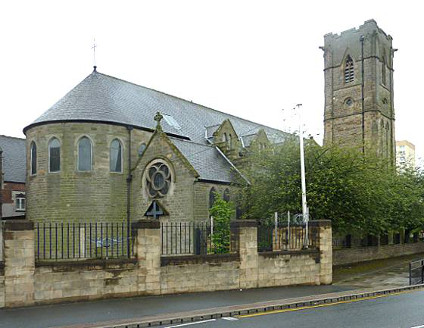
A Catholic chapel was built in Stockton in about 1790, but the present building, which was the first permanent Catholic church to be established on Teesside in the nineteenth century, was opened on 7 July 1842 by Bishop Mostyn. A new and larger church had been necessitated by the large-scale arrival of immigrants, many of them Irish, looking for work in the ship repair, steel and chemical industries. The founder of the mission was Fr Joseph Dugdale, and his architect was the great architectural and Catholic polemicist, A.W. Pugin.
The north aisle and lower part of the tower were added in 1866 at a cost of £1,300. In 1870 there followed the south aisle and sanctuary by Goldie & Child, added at a cost of £4,000. The upper stage of the tower and a clerestory were added in 1909, along with the presbytery, from designs by Hadfield of Sheffield. The intended spire was never built.
The church was reroofed in 1970 when the sanctuary was also reordered in accordance with Vatican II principles. The earlier appearance of the interior included a nave pulpit with elaborate Gothic canopy, altar rails, polychrome decoration at the east end and Gothic altars with elaborate reredoses in the Sacred Heart and Lady chapels.
Taylors Job book states – “New bell, completed 11 October 1907. 43½” 744 14-3-15. Ringing fittings with iron stock, wheel, Hesse clapper, chiming hammer and cast iron lowside frame.” The Daybook notes on the same day, “Rev. R. Taylerson, St.Mary’s Presbytery, Stockton on Tees. New bell 14-3-15 £135.8.11, inscription 6d.8d., New fittings for ringing £15, iron frame £19, Ellacombe hammer (NB should have been outside hammer with spring) £4, fixing £9, carriage £5, [Total] £187.15.7., Settled 21 October 1907″
1 14-3-15 43.50″ 1907 John Taylor & Co 744.0Hz F#+9c
Inscription
TE DEUM LAUDAMUS
A.D. 1907
Ushaw Moor, Ushaw College, 1 bell – 6-3-7 Whitechapel 1847
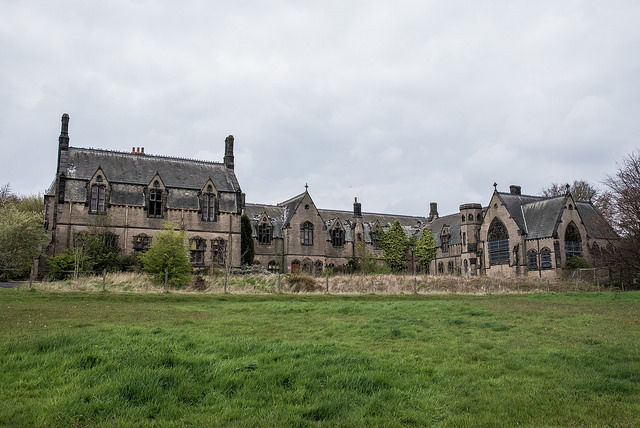
The Roman Catholic Seminary, closed 2011 and became largely derelict.
The building was reopened as “Ushaw: Historic House, Chapels and Gardens in late 2014.
The fate of the bell is not currently known. If you have any information about it, please let me know.
Tyne and Wear
Bensham St Chad, 2 bells, 15-1-15 in F.
Treble and tenor of proposed eight. Both cast in 1903 by Taylors.
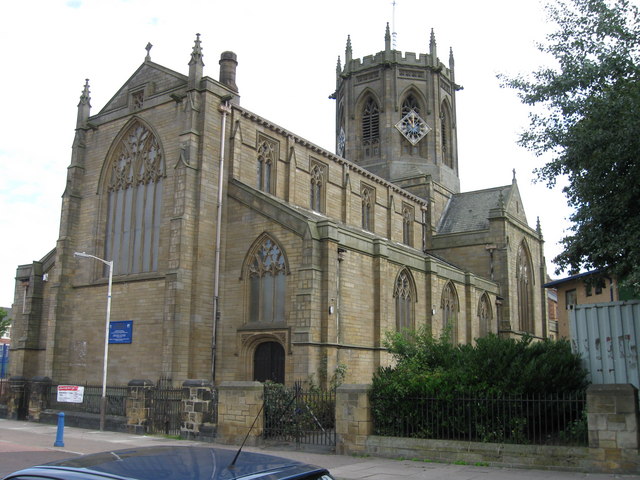
The church was consecrated in 1903. The church was designed by William Searle Hicks in the ‘Arts and Crafts’ style. It was built on land given by Lord Northbourne, and the building was paid for by Emily Easton.
“It has a stone-built 4-bay aisled nave, transepts, aisled chancel of three bays with a square ambulatory and, beyond to the east, the small All Saints’ Chapel. The most striking feature is the large central octagonal tower. The walls were meant to be frescoed, and the general opulence was intended to inspire the working class of the district.” (Pevsner)
The ringing fittings were completed on 27th August 1903. The cost of the bells was £134.8.6., Inscriptions 111 letters £1.17.0, fittings for treble for ringing £9.0.0., Fittings for tenor stationary £2.10.0., Deal frame for both £10, Fixing £10, carriage £5, etc, total £173.10.6., The invoice was settled on 10th February 1904. Taylors daybook notes, “Tenor was, by error, hung for ringing. Extra cost £12. Not allowed”. Both bells were cast with flat heads.
1 4-3-9 26.50″ 1903 John Taylor & Co 1402.5Hz F+7c
2 15-1-15 44.50″ 1903 John Taylor & Co 700.0Hz F+4c
Inscriptions
- PER SINGULOS DIES BENEDICIMUS TE
ST. CHAD’S GATESHEAD
M.C.M.III, - IN TE DOMINE SPERAVI : NON CONFVDAR IN ÆTERNUM
ST. CHAD’S GATESHEAD
M.C.M.III
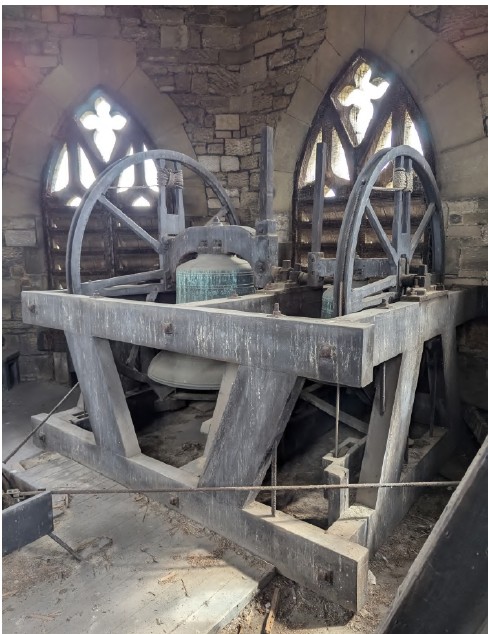
©Crosby Granger Architects
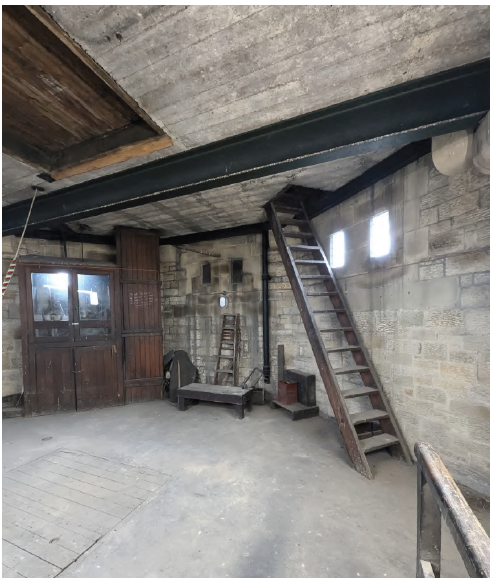
Gateshead Fell, St John, Sheriff Hill, 1 bell, 6.5 cwt.
No Stay/Slider. 1610 unknown.
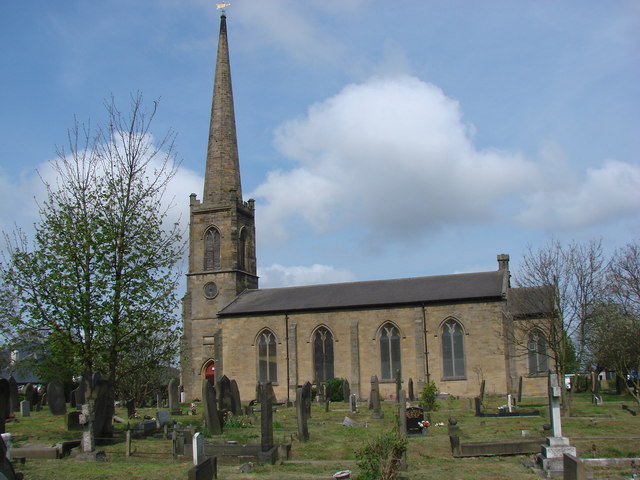
In 1809, the Enclosure Act decreed that there be a church built on Gateshead Fell and an acre of land was set aside for that purpose. A grant of £1,000 (equivalent to £90,000 in 2019) was given towards its construction by the Church Building Commission. Designed by John Ions, the foundation stone was laid by Rev. John Collinson, at a “lofty eminence” on Sour Milk Hill, on 13 May 1824. Building continued into the next year and the church was consecrated on 30 August 1825. The total cost was £2,742 (equivalent to £240,000 in 2019).
The Newcastle Society of Anitiquities reported on the bell in 1904
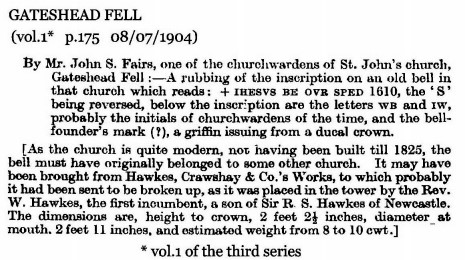
The bell is therefore older than the church.
Gosforth, St Nicholas, 1 bell, 2-2-22.
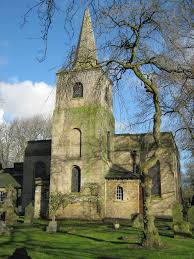
No Stay/Slider. 1792 W & G Armstrong
The church is located on Church Road in South Gosforth. It was built in 1799 by John Dodds, after the demolition of earlier church.
In 1820 the church was extended and modified by John Dobson. There were further modifications in the early 20th century.
The church is Grade II listed on the National Heritage List for England.
Low Fell, St Helen, 1 bell, 8cwt 39.13″ 799.0Hz G+33c 1876 John Warner & Sons
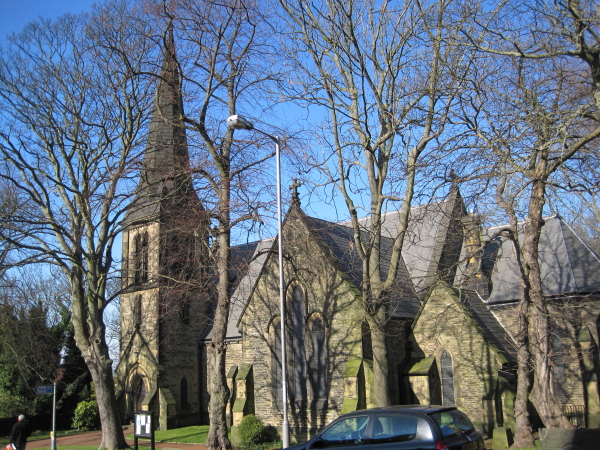
The church was consecrated on the 29th of August 1876. The new Parish Church was built to meet the expanding population of Low Fell following the growth of local coal mining and the building of the Gateshead to Durham Turnpike. The Church cost £13,000 to build and was paid for by Edward Joicey of Whinney House, Low Fell, who was a partner in the firm of Joicey and Co., colliery owners. There is also a service bell c1¼cwt 20.00″ 1583.0Hz G+17c, also cast in 1876 by John Warner & Sons.
Newcastle, St Dominic’s Priory (RC) 1 bell, 25cwt 53.00″ Warner 1881 (Unringable)
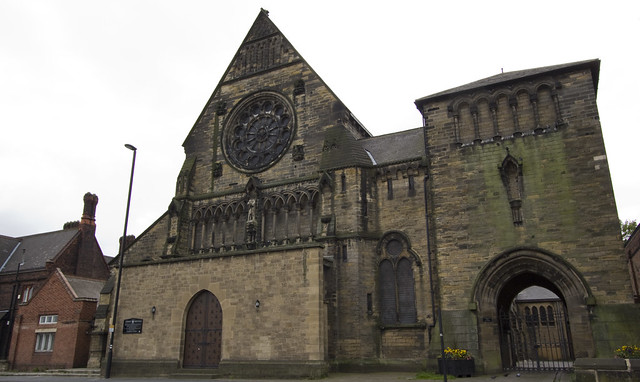
The church was built from 1869 and opened in 1873. It was founded by the Dominican Order. The construction of the church cost £15,000, and it was designed by Archibald Matthias Dunn. According to Historic England, it was built in the Romanesque-Gothic transitional style. The altar of the church came from St Andrew’s Church on Pilgrim Street. St Andrew’s Church was demolished and rebuilt on Worswick Street in 1875.
In 1887, the priory next to the church was built, St Dominic’s Priory. It was designed by Archibald Matthias Dunn with Edward Joseph Hansom. St Dominic’s Priory is also a Grade II listed building and was registered on 30 March 1987.
The dedication of bell was reported in the Northern Echo on 30 June 1881 – “A somewhat novel and interesting ceremony was performed at St. Dominic’s Catholic Church, Red Barnes, Newcastle, yesterday morning, in the dedication of a bell to the service of the church. The ceremony is one which has not been per- formed in Newcastle for the last four hundred years, and attracted by its novelty the church yesterday morning was crowded. The Catholic Bishop of the Diocese of Hexham and Newcastle performed the ceremony. … The bell, which has been subscribed for by the parishioners of St. Dominic’s, has cost £200, and is from the celebrated bell foundry of Messrs Warner and Sons, London. It weighs 25cwt., is 53 inches in diameter, and is one of the largest bells in Newcastle. We understand it will be hung in the belfry of the church in the course of next week.”
Howard Smith says “I did go and see it about 15 years ago. Definitively it is 53 inches diameter and 1887 (sic). From memory it is hung for ringing though I doubt that it was rung full circle. The frame is not substantial and to reduce movement for swing chiming it had been braced at the top if I remember correctly against the window mullions”
Newcastle, St Thomas the Martyr, 1 bell, 10-0-18 830.0Hz Ab-1c 38.625″ Thomas Mears 1835 U/R
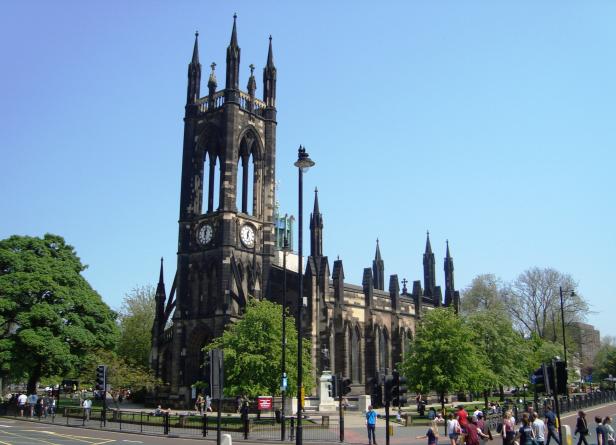
This is an elegant Gothic-style building, erected at a cost of £6000. The present church was built by John Dobson, between 1827 and 1830. Galleries were added in 1837 and the seating was replaced in 1881. In 1972 the level of the High Altar was lowered, the chancel screen removed and the chancel extended into the nave, with a nave altar. The present church is a Grade II* Listed Building.
The modern St Thomas the Martyr has no parish, but neither is it a Peculiar (ecclesiastical enclave), making it unique in the Church of England. It is governed by the Body Corporate (comprising the senior priest and Churchwardens) and ultimately through Acts of Parliament.
A single bell for ringing was supplied by Mears in 1835. Taylor’s records show that the bell was rehung in 1990: “Newcastle upon Tyne, St. Thomas the Martyr, Northumberland: Taylor index – 1990 1 38⅝” 10-0-18. Balanced fittings and lowside frame. The later addition of electronic chiming gear stops any movement.
Sunderland, Christ Church, Bishopwearmouth 1 bell 14-1-24
Taylors 1882 – bell removed
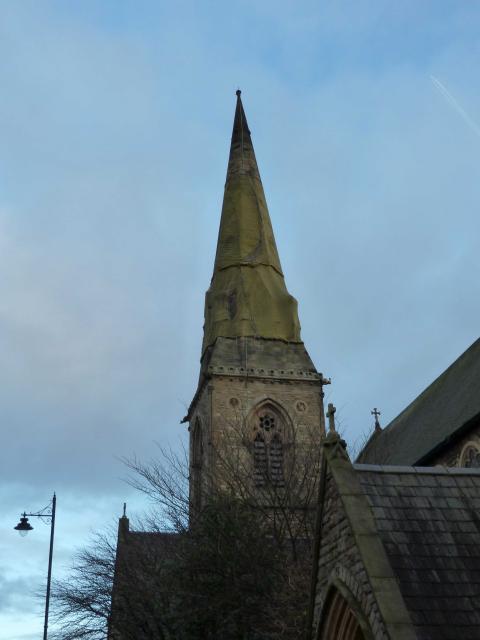
The church, built in 1862-64 is by James Murray of Coventry, with an attached vestry and verger’s house c1877 by JC Cundall of Leamington. It is built from snecked rock-faced limestone with ashlar plinth and dressings of coarse-grained sandstone. The roof is of pale grey slate, perhaps Lakeland, with stone copings and a stone spire. There is a Chancel with a south chapel and North-East tower; an aisled nave with transepts and a North porch. The church has a 5-bay arcade with double-chamfered arches on round piers with crocket capitals; similar chancel arch on shafts; scissor-braced roof on corbelled wall-posts. There is some fine glass in the church.
The church was declared redundant towards the end of the 20th century and is now a Sikh Gurdwara. The bell was removed and now forms the tenor of ring of bells at Hawton, Nottinghamshire. It was hung for ringing and was intended to be the tenor of a ring of 6 or 8.
Taylor index 1882 records 1, 43½” 14-1-24 ….. Tenor to a future peal of 6 or 8. Bell 43⅝” in F … Ringing fittings. The invoice was sent to T.G. Hutton Esq, 3 The Cedars, Sunderland. “To new tenor bell 14-1-14 (sic) £93.18.4., Fittings, clapper (£20), hangings (£8.10.0.), rope (12s), Frame pitch pine (£10), fixing (£6), carriage (7), £34.4.0., [Total] £128.2.4. Settled 7 October 1882″
Inscription
J : TAYLOR & CO BELLFOUNDERS LOUGHBOROUGH 1882
Waist:
WM SCOTT MONCRIEFF. VICAR
W.B. FERGUSON }
T.G. HUTTON } CHURCHWARDENS
A.D. 1882
Tynemouth, Holy Trinity (North Shields) 1 bell 16-0-4 – lost bell
Taylors 1938
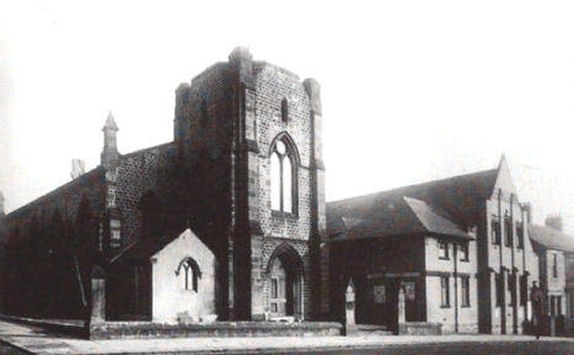
This church was on Coach Lane, North Shields (Tynemouth Parish being part of North Shields). Holy Trinity, or Western Town, was an ecclesiastical parish formed April 16, 1861; the church, in Collingwood street, was a building of stone, consisting of chancel, nave, and a western tower containing 1 bell: it had galleries on three sides; there were 1,000 sittings. The church was closed in 1982 and demolished in 1984.
Taylor’s records show:
“Metals book – 3 February 1938, new bell 16-0-4; Daybook – 18 February 1938. Miss M.E. Herdman, Pinfold Close, Ripon. Supplying a 44” bell with ringing fittings for Holy Trinity church, North Shields. Bell 44” 16-0-4 £165, fittings £35, cast iron side frame and girders £35, carriage £12, erection £23, [Sub-total] ££270.0.0., Inscription 109 letters £2.14.6., Bellmetal inscription tablet £11.0.0., [Total] £290.8.0.,”
There was also a swing chiming bell in the tower, a recast of an earlier bell, dated 1960. It was noted that it could be the treble of six. Taylor’s records note: ” January 1960, Most Holy Trinity, Tynemouth (North Shields). Recast old bell, 1. 26½” 1162 D 3-2-16. Wrought iron headstock with lever; Metals book April 1960, Holy Trinity, North Shields, new bell 3-2-16; Daybook – 29 April 1960. Recasting and refitting bell, 26” 3-2-16 (old bell 3-2-9), adjustments for recasting instead of rehanging, lever fittings, two steel stanchions etc, total £100.3.0.”
The large bell was bought for scrap by Taylors and the metal was used in the casting of 9th September 1983. The smaller bell in the tower is now at Stainland, where it is the 5th in a chime of 6 that were install in place of an old steel ring of 6.
1 16-0-4 44.38″ 1938 John Taylor & Co
TO THE GLORY OF GOD
AND IN LOVING MEMORY OF
ROBERT MORRISON HERDMAN
AND
MARY HERDMAN
THIS BELL IS GIVEN BY THEIR THREE DAUGHTERS
1938
Northumberland
Ancroft, St Ann, 1 bell, 7.5 cwt.
1884 Warner. 918.0Hz A#-27c
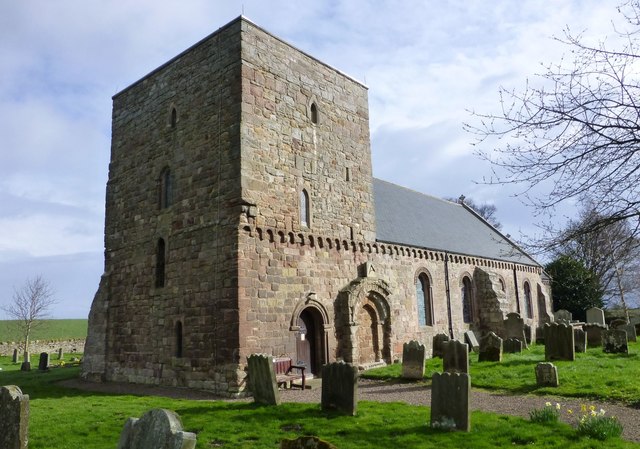
“Set back in the centre of the flat leaded roof is a timber bell cage, in its present form of no great age.” Peter Ryder, July 2020.
The 11th-century church began as a chapel of ease in the Norman period. Ancroft was close enough to the Scottish border for the parishioners to be concerned about the possibility of Scottish raids, so in the 13th century a squat, sturdy three-storey pele tower was attached to the west end of the nave, to offer refuge in times of trouble. Most pele towers were detached from the church body but in Ancroft’s case, the tower is directly attached to the nave. The church was restored twice in the 19th century, the second time in 1870 by FR Wilson. Wilson created the current chancel and replaced all the doors and windows.
The bell was rehung by Hayward Mills Associates as one of their early jobs (no date given, but pre 2007.) It is rung from the old priests room on the first floor of the tower. It goes well and has stay and slider. There is also a service bell, 1829, Thomas Mears II which is 14.0″ in diameter and has the frequency 2488.0Hz (D#-1c)
Bedlington St Cuthbert, 1 bell, 11-2-17.
1870 Taylor. Loose headstock.
“The belfry has long-headed wooden frames of bolted construction, with incised carpenter’s numbering, now just with a single bell.” Peter Ryder 2015.
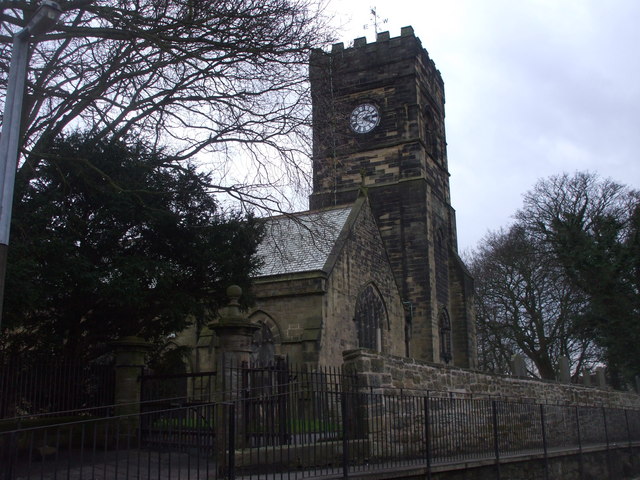
The Nave is mid-12th century, with a 14th century south chapel. The Chancel was rebuilt 1743 and again in the mid-19th century. The west tower was built in 1868, the north aisle, vestries and nave windows are from 1911-12. The Nave and chapel are of squared stone, the 19th century parts squared tooled stone, the 1911-12 work snecked stone; cut dressings. The 19th century work is in Romanesque style, the 1911-12 work is in free 14th century style.
Taylor copy book contains a letter with a plan of a proposed frame for three bells, and details of bell cast 15 December 1870, Tenor 38¾” in A#, 11-2-17. Also sketch plan of tower showing position of clock; The Daybook, 21st January 1871. The Rev. C.F. Whitley, Bedlington, Northumberland. To one bell 11-2-7 £77.9.8., clapper £1.0.0., Hangings £6.10.0, rope etc 10s.0d., English oak frame for 3 bells £25.0.0., Carriage £6.5.1., Fixing etc £3.7.6., railway fares £1.13.2, [Total] £121.15.5. Settled 10 January 1873.
Belford, St Mary, 2 bells, 10-3-4.
Originally 3 bells. (q.v.)
Blanchland, St Mary the Virgin,
1 bell. No Stay/Slider. 1878 Watson, 28.0″.
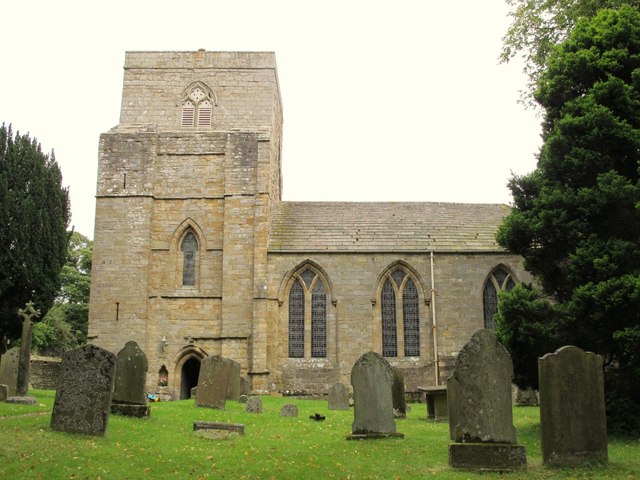
“The present bellframe is a simple construction of four posts, set
centrally, with various horizontal struts to the side walls providing stability; its
single bell has an inscription stating that it was made in London in 1754 and
recast by H. Wilson (sic.) in 1878″
The Abbey church is listed as Grade 1 for its special architectural or historic interest. The church, formerly part of church of Premonstratensian abbey founded 1165 by Walter de Bolbec. Chancel c,1200-1210, north transept and tower mid C13 except for belfry stage of tower, C14. Repaired and adapted as parish church 1752 by Lord Crewe trustees, transept aisle rebuilt 1854, east end rebuilt 1881.
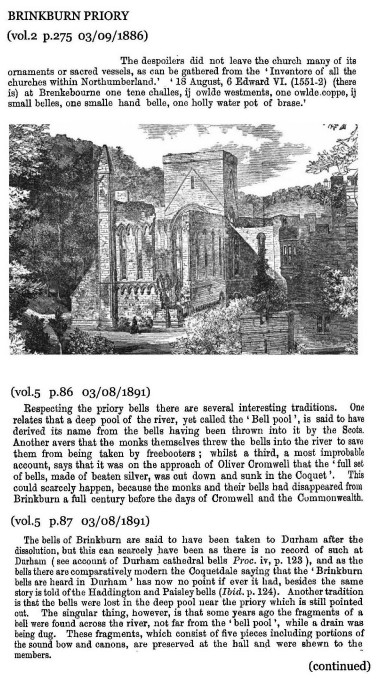
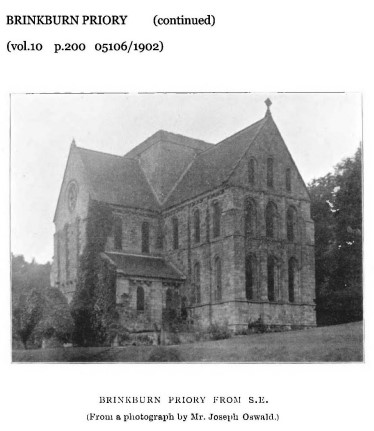
Brinkburn, Priory, 1 bell.
Unringable, “hits something”. English Heritage property. 1866 Warner, 32.00″.
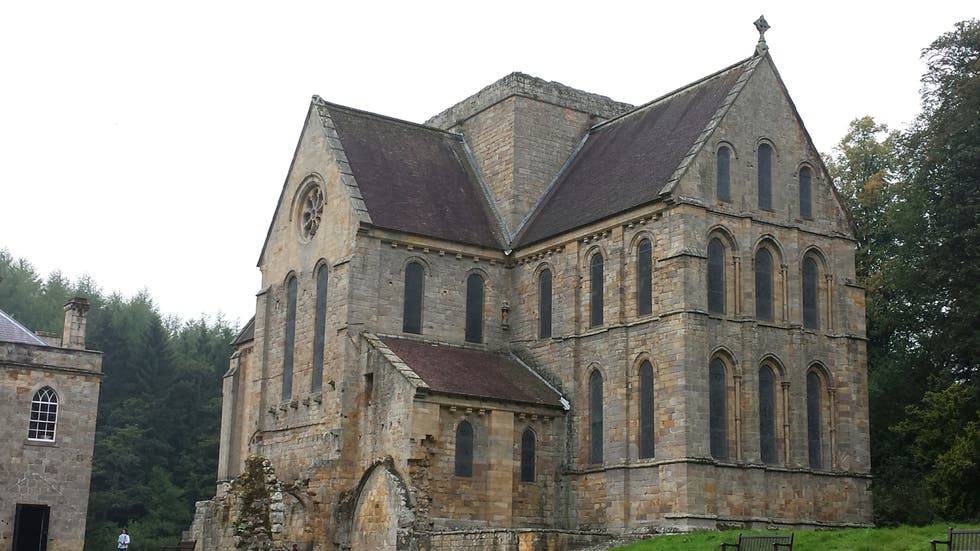
The 12th-century church of the Augustinian Priory was dissolved in 1536 after Parliament enacted the Dissolution of the Lesser Monasteries Act. The “lesser monasteries” were those with an income of less than £200 per annum, and Brinkburn fell into this category as in 1535 the priory’s value had been recorded as £69 in the Valor Ecclesiasticus. After the dissolution the estate was mainly owned by the Fenwick family and in the late 16th century they built a manor house on the ruins of the Priory buildings and adjacent to the Priory Church. Services continued to be held at Brinkburn and the church was retained in a fair state of repair till the end of the 16th century. In 1602 it was reported to be in a state of decay, and at some point before 1700 the roof had collapsed and regular services were abandoned.
In the 19th century the Cadogan family, owners of Brinkburn, revived the plans for the restoration of the church and work began in 1858. The roof was completed in the space of a year, and the stained glass windows had been inserted by 1864. The church, however, was not furnished until 1868. It is one of the best examples of early Gothic architecture in Northumberland.
 |
|
|
There is an article about this church, with some good photographs on the Fabulous North website
Bywell, St Andrew, 2 bells.
Churches Conservation Trust. (1) 1-2-16 19.88″ 1510.0Hz F#+35c 13thC unknown, (2) 1-3-10 21.06″ 1526Hz G-47c18thC unknown.

The tall tower of St Andrew’s is a magnificent example of a late Anglo-Saxon building. Dating from about 850, it has massive walls 5 metres thick, clearly intended for defence; but it is much more than a defensive structure. It is built from a lovely mixture of cream, yellow, brown and even red sandstone and has the small rounded windows characteristic of the time.
The main body of the church dates from the thirteenth century and was considerably enlarged and restored in 1871. Most of the interior dates from this Victorian restoration, including the mosaic floor of the sanctuary and the glittering reredos. There is very fine Victorian stained glass, some by the notable designer William Wailes, who is buried at St. Peter’s, Bywell’s second church. Set into the walls, both inside and outside, are magnificent early Medieval grave slabs. They have bold carvings with emblems denoting the status of the person they commemorate – swords, shields, a hunting horn, shears and a book.
The bells were rehung by Taylors in 1974 with ringing fittings using the old three-quarter wheels, at a cost of £534.60.
Cambo, Holy Trinity, 1 bell, 17-0-14.
All “unringable”, Pembleton 2007. Tenor of chime of 6. (q.v.).
Chollerton, St Giles, 1 bell, 12-3-17.
42.25″ 736.0Hz F#-9c 1910 Taylor.

There are two bells in the tower. The (lower) bell which is only tolled for services was made by John Taylor & Co. of Loughborough in 1910. It is hung in a modern design metal frame with all appropriate fittings for full circle ringing in the traditional English fashion. A second, smaller, bell is located in the upper part of the spirelet – Thomas Mears, Whitechapel, 1791, 22.625″.
The church consists of chancel, nave, aisles, south porch and a tower, heightened by the addition of a belfry stage. It was last restored in 1875, as much as possible of the ancient structure being retained. The unsightly modern windows were removed and replaced by others in the later Early English style: all the windows in the nave and chancel are stained. One hundred people can be sat comfortably in church. In the nave are Roman pillars that support the south side of the main roof. It is thought the pillars were removed from either the Corbridge or Chesters Roman sites. The church is Grade I listed.
The foundry details of the bell are as follows:
“Iron side frame with girders. Ringing fittings including cast iron stock and Hesse clapper. Completed 21 July 1910; Inscription book 4 p.97 – ECCL. PAROCH. CHOLLERTON Waist: MEMORIÆ ET NOMINI JOHANN. FRED. / HORNBY DECESS. MART. X. MDCCCCIX / POSVIT CVM PRECIBUS VXOR MARIA. / VIVAT IN DEO MEMOR SVORVM. / MDCCCCX; Daybook 12 p.287 – 21 July 1910. New bell 12-3-17 £91, Fittings £15, frame and girders £30, fixing £14, carriage & carting £9, mason’s work £18, inscription (124 letters) £2.1.4., total £179.1.4.”
Heddon on the Wall, St Andrew, 1 bell.
19th C Unknown, 22.375″.
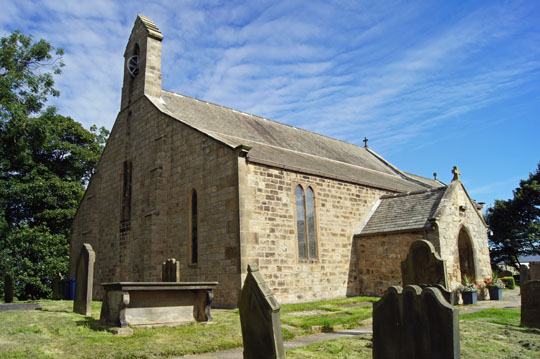
The church was consecrated in 630 and still retains many Saxon and later Norman elements. There are fragments of a 7th century Anglo Saxon church with a Norman sanctuary. The original nave occupied space now taken up by the two easternmost bays of the present nave. The apsidal chancel occupied what is the now the choir and a little of the Norman chancel. Of this church little remains. Some of the masonry in the walls of today’s choir is undoubtedly Saxon. There is also Anglo Saxon long and short work and just visible on the gable of the south aisle the old roof line can be seen. Finally, there are blocked Anglo Saxon windows within the choir fabric.
In 1165 the monks of Blanchland Abbey were given the lands around Heddon and assumed responsibility for its church. They demolished the apse and built the existing sanctuary. It cannot have been very long before the aisles were added and church extended westwards because the rest of the church is decidedly Early English in character. Pevsner puts the north aisle at about 1200. A little later the south aisle was built and the nave remodelled with a third bay extending the nave westwards.
In the 1840s when there was further extension westwards with a fourth bay being added to the nave. The windows in the north aisle were replaced in 1839 in a pseudo Early English style. There has never been a tower here.
Lowick, St John the Baptist, 2 bells
Unringable (1) 27.25″ Thomas Mears II 1829 (2) 28.38″ Thomas Mears II 1825. Also a sanctus bell 14″, c.1600.
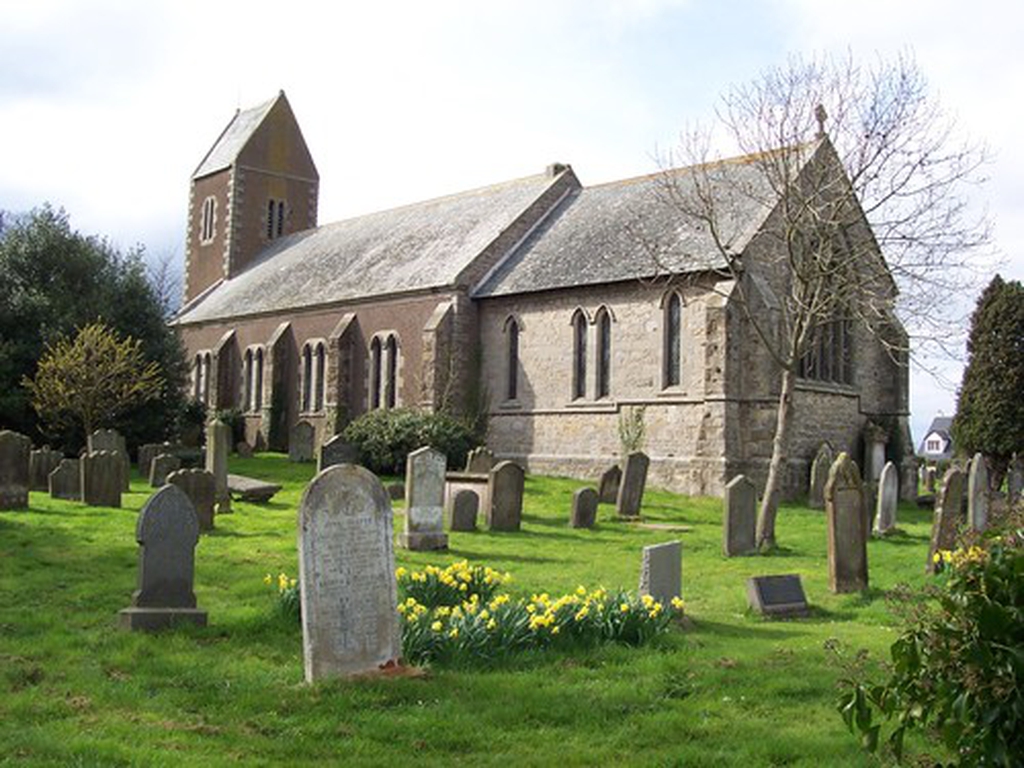
The Parish Profile notes, “The church …. stands in an elevated position at the west end of the village of Lowick. The present building dates largely from 1794 (the Nave) but there has been a church on the site since the earlier part of the twelfth century, probably since the time village began to develop at the intersection of the former Roman road known as the Devil’s Causeway and the pilgrim’s route to Holy Island. It was subject to alteration some 40 years later in the gothic style with the Chancel and Vestry being added in 1887.” It also notes that the bells cannot presently be rung.
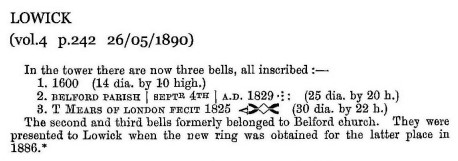
Both of the Mears bells were at Belford until about the 1840s.
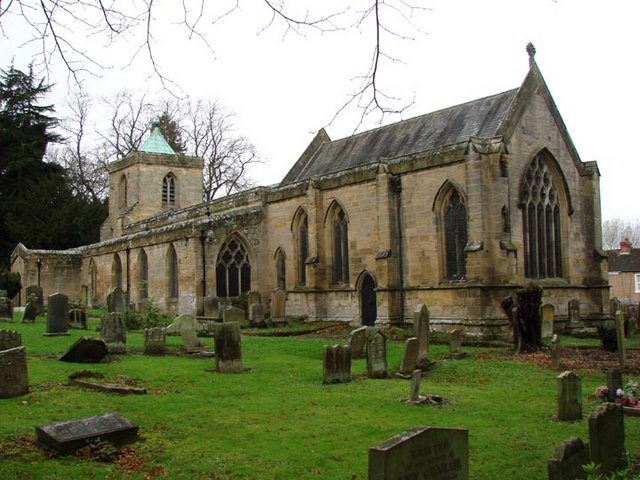
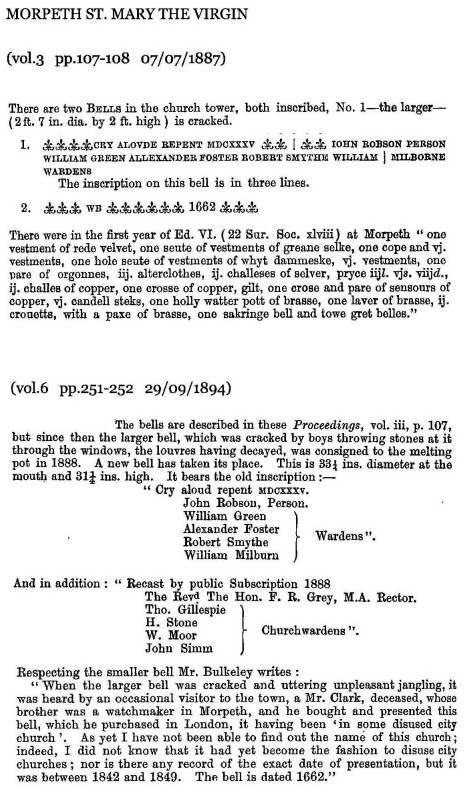
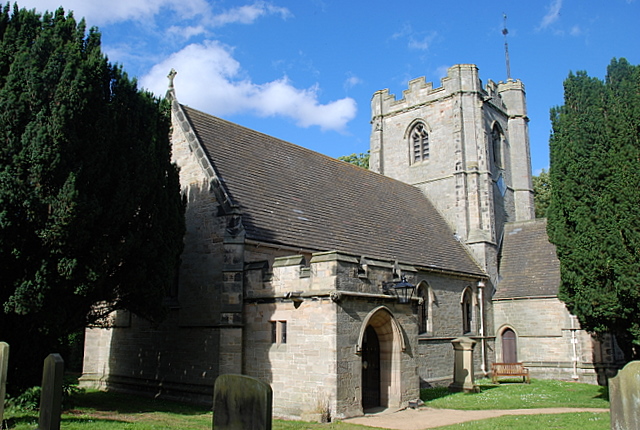
Morpeth, St Mary, 2 bells, 8 cwt. Unringable
Frame unsafe. (1) 1662 Bartlet, (2) 1888 Warner.
“The medieval bell frames, perhaps contemporary with the tower, are an important survival and consist of three parallel north-south pits (Pickford 1993 plan 3.1) . The frames are of the
short-headed type (Pickford op.cit type 3 I) with king-posts, curved braces, struts from the braces to the head, and transom struts from the sill to the braces. The western pit is now redundant, and has lost its head. The king-posts are jowelled at their bases, and there is a central foundation beam as well as ones on north and south.” Peter Ryder December 2003
St Mary’s is an ancient Grade I listed church The oldest remaining parts of the structure belong to the Transitional Early English style of the mid to late 12th century, but the church is mostly in the 14th century style. The church, which was the main Anglican place of worship in the area until the 1840s, has been restored several times after being destroyed by the Scandinavians, Scottish and Cromwellians in the 10th and later centuries. The suffragette, Emily Davidson, killed by the King’s horse Anmer in the 1913 Derby, is buried here.
The larger bells weights about 8cwt, and its frequency is 1072.0Hz C+42c; It is inscxribed CAST BY JOHN WARNER & SONS LONDON Waist: RECAST BY PUBLIC SUBSCRIPTION 1888. / THE REVD THE HON. F. R. GREY M. A. RECTOR. / THOS GILLESPIE } / H. STONE } / W. MOOR } / JOHN SIMM } CHURCHWARDENS. Opposite: CRY ALOUDE REPENT MDCXXXV / JOHN ROBSON PERSON } / WILLIAM GREEN } / ALEXANDER FOSTER } / ROBERT SMYTHE } / WILLIAM MILBORNE } WARDENS. The weight of the smaller bell being unknown.
Details of the bells were given by The Society of Antiquities of Newcastle before and after the larger bell was recast.
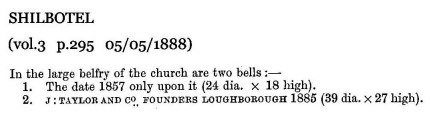
Shilbottle, St James, 1 bell, 8-3-19.
Ringable. 1885 Taylor, 35.5″
“We don’t know when people first came to live in Shilbottle, though a few early finds that probably date from the 5th century have been excavated. The Saxons would have had a wooden church, but nothing remains of that. The Normans rebuilt in stone, and we still have their south door arch, font and chancel arch (though now set over the organ). On the outside of the north wall can be seen two of their tiny window frames. It was rebuilt and repaired through the generations until local landowners decided that something new was required. Our present building dates from 1885 and was designed by Newcastle architect WS Hicks. It is a striking building, containing features from its predecessor and some excellent 19th century carved woodwork. All eyes are drawn towards the altar. The window above it is the community’s War Memorial and the names of those who died in 20th century conflicts are inscribed on the reredos.” (Church Website)
Taylor’s records state – “Shilbottle, Northumberland: For the Building Committee of Shilbotel church, 13 May 1885. New bell 8-3-19, frame and fittings. £74.19.0.”
There is another bell, cast in 1857 by Abbot and Co, with a diameter of 24.5″, that is not hung for ringing.
There is an article about this church, including some photographs, on the Fabulous North website
Stamfordham, St Mary the Virgin, 1 bell, 3.5 cwt.
No Stay/Slider. 1820 Watson, 25.25″.
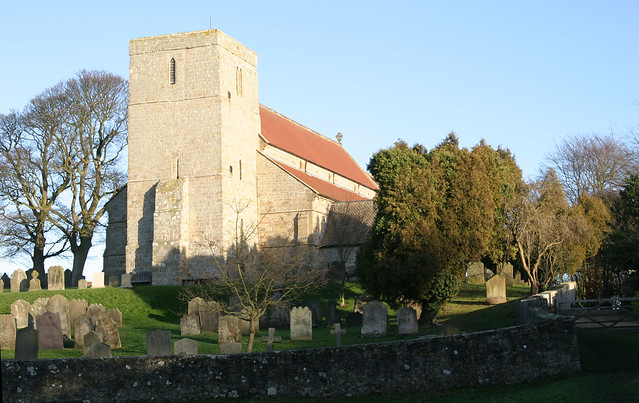
The church is mainly 13th century in origin, but was much altered and was partly re-built in 1847-8 by Benjamin Ferrey. There are surviving Saxon and early-Norman fragments. The rich history of the church is reflected in he Vicars’ tablet recording all incumbents since 1150, a 13th century effigy of a Knight (believed to be a Fenwick), a 13th century effigy of a Priest, a reredos dating to c.1330, an altar tomb commemorating John Swinburne, Lord of the Manor of Stamfordham, d.1663, a wall memorial to William Dixon, a renowned Northumbrian Piper who wrote the first Manuscript of Northumbrian Pipe music in 1733, the desk and chair of Lord Stamfordham, Private Secretary to Queen Victoria/George V and Banner from his Westminster Abbey stall, Banner of his grandson, Lord Adeane, Private Secretary to Queen Elizabeth II.
The wheel is currently in poor condition and ringing is not advisable. The bell is inscribed:
R WATSON NEWCASTLE 1820
Wooler, St Mary, 1 Bell, 7-0-18.
Taylors 1894, 33.5″ 987Hz B-1c
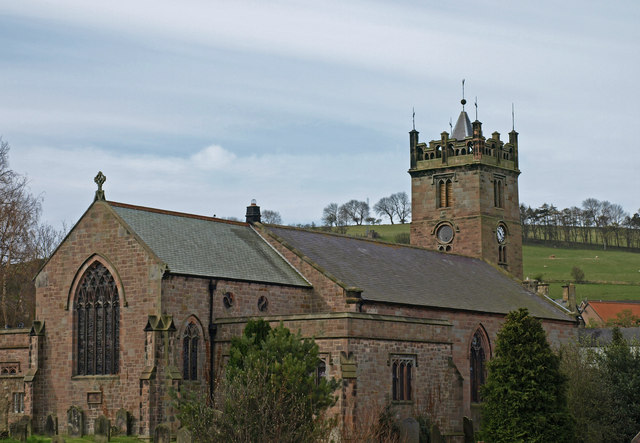
In the heart of Wooler, just off the market place, stands the parish church of St Mary. The church was built in 1764 to replace an earlier 12th-century building. It boasts a collection of outstanding Victorian stained glass in the nave.
The church was built of Doddington stone, quarried locally, and completed in 1765. It is topped by a roof made of Lakeland and Welsh slate.
Many of the interior furnishings we see today were installed during enlargement of the church in 1913. Among these early 20th century furnishings are the organ, choir stalls, and pulpit.
The east window is an outstanding example of 20th-century craftsmanship, created by Harry Stammers of York in 1962 and depicting Christ in Glory. Under the east window is a memorial to those local residents who died in both World Wars.
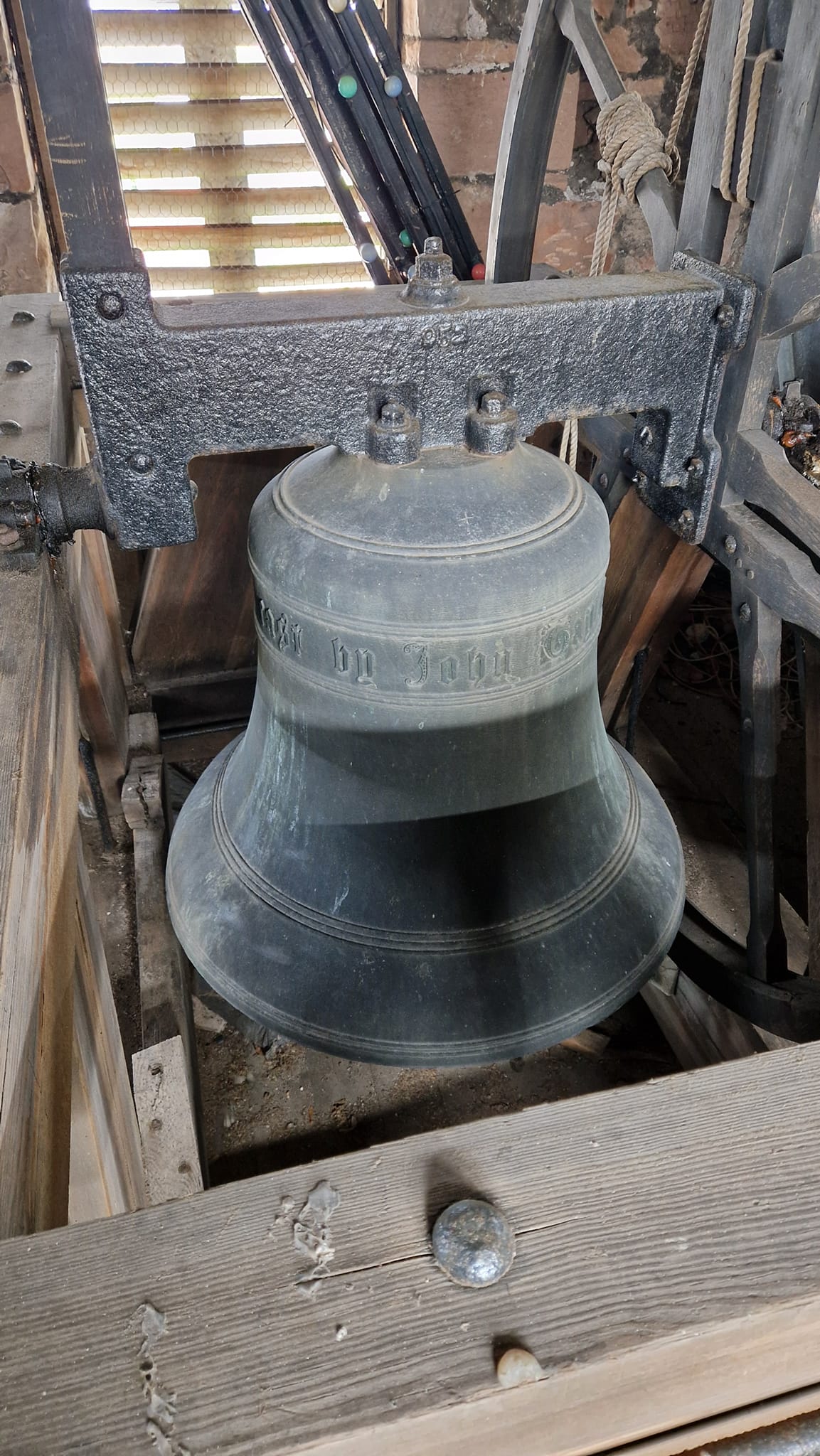
From Dove, “Wooler, St Mary, Northumberland: Taylor index – 1896 1 33½” 7-0-18 Not in job book (but see Metals book (bells) 2, p.122. Cast for Mickleton (i.e. as 4th of eight, 1894); George Elphick (visit 10 September 1975) noted a 33½” bell, inscribed cast by John Taylor (two oak leaves). Flat head. Hung for ringing in an iron frame. There is a clock. The Vicar wrote to tell George that “the 1772 bell was replaced some years ago … and it hung in a stand in the new churchyard until about 20 years ago when the stand collapsed and the bell was sold for scrap”.
The bell was cast for Mickleton as the 4th of the ring of 8 but was not used there and another bell was cast.
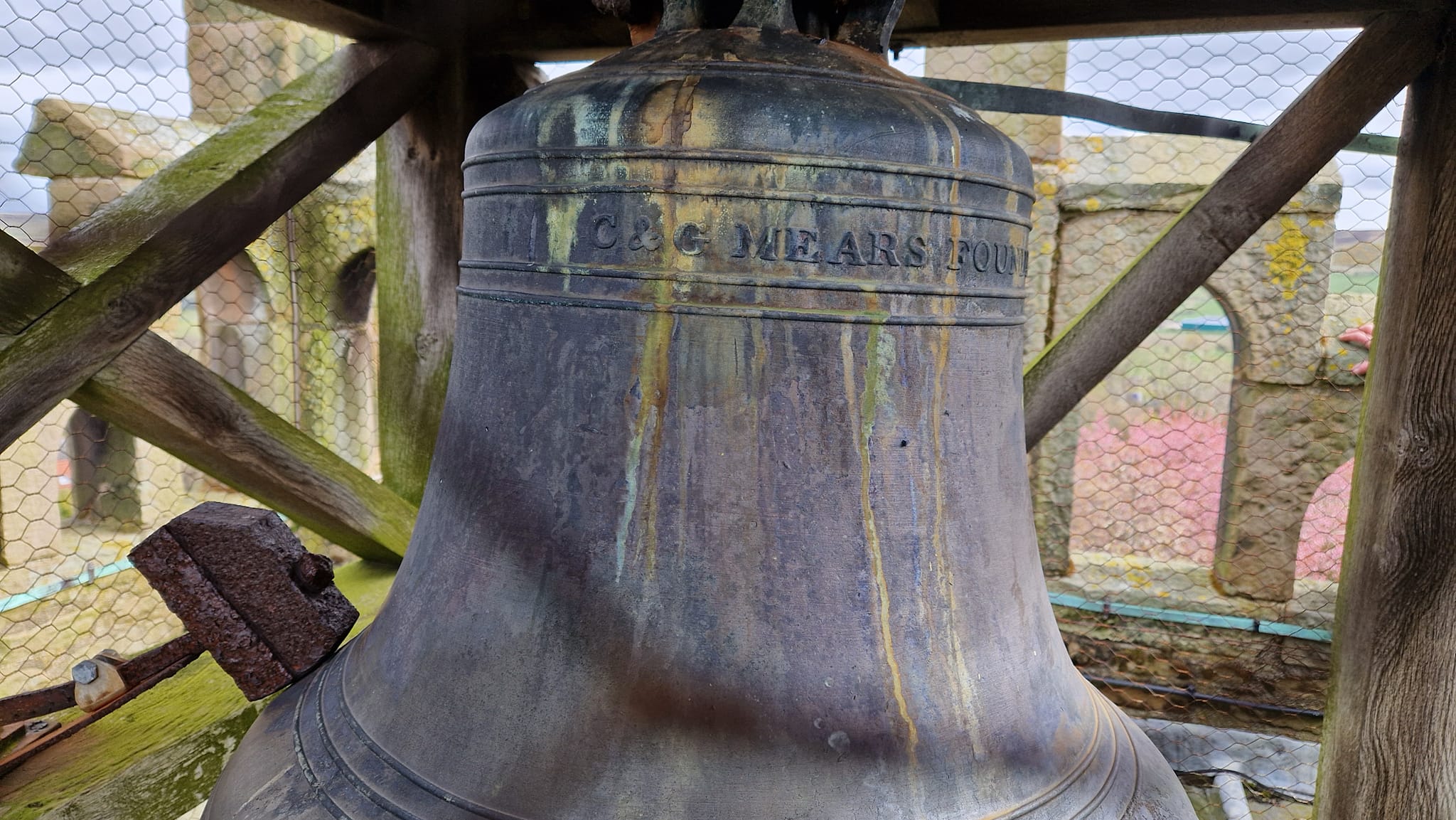
There is a clock bell, C & G Mears 1855.
An article on this church, with some good photographs, can be found on the Fabulous North website