Chimes in the County of Tyne & Wear
Most of the bell data on this page is taken from George Dawson’s National Bell Register – to whom my thanks are extended.
A list of Church of England churches, with basic details, in the county that have one or two bells may be found here
Birtley, St John the Evangelist 6: 12-0-27 in G
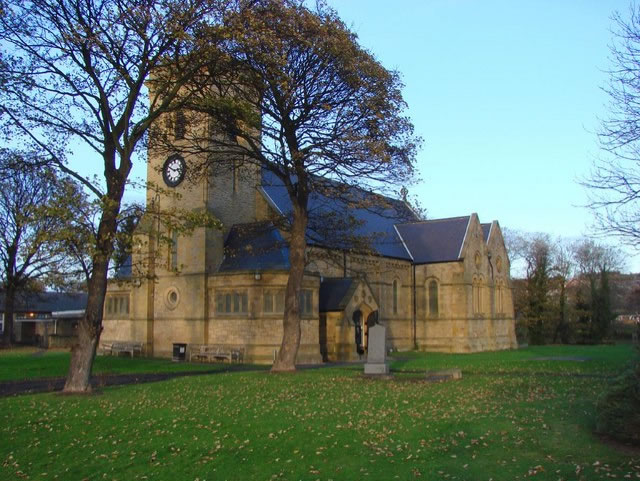 The building of St John’s started in 1848 and it opened for worship in December that year. It is a traditional building of the time in a Norman style. A vestry and an organ were added over 1849 and it was finally consecrated by the Lord Bishop of Durham on August 9th 1849.
In 1880 the building was further extended to include 2 transepts and 2 vestries with a new entrance porch at the west end. The tower and spire were added in 1883, with a single bell:
A handsome tower and bell spire in the Early English style is being added to this ancient church, the gift (with new bell and furniture of about £300) Geo. Wray, F.R.G.S., of Leamington, Warwickshire. It is intended as a memorial to his late wife, who was formerly for about 36 years a resident in parish at Reedsmouth House. The semi-public ceremony of laying the foundation-stone took place on Tuesday last, when Mrs G. Rome Hall, a life-long friend of the much lamented lady, laid the stone, and the vicar, with the Rev C. Bird, vicar of Chollerton, and Mr Robson, senior churchwarden, took part. There were present besides Mr Churchwarden Wood, Mr A.B. Plummer. A.R.I.B.A., architect; Mr W. Welton, contractor; and the workmen, with several parishioners and friends. It is hoped that the vicar and churchwardens will able ere long to begin the repairs and restoration of the old Early Norman church itself. They have to thank many kind friends, rich and poor, for their generous help; but as about £200 is still required, additional subscriptions will be most gratefully received and acknowledged. (Newcastle Journal, 7 September 1883)
A new organ (the present one) was installed in 1899 to mark the Church’s 50th jubilee.
In 1911 a new clock with chime of bells was added, said to celebrate the coronation of King George V, but note the inscription of the tenor. These are a complete set of 6 by John Taylor, 1911. They were ordered through Potts of Leeds, clockmakers. They were cast with flat tops.
Taylors daybook notes:
The new chime of six bells for Birtley Parish Church, Co. Durham, 1. 3-0-19, 2. 4-1-1, 3. 5-3-4, 4. 6-3-1, 5. 8-3-8, 6. 12-0-27, total 41-0-4 £272.17.9., Inscriptions (207 letters £3.9.0., Ellacombe chiming apparatus for the six bells £12.0.0., eyebolts, carriage etc, [Total] £291.11.6.
 |
 |
| Images of the bells, taken from the church’s website |
The Bells
1 3-0-19 25.5″ 1911 John Taylor & Co 1282.0Hz E-49c
2 4-1-1 28.0″ 1911 John Taylor & Co 1146.0Hz D-43c
3 5-3-4 31.0″ 1911 John Taylor & Co 1019.5Hz C-45c
4 6-3-1 33.0″ 1911 John Taylor & Co 958.0Hz B-53c
5 8-3-8 36.5″ 1911 John Taylor & Co 859.5Hz A-41c
6 12-0-27 41.0″ 1911 John Taylor & Co 764.0Hz G-45c
The front five bells only have the founder and the date cast around the top of the bell. The inscription on the tenor reads,
THIS PEAL OF BELLS WAS PRESENTED TO BIRTLEY
PARISH CHURCH BY MR. AND MRS. PHIL. KIRKUP OF
LEAFIELD TO COMMEMORATE THIR SILVER WEDDING
AND WERE FIRST RUNG FOR DIVINE SERVICE
FEBRUARY 19TH. 1911
PHILIP KIRKUP AND MARY A. HODGSON MARRIED
FEBRUARY 22ND. 1886
Earsdon, St Alban 3: 6-3-14
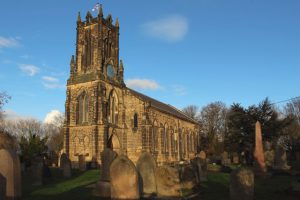 The Parish Church at Earsdon was built 1836-1837, on the site of a much earlier 13th century church. The church was designed by John & Benjamin Green, and was consecrated on the 12th of October 1837. The chancel was added in 1889. It was built in the “Early English” style.
In the churchyard are buried 159 of the 204 miners who died in the disaster at Hartley Colliery in 1862. There is a memorial to the miners lost in the disaster in the churchyard. The Church is a Grade II listed building.
The Bells
The installation of the bells is noted in the church history on their website

It does not say if they were hung for ringing or not. They are all inscribed
MEARS & STAINBANK, FOUNDERS, LONDON 1866
In the Ringing World of 11th December 1953 the bells are described as being cracked in an article that criticised a plan to broadcast a recording of bells instead of “real” bells. It was said that the church was built over mine workings and the tower was not stable enough contain a ringing peal of bells.
How the bells are rung I am yet to ascertain, but I have found a mention that they are capable of being “rung”. They may be only a “ting-tang” and an hour bell for the clock.
1 3-1-17 24.75″ 1866 Mears & Stainbank
2 4-1-22 28.75″ 1866 Mears & Stainbank
3 6-3-14 34.63″ 1866 Mears & Stainbank
They are inscribed with the founder and date only.
Greenside, St John 3: 2-0-4 in G (Hemispherical bells)
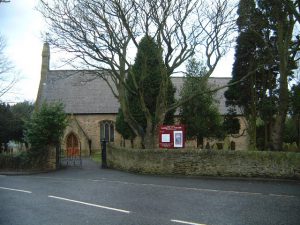 St John’s Church is formally known as St John the Evangelist.
It was founded by Archdeacon Charles Thorp as a Chapel of Ease to Ryton Parish in memory of his father, the Rector of Ryton, 1795 to 1807, built from stone from the Overstone Quarry.
It was consecrated on 18 September 1857, by the Bishop of Durham.
The three hemispheres are hung horizontaly in the bell cote, left to right from smallest to largest. The top of one bell is inside the base of the next. They cost £79/8/5, with an allowance of £9/8/1 “for old bells 1-3-19 net. The largest bell, weighing 2-0-2, required recasting in 1924 and this cost £15. The bells were the gift of John B. Simpson esq. J.P., D.C.L.
The Bells
1 1-2-23 22.0″ 1913 Mears & Stainbank
2 1-3-0 23.38″ 1913 Mears & Stainbank
3 2-0-4 25.0″ 1924 Mears & Stainbank G
Jarrow, St Bede (R.C.) 3 bells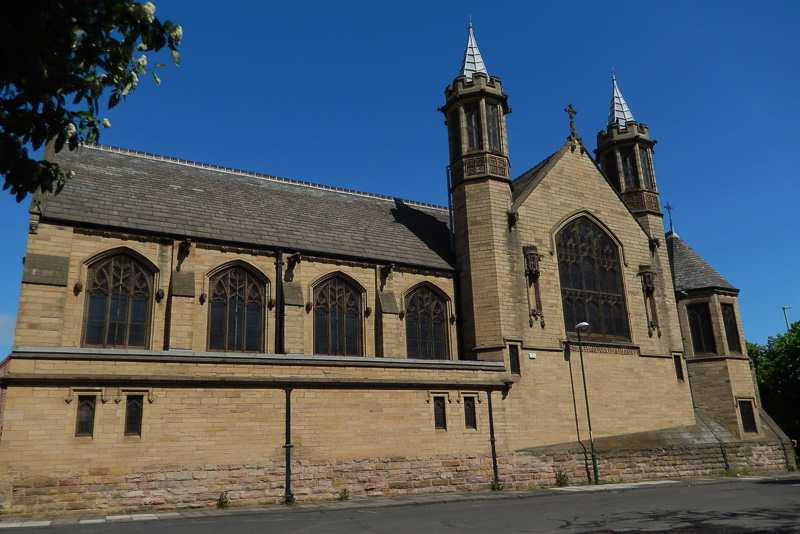
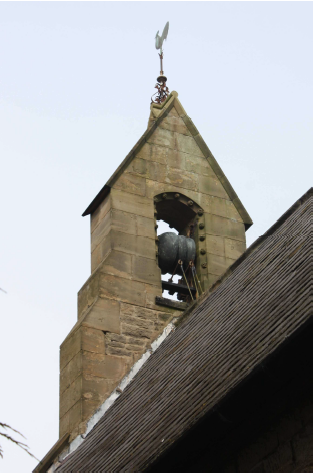
The foundation stone of the first church was laid on 30th October 1860 and the church was built with voluntary labour. it was opened on 27th December 1861. The first church was a very simple building with plain pointed windows harking back to a medieval style of architecture called ‘Early English.
As the Catholic population of the area grew it became clear that a bigger church was required and the church was “turned round” and an extension built along the south end. It was at this time that the turrets for the bells were built. The “new” church was opening on 1st April 1883. “The bells were blessed during the opening service. A description of this ceremony is given by Miss Foster: “The bells were baptised with holy water, and oil and chrism were used, like a baby being baptised. As the Bishop performed this ceremony, the Choir stood around the bells and sang appropriate anthems”. (Catholic Jarrow) Local papers report that the three bells were consecrated on 16th Oct 1882 so before the extended church was dedicated in 1883.
The Bells
I have no details of the bells, except that they were overhauled by Whitechapel in 1999. Can you help?
Lamesley, St Andrew 3: 6cwt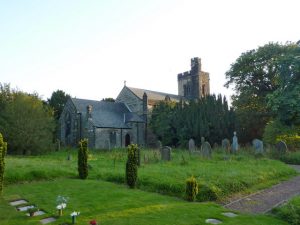
The church in Lamesley has medieval origins and can be traced back at least as far as the 13th century. The current church was built in 1759, replacing the earlier medieval church which had fallen into ruin. It was extended in 1821, around the time the Parsonage was built, with aisles and west tower. In 1847 the chancel was re-built and further restoration work was carried out in 1884.
The church is a Grade 2 Listed building. It has a large graveyard, including the tomb of Robert Moscrop from 1621, which itself is Grade 2 Listed. Anthony Gormley’s “Angel of the North” is situated in the parish.
The Taylor bells were cast with flat tops. They were added to the existing bell to make 1, 4 and 8 of an octave, at a cost of £59/12/4. The Church clock commemorates 3rd earl Ravensworth who died in 1902. As the bells were ordered through W. Potts & Sons, they may be a clock chime.
1 1cwt 16.13″ 1907 John Taylor & Co 2282.0Hz Db+50c
2 22.75″ 1759 John Lee 1711.5Hz Ab+52c
3 6cwt 30.50″ 1907 John Taylor & Co 1141.0Hz Db+50c
Newcastle Civic Centre 25: 71-1-13 in A
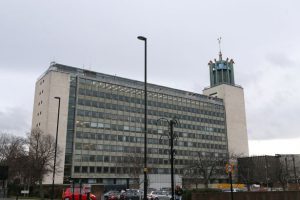 The Civic Centre is the main administrative centre for Newcastle City Council. The Grade II* listed building was designed by George Kenyon. It was completed in 1967 and officially opened by King Olav V of Norway on the 14th November 1968.
The Civic Centre has 2 sculptures by David Wynne (“River God Tyne” and “Swans in Flight”). The prominent carillon bell tower is topped with seahorses designed by John McCheyne. There are also 2 abstract murals by Victor Pasmore in the Customer Service Centre.
The grounds of the Civic Centre include “The Response” war memorial (1923) and a stone commemorating the visit of US President Jimmy Carter in 1977. NE1 8QH
The carillon is known as the “Edith Adamson Memorial Carillon”. It was donated in her memory by her husband, James Wilfred Adamson Recitals take place on Saturday at 14:00 and occasionally on Thursday at 19:00.
The carillon is the work of Taylors of Loughborough, all the bells being cast in 1963. Note that carillons are numbered with the largest bell being “1” and upwards from there.
Taylor’s website on August 14th 2024 noted:
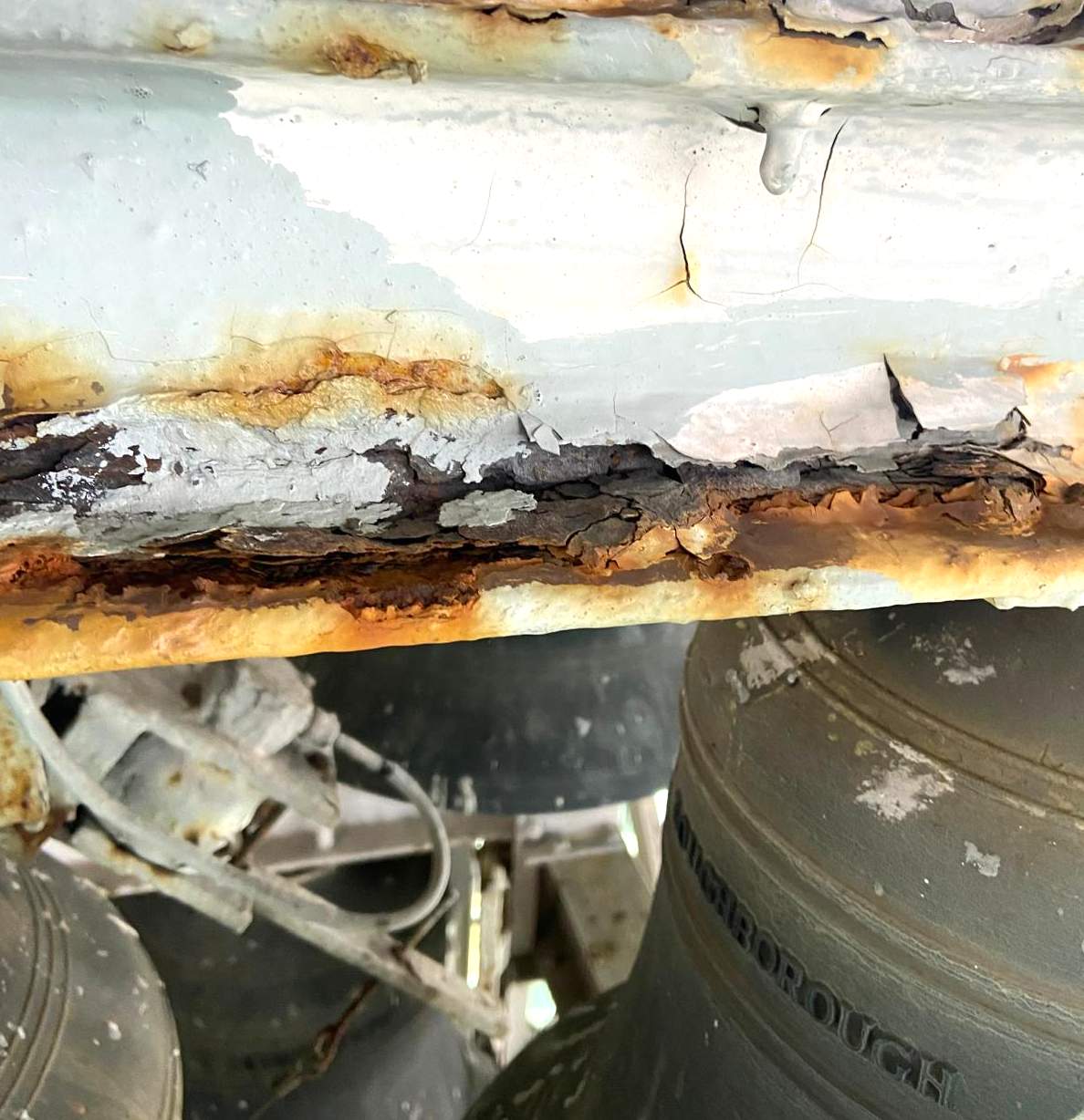
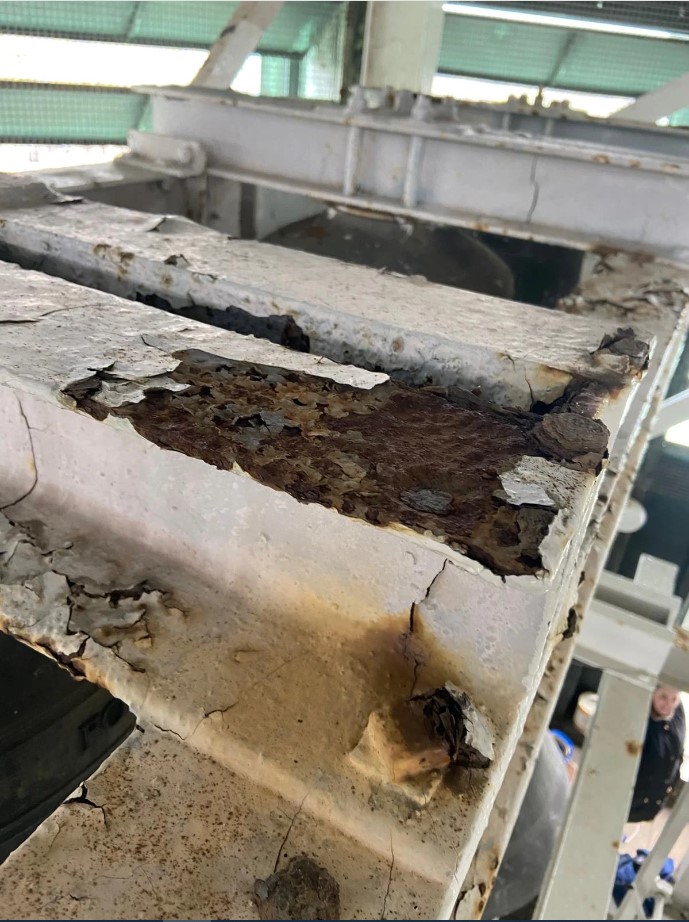
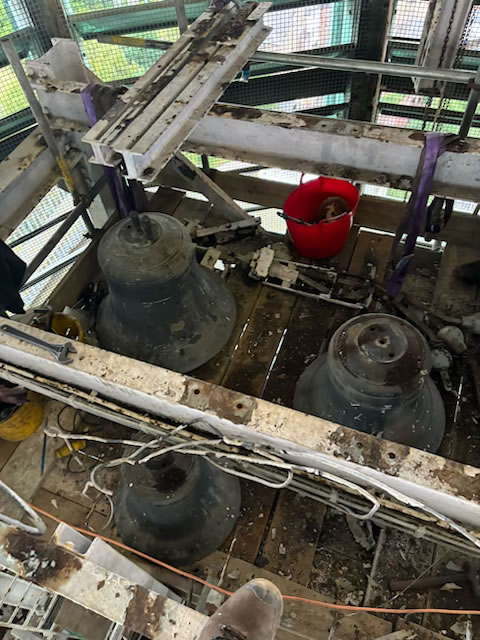
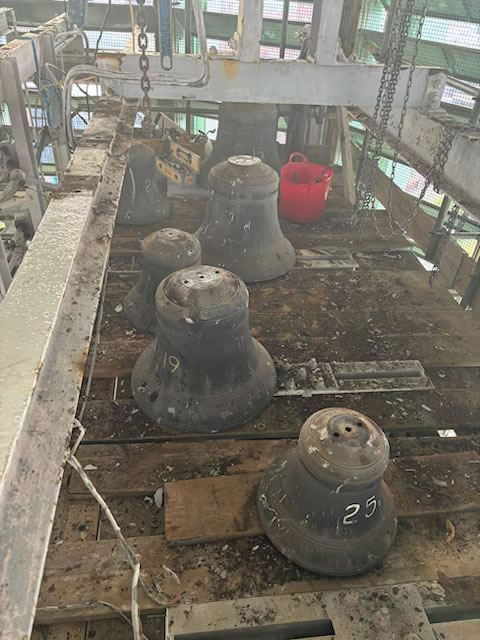
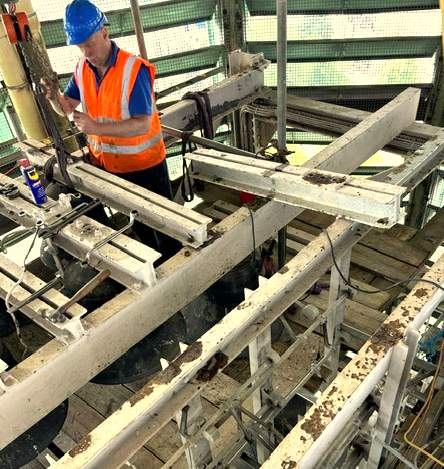
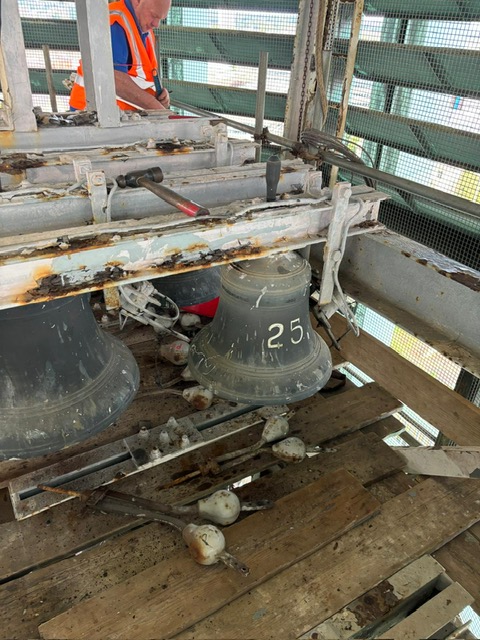
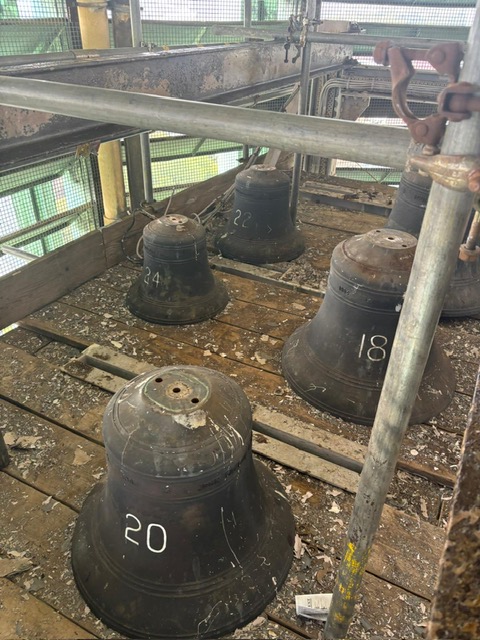
“The tower of Newcastle’s Civic Centre houses a beautiful carillon of 25 Taylor bells, largest 71 cwts. Being located close to the North Sea, constant wetting by salty rain water has caused serious damage to the upper tier of the bell frame. Ten of the bells will be lowered from the upper bell frame and a new galvanised steel upper frame and new headstocks will be fabricated and installed.to replace those removed. New bell seating pads will be manufactured and the bells’ clappers and crown staples will be restored and new bell bolts manufactured before the bells are rehung. The playing mechanism and transmission will be adjusted. All areas of the bell frame where the existing painting has broken will be cleaned, treated and be re-painted.”
 |
 |
 |
 |
 |
 |
 |
 |
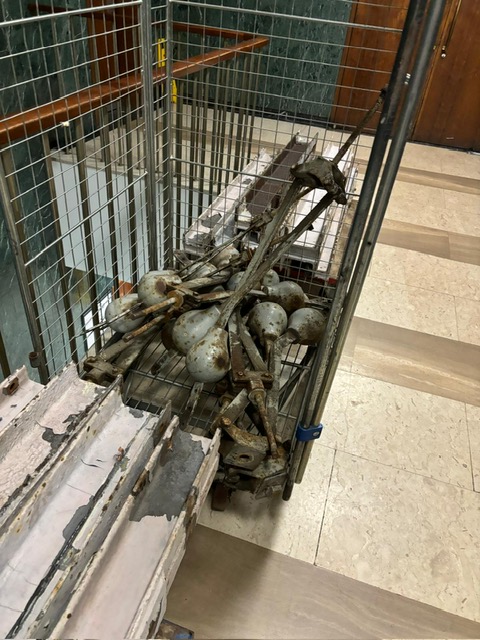 |
Photographs of the 2024 work on the installation.
©Taylors |
This analysis is courtesy of Bill Hibbert.
25 1-1-22 19.0″ 1764.8Hz (A+5c)
24 1-2-20 20.0″ 1662.0Hz (G#+1c)
23 1-3-13 21.0″ 1571.0Hz (G+3c)
22 2-0-25 22.0″ 1480.8Hz (F#+1c)
21 2-2-3 23.19″ 1400.3Hz (F+4c)
20 2-3-11 24.38″ 1321.9Hz (E+4c)
19 3-1-21 26.0″ 1246.2Hz (D#+2c)
18 4-0-17 27.5″ 1175.9Hz (D+2c)
17 4-3-20 29.0″ 1108.9Hz (C#+0c)
16 5-2-9 30.63″ 1046.4Hz (C+0c)
15 6-1-18 32.25″ 987.7Hz (B+0c)
14 7-2-6 34.0″ 931.4Hz (A#-2c)
13 8-3-16 36.0″ 880.2Hz (A+0c)
12 10-1-17 38.0″ 830.4Hz (G#+0c)
11 12-3-15 40.63″ 783.0Hz (G-2c)
10 15-1-1 43.13″ 741.2Hz (F#+3c)
9 18-1-24 45.5″ 698.4Hz (F+0c)
8 20-1-23 47.88″ 659.6Hz (E+1c)
7 25-2-24 51.13″ 622.9Hz (D#+2c)
6 30-3-21 54.0″ 588.3Hz (D+3c)
5 35-0-5 57.0″ 554.8Hz (C#+1c)
4 41-3-7 60.5″ 523.4Hz (C+0c)
3 49-3-2 63.75″ 494.2Hz (B+1c)
2 60-2-7 68.0″ 465.3Hz (A#-3c)
1 71-1-13 72.0″ 440.0Hz (A+0c)
The full analysis of the bells is here Tonal Analysis by Bill Hibbert
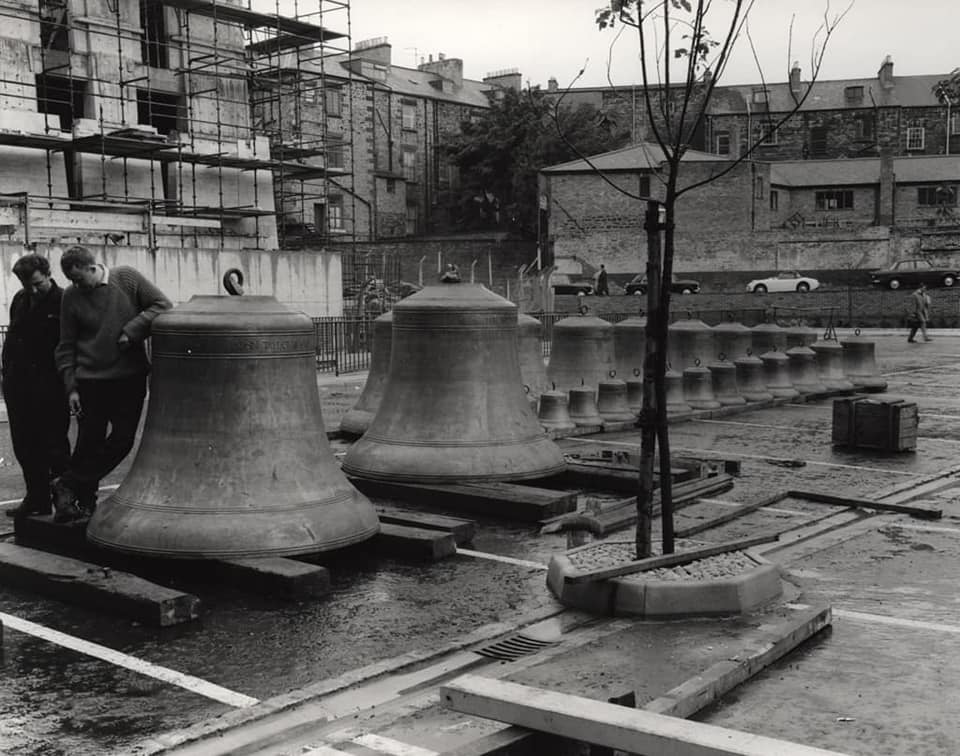
The bells lined up outside the Civic Centre prior to their installation
A video about the carillon
Newcastle upon Tyne, St Andrew 6: 16-2-12 in F
Though recast when hung as a chime, these are a lost ring. Details may be found here
Newcastle upon Tyne. Fenham, SS Basil and James 17: 14-0-10 in F
There are 9 chiming bells, in addition to the ring of 8, all by Mears & Stainbank, 1930 that together form a chime of 17 bells
Details can be found here
South Shields, Holy Trinity, Tyne Dock 6: 17-3-21 – Bells lost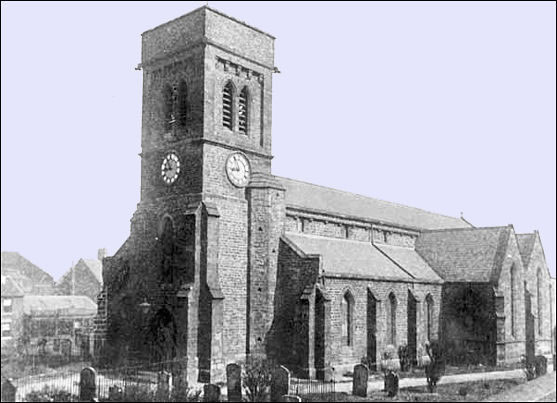
The church was in Laygate Lane, at its junction with Commercial Road.
The following has been found online.
“The foundation stone of a new church in South Shields, dedicated to the Trinity, was laid by the Rev. James Carr, incumbent of St. Hilda’s. It has since been built, and endowed at the sole expense, of the dean and chapter of Durham, and contains 1,200 sittings, 800 of which are free.” 22nd May 1833.
The church, which was 94ft. 8in. in length and 41ft. in breadth, was built to designs by the esteemed Durham-born architect Anthony Salvin, in the Early English style. The parish was created in 1848 from St Hilda’s church.
“… erected at a cost of about £3,700, was consecrated in 1834, and is an edifice of stone in the Early English style, consisting of chancel, nave of five bays, aisles, transepts and a western tower containing an illuminated clock and 6 bells: in 1879 extensive additions and alterations were made, the cost of which exceeded £3,000; the east and west windows are stained, and in the south aisle is a stained window, erected in 1886 by the members of the Church Institute to Thomas Henry Swinburne, one of the Felling Colliery heroes: there are 1,200 sittings, of which 800 are free. The register dates from the year 1834….”
There was a mine disaster at the nearby St Hilda’s pit on 28th June 1839 that killed 51 men and boys. Twenty-five of the dead were buried here. Details may be found here.
Services were suspended with effect from 25 May 1980 after surveys revealed the building to be structurally unsound, and demolition began on 1 November 1980.
The footprint of the church was preserved within a garden area. Some of the glass and one of the clock faces is preserved in the South Shields Museum.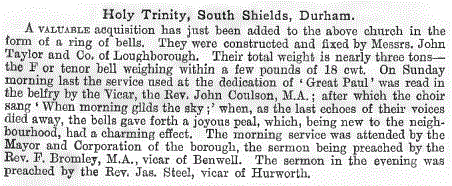
(“Church Bells” – June 30th 1883)
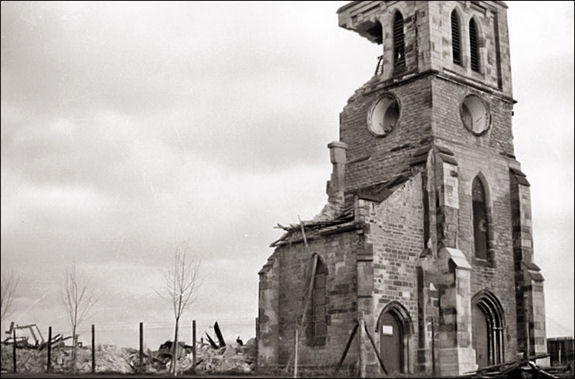
Picture of demolition by D Brown Love
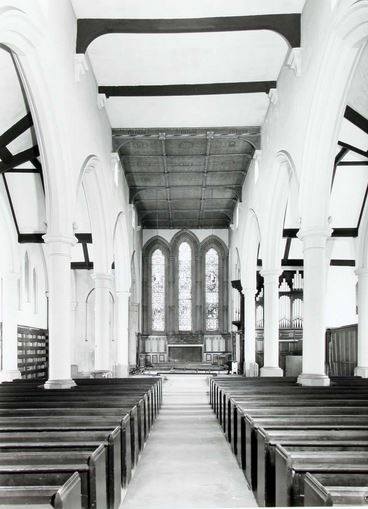
The interior of the church
The bells were sold to Taylors for scrap in January 1982. The metal was used to cast other bells on 20th January (5 & 6), 22nd April (2, 3 & 4) and 22nd July (1).
1 4-1-8 27.38″ 1883 John Taylor & Co D
2 5-2-7 30.5″ 1883 John Taylor & Co C
3 7-3-8 34.18″ 1883 John Taylor & Co Bb
4 9-1-13 36.38″ 1883 John Taylor & Co A
5 12-3-24 40.5″ 1883 John Taylor & Co G
6 17-3-21 45.63″ 1883 John Taylor & Co F
Taylors records mention “Four Cambridge quarter bells, all with canons”. The details of the fourth and fifth bells have been added on an inserted slip saying – Two more bells “to complete a peal of 6”. It therefore is likely that the initial plan was to have just the Cambridge Chimes, 1, 2, 3 & 6 of 6. and this was quickly amended to include the “missing” bells.
The inscriptions were
- JOHN TAYLOR & CO LOUGHBOROUGH 1883
- JOHN TAYLOR & CO FOUNDERS LOUGHBOROUGH 1883
- JOHN TAYLOR & CO FOUNDERS LOUGHBOROUGH 1883
- JOHN TAYLOR AND CO FOUNDERS LOUGHBOROUGH 1883 Waist: + TRINITATE SACRA FIAT HAEC CAMPANA BEATA
- JOHN TAYLOR & CO BELLFOUNDERS 1883 Waist: + NON CLAMOR SED AMOR CANTAT IN AURE DEI
- JOHN TAYLOR & CO BELLFOUNDERS LOUGHBOROUGH 1883.
All were cast with angular canons
Sunderland, St Mary, Hylton 8: 2-3-13 in F
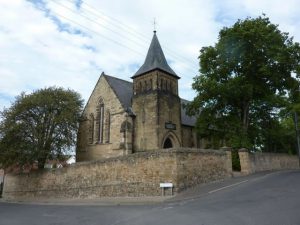 There was supposed to have been a peal of Grandsire Triples at this tower on the 4th of March 1845. I was always extremely suspicious of this as a local history book says that the church building then standing was converted from a previous property given for the purpose.. Also, the tower was not built until 1930. The newspaper report that lead to it being believed a peal was rung here read:
SUNDERLAND.-On Tuesday the Newcastle and Gateshead Union Society of Change-ringers having been waited upon by Mr. Thomas Gay, of the Union Society, York, and Mr. Charles Balle, of the Cumberland Society, London, visited the town of Sunderland, and rung upon their melodious peal of eight bells, at the parish church of St. Mary’s, a true and complete peal of Grandsire Tripples, consisting of 5040 changes, which was performed in an admirable style in two hours and fifty-four minutes, being the first peal ever accomplished upon these bells, and was performed by the following persons:-John Bennett, treble; Charles Walker, 2nd; George Hyde, 3rd; Charles Balle, 4th; Joseph Pesscott, 5th; Thomas Gay, 6th; Robert Balmbra, 7th; Thomas Marshall, tenor. The peal consisted of 194 bobs, and 46 singles, and was ably conducted by Mr. Thomas Gay, it being the first peal of this composition ever performed in the counties of Durham or Northumberland. Weight of tenor, 14 cwt. (Era, Sun. 9 March 1845; also reported in similar terms in the Newcastle Courant of Fri. 7 March 1845.)
This fits Holy Trinity, Sunderland; it being the only ring of 8 in Sunderland at the time and its tenor was the right weight. The peal is now recorded on Felstead as being rung at Holy Trinity. (With thanks to Tim Jackson/John Eisel)
The present building is from the 1870s, a replacement for the original one that burnt down. The tower was added in 1930 by George Edward Charlewood. Four bells were installed in c.1930, the gift of Reverend William Marshall Teape, Vicar of the church until he retired in 1922 due to ill health, when the tower was built and the four others in 1938. All were cast by Mears & Stainbank. The chime was installed in 2 groups of 4 bells, the tenors in 1929 and the trebles in 1938. The four trebles are inscribed “M & S 1938”. 5th is incribed “FOR EVER”, 6th “ENDURETH” 7th “HIS MERCY” and the tenor “CAROLINE TEAPE, TO HEALTH RESTORED”
The church was closed for public worship on 6th June 2019 and I have been informed that the bells we be removed from the building in the future. There is a planning application with Sunderland Council as of May 2025 to turn the building into an Adult Learning and Arts Centre. This was noted on the BBC website on August 18th 2026. It was noted on the BBC website on October 20th 2026 that approval had been given by the council to remove the bells.
The Bells
1 0-1-27½ 12.88″ 1938 Mears & Stainbank 2864.0Hz F+43c
2 0-2-12 13.75″ 1938 Mears & Stainbank 2685.0Hz E+31c
3 0-2-20 14.88″ 1938 Mears & Stainbank 2392.0Hz D+31c
4 0-3-12 16.0″ 1938 Mears & Stainbank 2148.0Hz C+45c
5 1-0-12 17.5″ 1929 Mears & Stainbank 1910.0Hz Bb+42c
6 1-2-16½ 19.5″ 1929 Mears & Stainbank 1792.0Hz A+31c
7 2-0-4½ 21.0″ 1929 Mears & Stainbank 1610.0Hz G+46c
8 2-3-13½ 23.5″ 1929 Mears & Stainbank 1432.0Hz F+43c

A picture of the bells taken from the sales brochure
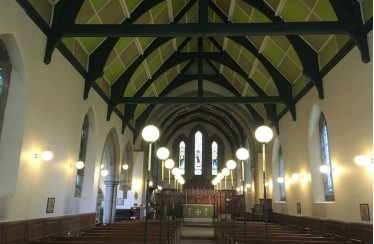
The interior of the church, also from the sales brochure
Sunderland, Monkwearmouth, Venerable Bede 6: 5½cwt – bells transferred to Pennywell (q.v.)
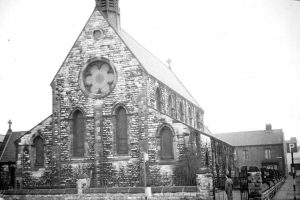 The church was built in 1870 and closed in the early 1960s, the last christening taking place in 1961 and the last marriage service in 1962. The church was located at the well known “Wheatsheaf” junction, on the corner of Newcastle Road and Monk Street. The site is now occupied by a Kwik Fit garage.
The Venerable Bede’s is an ecclesiastical parish, formed May 16th, 1871: the church, situated near the Newcastle Road, was built by subscription, at a cost of £5,000, and consecrated 4th August, 1870; it is in the early style of French Gothic, and consists of chancel, nave of five bays, aisles, vestry, organ chamber and a north porch: there are sittings for 587 persons (Kelly’s Directory 1890)
It served a relatively small population and was formed out of Monkwearmouth parish. The bells were in the spirelet, the bottom of which is just visible in the photograph.
Newspapers reports state, “Bazaar to be held to raise funds for church improvements including building a spire and obtaining a bell or peal of bells (Sunderland Daily Echo, 9 November 1874); Another bazaar was held at Easter for the same purposes (Sunderland Daily Echo, 19 December 1879); Active fund-raising in 1880 (passim); Still hoping for funds for spire and bells, but only £275 raised towards the £1000 required (Sunderland Daily Echo, 26 January 1881)”
The chime was transferred to St Thomas, Pennywell, (q.v.) I have no details of the bells, except the tenor weight and the diameters. Can you help?
Sunderland, Pennywell, St Thomas 6: 5½cwt
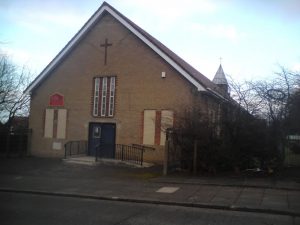 The chime of 6 bells with a “tenor” weight of 5½cwt that hang here were transferred from Monkwearmouth, Venerable Bede when this church was closed. (q.v.)
This church was built around 1964, to the design of Francis Johnson. I can find little about the church online – can you help? The pictures suggests that it is a fairly typical church of that time, but with a tower on the liturgical west end.
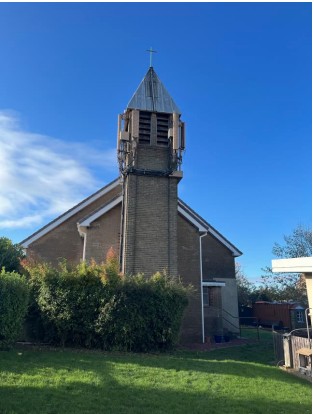
The Tower
It appears to have replaced a temporary church, photographed in 1951:
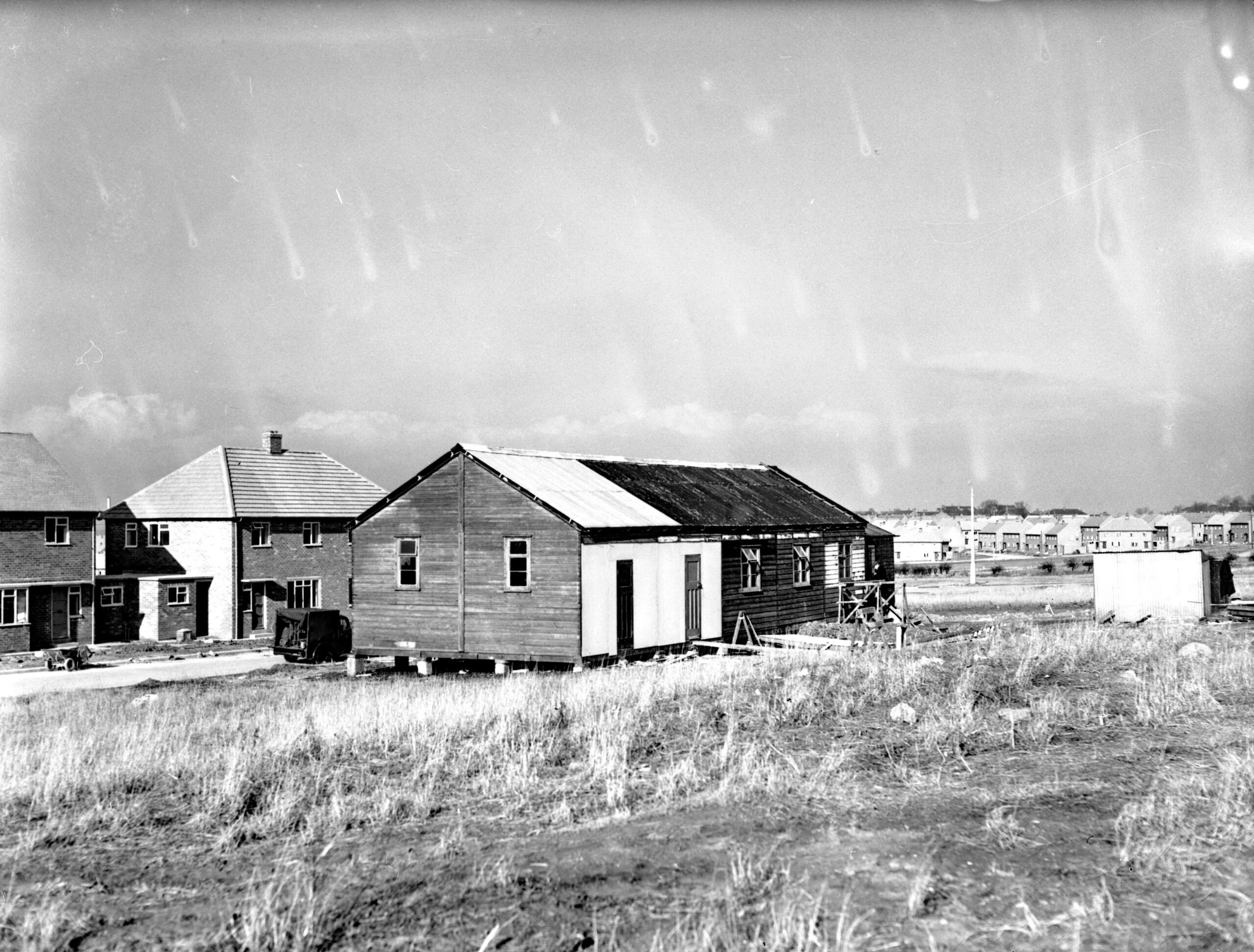
The building was subsequently used as a Cub Scout Hut (Wearside Echoes)
The parish was created in 1985 from Bishopwearmouth St. Gabriel, Herrington St. Aidan and South Hylton St. Mary.
It was built in the suburbs to replace St John’s Church, John Street that was destroyed in an air raid in 1943. The site of that church had Joplings Department Store built on it. At one time this had, to my ears, a dreadful electronic clock chime, but is now closed as a store and has been converted student accommodation with 4 commercial units.
There was a legal issue regarding a faculty for the introduction of a place for the reserved sacrament in 1995 that some may find interesting.
The Bells
All that I have about the bells are their diameters and the tenor weight. They were cast in c.1888 and retain their canons. They are uninscribed. I would welcome any additional information that you can provide.
1 24.13″
2 24.10″
3 25.00″
4 25.75″
5 27.50″
6 5½cwt 28.50″
Sunderland, Ryhope, St Paul 6: 5½cwt
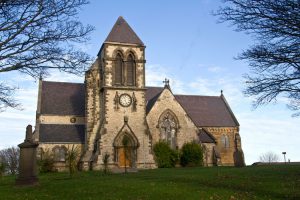 The church was built in 1868-73 by T. C. Ebdy. It was restored in 1920 by Frank L. Pearson. The chancel and north aisle were added in 1927 by Hicks & Carlewood.
The first build is rock-faced snecked limestone with rock-faced sandstone quoins and ashlar dressings and the additions sandstone ashlar There Welsh slate roofs on the first build and Lakeland slate roofs on the second
The building consists of a chancel with a north vestry and a south organ chamber; a nave with a north aisle and south transept, a tower and aisle.
See the source: https://historicengland.org.uk/listing/the-list/list-entry/1217835 for more details
The bells, which are completely uninscribed, were cast by Carrs of Smethwick in 1912, acting as a sub-contractor to Potts of Leeds, the well known clock makers. The Sunderland Echo suggests in their edition of October 13th 2018 that the “metal supports” were being renewed. It is possible that these are the bell bolts.
1 2½cwt 22.50″ 1912 Charles Carr A
2 2¾cwt 23.50″ 1912 Charles Carr G
3 3¼cwt 24.50″ 1912 Charles Carr F
4 3½cwt 25.00″ 1912 Charles Carr E
5 4½cwt 27.00″ 1912 Charles Carr D
6 6cwt 30.00″ 1912 Charles Carr C
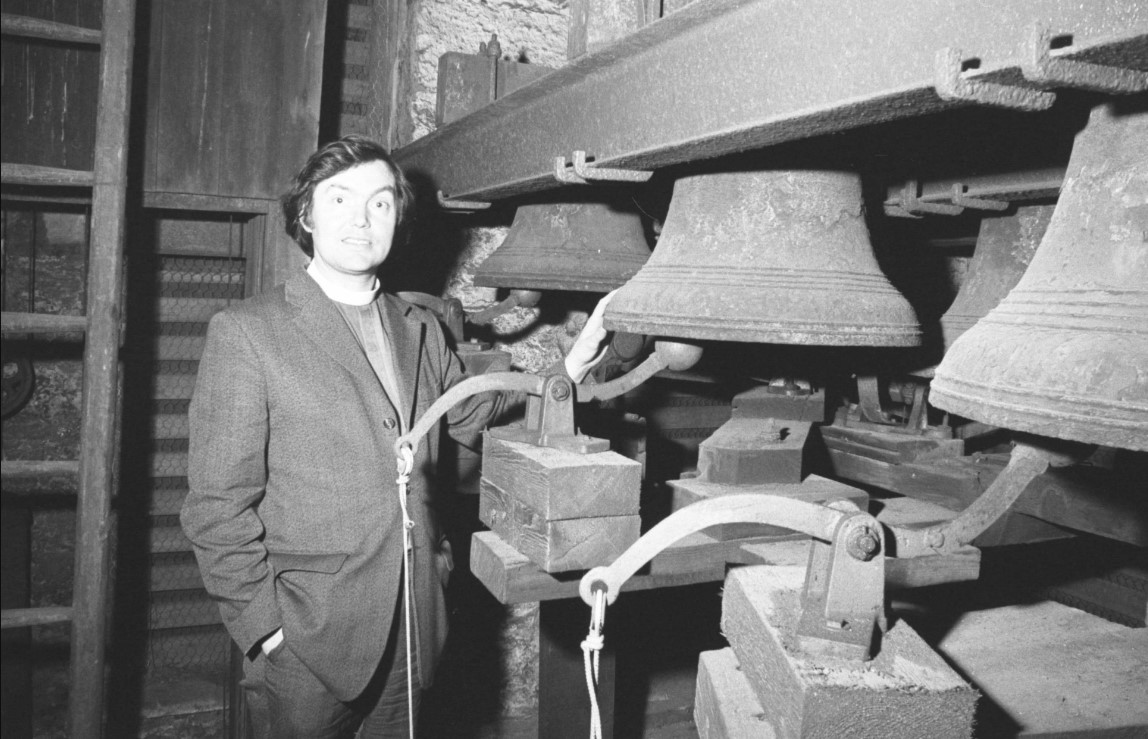
Rev David Goodacre examining the bells in the tower of St Paul’s Church, Ryhope in 1978