Newcastle, St Andrew, 6: 16-2-12 MAP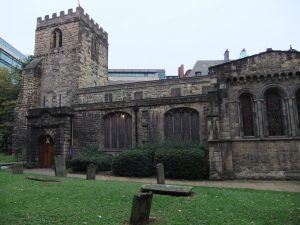

Nearest Metro Station: St James
Church History
St. Andrew’s Church is on Newgate Street beside the Town Walls. The Newgate was nearby, as was the Newgate Gaol.
The church dates from the 12th century, although there is evidence of an earlier building here, and some of the stones used to build the tower is reused Roman material. Most authorities put this church as the oldest in Newcastle.
The southern transept was added to the building in 1844 by John Dobson. The three semi-circular topped windows and the filigree decoration above are the Victorian date stamp, but the whole was intended to blend with the older structure.
The transept houses the Lady Chapel. It is here that Dobson’s vision is clear. His trademark is uncluttered grace, and here it is in its glory. The central “Children’s Window” depicts a child at prayer, Jesus blessing children, and an angel taking a child to heaven
There has been a Lady Chapel recorded in this location from the 13th century. It was originally an altar placed on the south wall of the aisle.
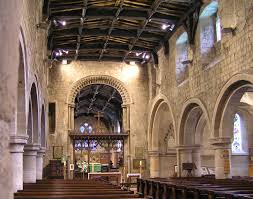
The exceptional feature of this church is this Norman arch, dating from the late 12th century. It separates the nave from the chancel beyond.
Looking carefully at the proportions draws the conclusion that it is too high for its width. The evidence also confirms that the arch was originally about 2.5 metres (8ft) lower. The roof was raised during the late 14th or early 15th century. Some indication of this can be seen at the west end of the south walls where the lines of the original clerestory windows show the lower roof level.
Beyond the arch and rood screen lies the chancel. This is not built on the same line as the nave, and a traditional explanation for this is that it is a symbol of Christ’s head drooping at the crucifixion.
Looking towards the high altar in the chancel we can see the extension of this section. The original east wall was 6.2 metres (20 ft) closer than now; the present wall being built in the mid 13th century. The window was restored during 1866 and is a copy of that original.
The choir stalls date from 1907 and replace rather ugly box stalls. They were made by Ralph Hedley of Newcastle who also made the Bishop’s chair, just visible on the left near the altar.
Just out of sight to the right of the altar, near the flag of St. Andrew, are two piscina, stone bowls used by the priest during mass for draining water. There is also a “squint” window on the left so that clergy in the side chapel could synchronise actions with the main priest during the ritual.
There are fourteen choir stall heads, they all depict different flowers.
The stalls, the rood screen and pulpit are all made from Austrian oak, and were made about the same time.
The chancel houses two of the oldest gravestones in the city. One, in front of the altar and to the left bears three horseshoes and the Latin “Orate pro anima thome lyghton” meaning pray for the soul of Thomas Leighton. This dates from 15th century and may refer to the Sheriff of Newcastle of that name.
The second old grave is decorated with a cross and steps leading to it. The word “sinister” can be made out, but other markings are indistinct.
The pulpit was moved to its present position in 1889, but was a stone pedestal. This oak pulpit is exquisitely carved and is typical of both Ralph Hedley’s work and of Victorian high fashion.
The money for this more recent restoration was raised by local donations and parish funds. The Corporation of Newcastle took over the upkeep of the churchyard during the 1950s.
The Trinity Chapel, to the north of the chancel, at the head of the north aisle, was built between 1385 and 1420.
The building was paid for by indulgences. The Bishop of Durham sold 40 days of respite to Purgatory punishment for anyone contributing to the restoration and building of the new chapel. The Bishop of Galloway also sold 40 days in 1392 for anyone providing vestments and furnishings for the chapel.
In later years this chapel was used for storage, a place for the font, and later a place for the organ. It was restored in 1894 and the font removed to the present baptistery at the western end of the nave.
If the Norman Arch is the outstanding architectural feature of the church, then the Trinity Chapel has to be the place of placid beauty.
The east window is the only example of Decorated English style in the church, and the illustrations in the glass are wonderfully drawn with much fine detail and depth of colour. The artist was Kemp.
The arrival of the Black Death, or Bubonic Plague, in the mid 14th century must have depleted the number of local craftsmen and parishioners, yet this seems to have been a time of much renewal and change at St. Andrew’s. It speaks volumes for the power held by the Church establishment over the local population.
In the north aisle stone corbels jut out from the wall showing the line of the original roof. The stone blocks would have supported roof beams and the horizontal line of stones above these were to deflect rainwater from the nave roof away from the aisle roof joint.
The aisles were widened in the 13th century. At the time this church was not only used for worship but also for more mundane meetings. The itinerant magistrates held court here, and the nearby market must have created the need for more impromptu gatherings.
The pillars and spandrels would have been brightly decorated, and it is certain that the roof timbers bore arms, standards and other bright colours. This all had to go after the 16th century Reformation.
The Baptistery contains the simple sandstone font and one of the most ornate and finest font covers in the land. It is medieval of artist unknown and rises by a system of pulleys and counterweights in the tower. The window depicts the baptism of Jesus and that of an Ethiopian eunuch.
A George IV arms adorns the rear wall, and there is a painting of the Last Supper by Giordano.
Source: http://home.freeuk.net/timarchive2/html/standrews.htm
The interior of the church. Source: Purves Architects
The Bells
Peals: None
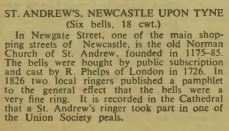
The bells in this tower date back to 1726 when a ring of 6 by Richard Phelps of Whitechapel was installed. The tenor reportedly cracked when being tolled for the death of Disraeli in 1881, following which they fell into disuse.
https://www.british-history.ac.uk/no-series/newcastle-historical-account/pp323-341#h3-0006 notes:
“In the year 1726, the old bells were taken down; and the present six bells were procured by a public collection. The corporation gave £50 towards the expense. They were cast at London, by Mr. R. Phelps, and are now a hundred years old; “It is generally allowed by professional men, that this peal has never been surpassed, and but seldom equalled, in point of musical correctness and harmony of tone, by any other peal that has been cast, either before or since that time. Not one bell in the six is in the smallest degree faulty.”
The bells were certainly being rung in 1862:
“Newcastle upon Tyne, St.Andrew, Northumberland: CHANGE RINGING. On Monday, being the anniversary of the birthday of the Duke of Northumberland, six of the bellringers, at present in this neighbourhood, ascended the tower of St. Andrew’s, Newcastle, and rung, on the melodious bells, a true peal of Oxford Treble Bob, consisting of 720 changes, which was done in a masterly style. After leaving the tower, each man contributed his mite to the box placed in the church for the relief of the distress in Lancashire (Newcastle Chronicle, Sat. 20 Nov. 1862”
There is quite a bit in the Bell News around that time lamenting the state of some of the rings of bells in Newcastle, including this article in their edition of November 22nd 1884
A writer in the Newcastle Weekly Chronicle says :—
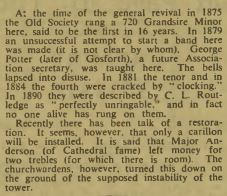
“ If the meetings which the Diocesan Bell-ringers hold occasionaly (sic) in Newcastle are attended with no other good result, they have at least the merit of drawing attention to the condition of the city bells. Our visitors are enthusiastic in their work. They climb the belfrys of the various churches, sound the iron-tongued monsters hanging aloft, and are not slow to point out any serious defects they may find. The ringers have discovered in the course of their annual visit this week that St. Nicholas’ bells are shockingly defective, that the bells of All Saints’ are ditto, and that two of the bells swung in St. Andrew’s have cracked and become useless. It is not creditable to Newcastle that the melody of its chimes should be marred by so many defects, and I agree with M r. G. J. Clarkson, the secretary of the association, that “ the matter should receive the attention of the Churchmen of this wealthy city. ” It is pleasant to learn, however, on the authority of Mr, Clarkson, that there has been an improvement at St. John’s, where two new bells have been put up and one of the old ones re-cast. At St. Stephen’s, again, a very fine peal has been placed in position. Moreover, the change-ringing societies which have been established throughout the district are developing-the taste for campanological performances to a remarkable extent.
In the Bell News of November 22nd 1890 the following article by Charles L Routledge was published:
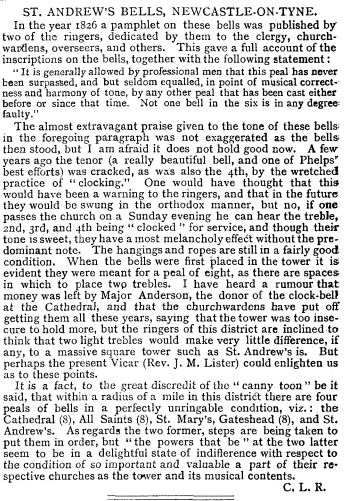
The Bell News in its edition of October 27th 1894 notes in an article that also mentions the bells of All Saints, St John the Baptist and St Ann:
The old bells of St. Andrew ’s were taken down in 1726, and replaced by six, cast by Mr. Phelps, of London, and a similar number occupy the old square tower of St. John’s. All these old bells are rather the worse for wear— especially the St. Andrew ’s peal, two of the bells being cracked— and it is to be hoped some pious and generous donors will enable the churchwardens before long to follow the example set by the cathedral church.
For some reason the same article was reprinted in The Bell News of September 4th 1911.
A plan to restore the bells was published in The Newcastle Evening Chronicle of 27th June 1963:
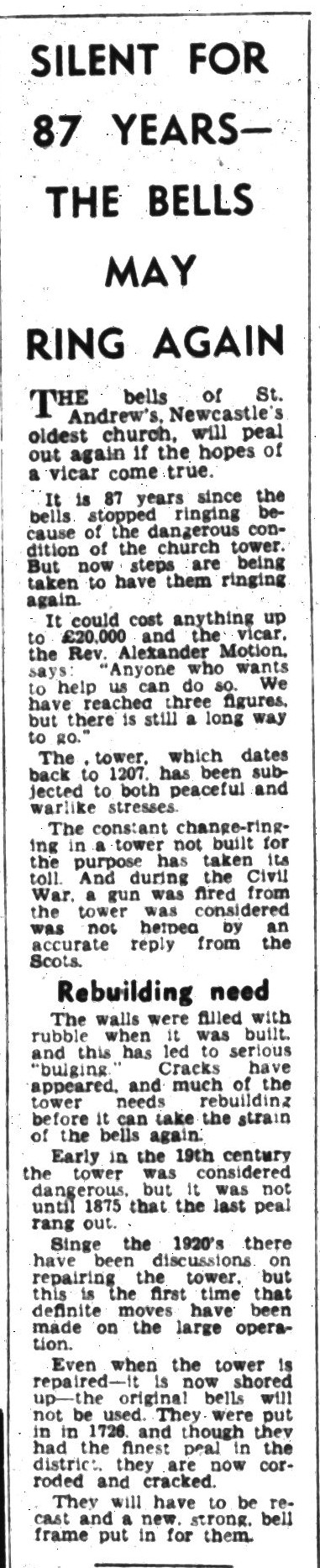
The removal of the bells for recasting was reported in the Newcastle Evening Chronicle of 12st October 1964:
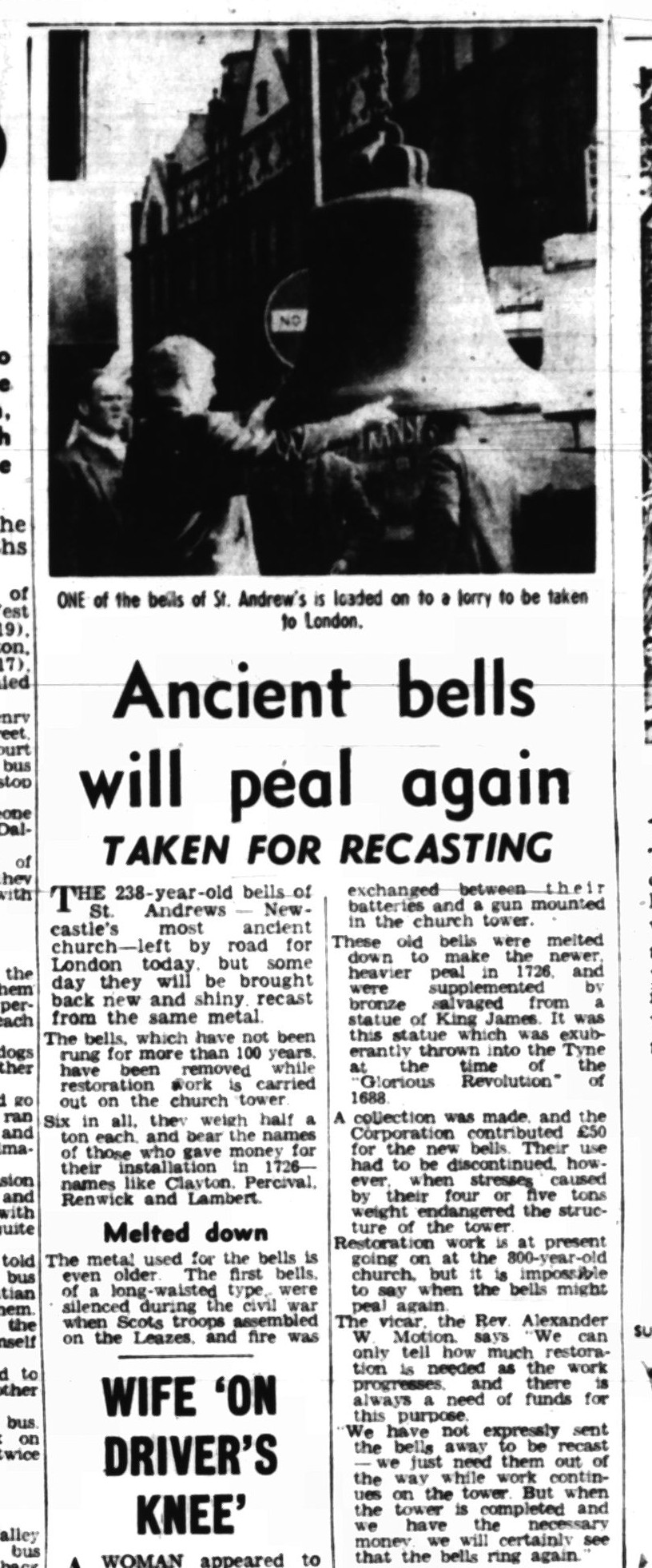
This appeared in The Ringing World of January 22nd 1965:
Tyneside Restorations
An appeal has been made for the restoration of the tower and bells of St. Andrew’s Church, Newcastle. These bells, now silent, were rung in defiance in 1644 to keep the Scots out, and an attempt was made at this spot to breach the city wall. Another restoration …..
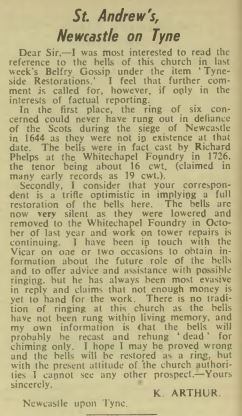
This resulted in a letter being published the following week:
The following week brought another letter!
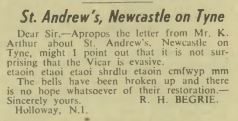
(Republished without the “gobbledegook” the following week!)
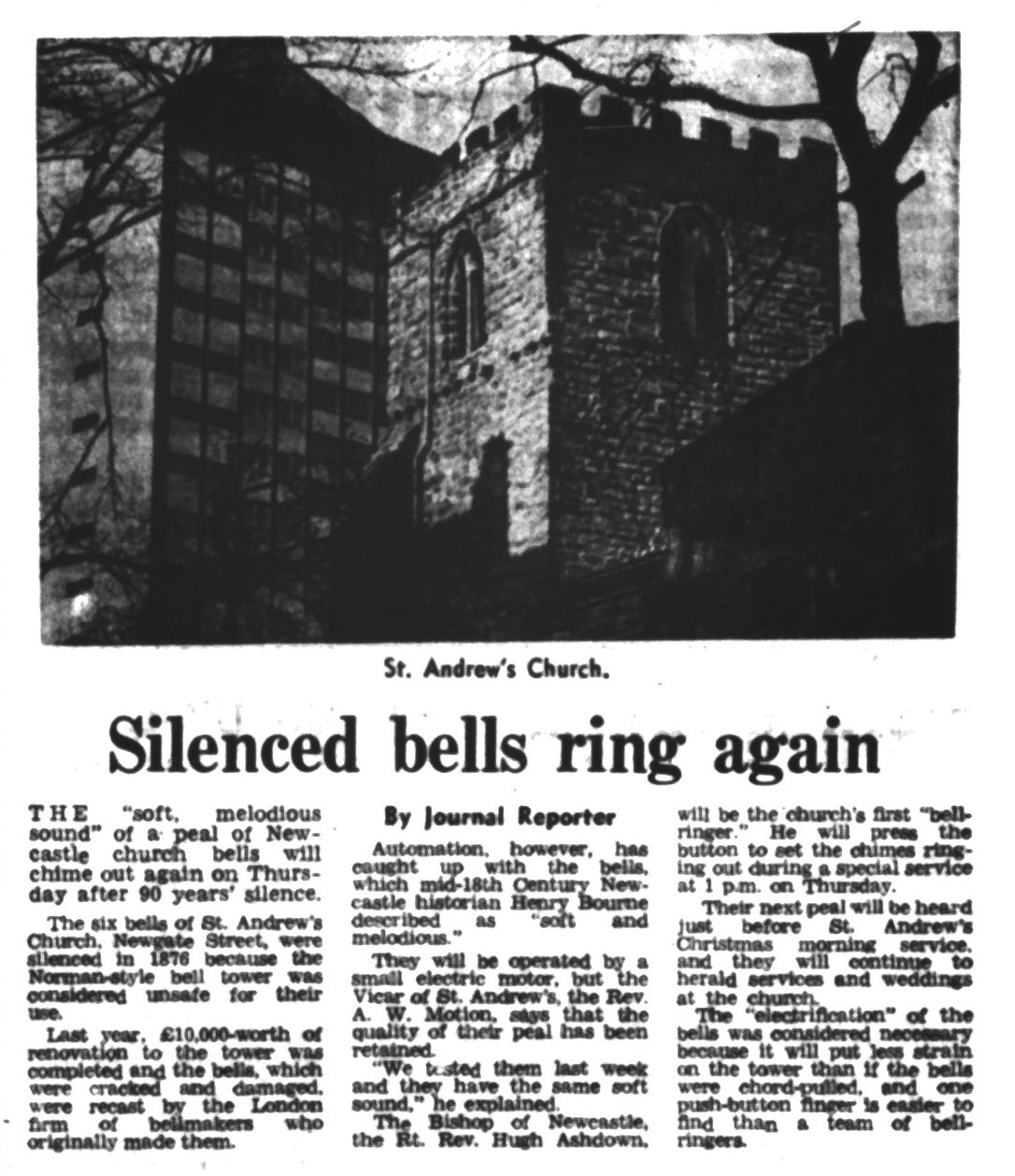
The completion of the work was reported in The Newcastle Journal of 19 December 1966:
Rodney A Yates had a series of articles published in The Ringing World in early 1966 and this was said of St Andrews in the February 4th edition:
 |
 |
The bells hang from concrete beams and one of the old wheels is preserved at the base of the tower.
Current bell details are:
1 5–0–26 30.00″ 1966 Mears & Stainbank 1168.0 D-10c
2 6–0–11 32.00″ 1966 Mears & Stainbank 1044.0 C-4c
3 7–1–9 34.00″ 1966 Mears & Stainbank 928.0 B♭-8c
4 8–2–20 36.00″ 1966 Mears & Stainbank 876.0 A-8c
5 11–2–27 40.00″ 1966 Mears & Stainbank 784.0 G+0c
6 16–2–12 44.88″ 1966 Mears & Stainbank 696.0 F-6c
NB Peter Rivet reports that the tenor was recast before the other bells, in 1960, though elsewhere it is reported to be 1966, at the same time as the rest of the chime. The weights chart in the church does have all as being cast in 1966.
Revd Joseph Thomas Fowler, writing in 1865, stated, “These bells are very difficult to get at or see. The fifth has this inscription: “Chr. Rutter, Fenwick Lambert, Tho. Sheuill, Percival Bell, Ch. Wardns. R. Phelps fecit, 1726.” The rest appear to have the same or something similar. All are very wide and flat at the top.
The Old Ring
1 6-1-7 1726 Richard Phelps, Whitechapel
2 6-2-14 1726 Richard Phelps, Whitechapel
3 7-3-2 1726 Richard Phelps, Whitechapel
4 8-3-21 1726 Richard Phelps, Whitechapel
5 11-2-1 1726 Richard Phelps, Whitechapel
6 15-3-5 1726 Richard Phelps, Whitechapel
Inscriptions
The Newcastle Society of Antiquaries (1887/88) gave the inscriptions on the Phelps bells as:
- WILLIAM COULSON ESQ: OF IESMOND R:P: FECIT 1726 (rose decoration)
- THE REVD:WM:BRADFORD A:M:VICR:N:ELLISON:A:M LECT WM:WILKINSON A:B CURE: R:PHELPS:LONDINI FECIT 1726
- EDW:JOHNSON FRA:RUDSTON NIC:FENWICK WM:CARR ESQS: ALDERMEN R:P FEC 1726
- SR: WM: BLACKET BART NATH:ELLISON MATH:FEATHERSTONE HEN:REAY RIC:RIDLEY ESQRS ALDERMEN R:P:FECIT 1726
- THE WORSHIPL:NAH:CLAYTON ESQ:MAYOR IOHN ISAACSON ESQR RECORDER THO:WASSE ESQR SHERIF
- MESSRS CHR:CUTTER FENMIC LAMBERT THO:SHEUILL PERCIVAL BELL CH:WARDENS R:PHELPS FECIT 1726
