Jarrow, Christ Church (Jarrow Grange) 8: 17-0-15 in F MAP
Ringing: Bells are unringable
Nearest Metro Station: Jarrow
Church History
The church, in Clayton Street, was built 1868/9 by Johnson and Hicks. It is built from coursed, squared rock-faced sandstone with a roof of Welsh slate. There is a 4-bay nave, north and south aisles and a south porch. There is also a 2-bay chancel, with south vestry and north organ loft, a tower, with a stair turret at north-east of the nave. It was built in the “Early English style”. The west elevation has 2 windows of 2 lights with cinquefoils. The clerestory has cinquefoil windows and there are lancets in the aisles. The high-pitched roofs have gable stone copings and finials and the tower has tall broach spire.
The nave arcades have round piers with plinths, clasping bands and acanthus capitals and stiff leaf stops to hood moulds of the arches.
Furnishings: There is a Norman-style front of Frosterley marble on pedestal and 4 columns; choir stalls, a rood screen, a lectern and an altar. The Gothic-style woodwork is of high quality.
Source: https://britishlistedbuildings.co.uk/101025199-christ-church-primrose-ward#.XVRxo-hKiUk
Pevsner states, “Excessively tall NE tower with stair-turret and broach spire, completed 1882”.
The Bells
These bells have not been rung for quite some time, the last peal here being in 1928. The tower was said to be insufficiently stable for ringing to continue. Work was done to the tower masonry in last 1971/early 1972. There is a picture here showing steeplejacks at the top of the spire doing work to enable scaffolding to be erected. Whether this would be sufficient for the bells to be rung now, if made ringable, I do not know.
A ring of 6 was installed in 1882, at the completion of the tower, and 2 trebles to make the octave were added in 1918. Bells 4, 5 & 6 have canons, the rest were cast flat topped. The notice of a failed peal in 1922 suggest some form of rehanging for the back 6 bells when the ring was augmented to 8.
The opening of the ring of 6 was reported in “Bell News and Ringers’ Record” in the edition dated November 11th 1882:
OPENING OF BELLS AT CHRIST CHURCH, JARROW-ON-TYNE.
On All Saints’ day, November 1st, a new ring of six bells was opened at the above church. In the morning, at eleven o’clock, a service was held, which was attended as largely as the church would permit, an admirable sermon being preached by the Bishop of Durham. After the service, the bells were rung by members of the Durham and Newcastle Diocesan Association of ringers from North Shields, and St. John’s, Newcastle, a good 720 of Kent Treble Bob Minor being rung, particulars of which will be found among our records of performances. During the rest of the day, touches of Plain Bob, Grandsire Minor, Oxford and Kent Treble Bob Minor, and College Single were also rung.
At 1.30 p.m., the ringers were entertained to a capital dinner, and the day was spent most enjoyably. A company of ringers during the afternoon proceeded to St. Peter’s church, in the same town, where they rang a 720 of Grandsire Minor. Ringing was kept up at Christ Church till 9.0 p.m.
The bells are by Messrs. Taylor. the tenor weighing 17 cwt., and the arrangements and fittings of the bells, as well as the handsome spire, are almost a counterpart of St. Stephen’s, Newcastle.
We learn a little more about the ringers here in an article on the front page of Bell News January 9th 1897, which gives details of Frederick James Harrison, who taught ringing both here and at St Peter’s, Jarrow:


The bells were augmented to 8 in 1919, at the same time the treble, which was considered to be too flat for the ring, was replaced. Chris Pickford informs me that the original bell was 30.0” in diameter and weighed 5-3-13 (the 1919 scrapping weight was 5-3-6). The job was completed and invoiced on 11th October 1919, the three new bells having being cast on 1st July 1919. (“Dove” had these as being cast in 1918, this was incorrect, though the Jubilee of the church mentioned in the inscriptions would be 1918, given the date of building of the church!).
Chris also notes:
The invoice shows that the treble was recast (or, rather, exchanged) free of charge. The old bell (not used to cast the new one) didn’t arrive at Loughborough until 15 October 1919 – the bellhangers ‘switched’ the bells in the tower when doing the installation work, which involved considerable changes to the arrangement of the frame. I think that there are three pits on top, for bells 1, 2 and 6 – type 6A, one pit 1882 and two additional pits 1919 (I say “I think” because that’s what JWT (jun) proposed – and it may be that they did something different when the job got done). I don’t have a layout plan of the 1882 bottom frame (originally for 2-6 of the six – later for 3-5 and 7-8 of eight, again “I think”). Not much doubt it’s likely to be type 6.A.
The augmentation does not seem to have been a complete success – this appears in The Ringing World of July 7th 1922:
DURHAM AND NEWCASTLE DIOCESAN ASSOCIATION.
On Saturday, June 17th, a peal of Stedman Triples was attempted at Christ Church. Jarrow-on-Tyne, but was lost after 2½ hours, owing to the 5th bell slipping her rope. It is about two years since the two trebles were added and the bells rehung, but they were never a satisfactory job. Mr. Brewis, the leader of the local ringers, with his good wife and daughter, very kindly provided tea, and the band tendered their warm thanks to their kind host and hostesses.
A district meeting was held here on July 13th 1935 and there is no talk of any issues with the bells or tower in the report in The Ringing World. Indeed there had been a most enjoyable meeting that had been enjoyed by all. However, in The Ringing World of August 21st 1936, in a report of a district meeting, where St Peter’s bells were rung, it is said, “It was regretted that Christ Church tower is unsafe for ringing,” This must have been a sudden decision, as the meeting notice had stated that ringing would take place at Christ Church. Strangely, there is ringing advertised here for a meeting on June 12th 1937! Ringing certainly took place here at a meeting on January 28th 1939, when a “very encouraging meeting” took place. There might have been ongoing concerns about the tower that were not yet certain enough to stop the ringing of the bells.
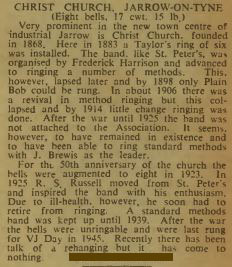
A review of ringing in the area was published in “The Ringing World” over a few weeks at the beginning of 1966. In the January 7th edition this appears:
Peals
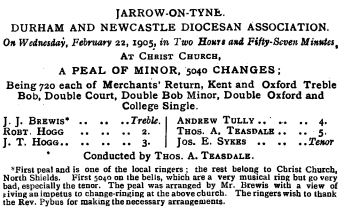
The first peal was rung in February 1905, when the bells were still a ring of 6, and is shown below in the entry from “Bell News and Ringers’ Record”. Note that there were already issues with the go of the bells.
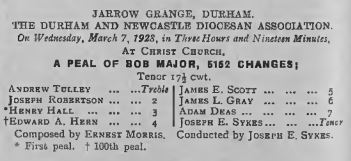
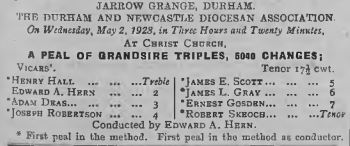
The final two peals on the bells were rung close together in March and May of 1928. The peals were reported in “The Ringing World” thus:
 |
 |
1 3-1-22 25.00″ 1919 John Taylor & Co 1418.0Hz F+26c
2 3-3-24 26.00″ 1919 John Taylor & Co 1337.0Hz E+24c
3 4-1-25 28.00″ 1919 John Taylor & Co 1188.0Hz D+20c
4 7-0-11 33.25″ 1882 John Taylor & Co 1067.0Hz C+34c
5 8-1-21 35.13″ 1882 John Taylor & Co 946.0Hz Bb+25c
6 9-0-26 36.75″ 1882 John Taylor & Co 883.0Hz A+6c
7 12-1-8 40.50″ 1882 John Taylor & Co 799.0Hz G+33c
8 17-0-15 45.75″ 1882 John Taylor & Co 708.0Hz F+23c
Inscriptions
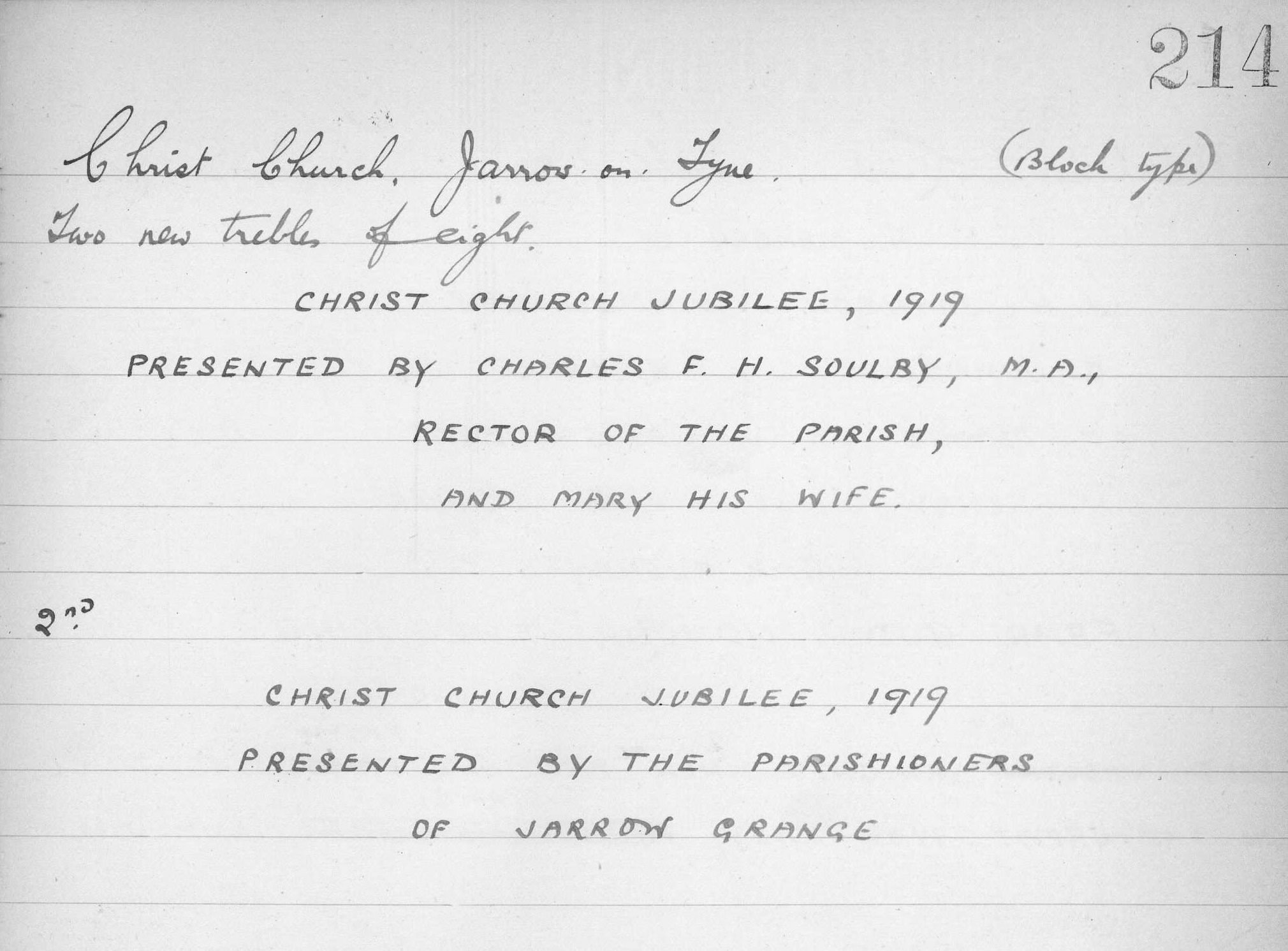
- CHRIST CHURCH JUBILEE 1919
PRESENTED BY CHARLES F. H. SOULBY, M.A,
RECTOR OF THIS PARISH,
AND MARY HIS WIFE - CHRIST CHURCH JUBILEE 1919
PRESENTED BY THE PARISHIONERS
OF JARROW GRANGE - 19 (Taylor Logo) 1919 around the shoulder
- JOHN TAYLOR AND CO. BELLFOUNDERS LOUGHBOROUGH 1882
- JOHN TAYLOR AND CO. BELLFOUNDERS LOUGHBOROUGH 1882
- JOHN TAYLOR AND CO. BELLFOUNDERS LOUGHBOROUGH 1882
- JOHN TAYLOR AND CO. BELLFOUNDERS LOUGHBOROUGH 1882
- JOHN TAYLOR AND CO. BELLFOUNDERS LOUGHBOROUGH 1882
(I have no information currently as to whether there was an inscription on the then treble that was not reproduced when it was recast in 1919).