 Gainford, St Mary 6: 11-3-4 in G# MAP
Ringing:
Sunday:10:15 to 10:45
Church History
The present church, though of early date, is believed to occupy the site of a still more ancient edifice, as we find it recorded by Simeon of Durham, that Edw or Edwine, a Northumbrian chief, who had exchanged his helmet for the cowl, died in 801, and was buried in the monastery of Gainford “in the church.” Of this foundation there is no further mention made by any of our ancient historians, but it was doubtless a humble structure – perhaps made of wood – and, like many more monastic institutions formed previous to the Norman Conquest, of a temporary nature and with no settled or certain foundation. A more valuable and permanent establishment arose soon after this circumstance, for Egred, Bishop of Lindisfarne, 821-845, and owner of extensive possessions in this district, chose Gainford as the spot whereon to build a church and also a vill. Fragments of crosses, coeval with this date, are still to be seen within the church, and built into the walls.
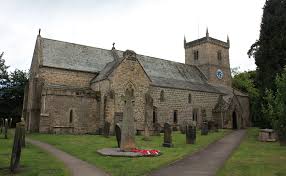
The church is dedicated to St. Mary (formerly St Cuthbert), and its erection is ascribed to the community of St. Mary’s Abbey, York, early in the thirteenth century. It is situated on the south side of the village green, and consists of nave, aisle, with north and south chancel, and a square western tower, containing six bells and a good clock. The tower is open to the nave, and is supported by pointed arches, and similar ones, of unequal span, resting on cylindrical pillars, separate the nave and aisles. The chancel opens from the nave, under a plain pointed arch, supported by corbels, beneath which are traces of the masonry on which the beam supporting the rood-loft formerly rested.
In 1864, owing to the church having fallen into a bad state of repair, a thorough restoration was made, at a cost of over £3000. The chief alterations at this time were the erection of an organ chamber, with fine organ, and a north porch. During the repairs, a number of sculptured stones of pre-Conquest date were found, and are now placed under cover. There are several fragments of fine Saxon crosses also preserved, some of which are beautifully carved. Amongst the collection of ancient stones there is a Roman altar, dedicated to Jupiter Dolichenus, and a stone marked LEG VI. V. Various grave-covers, and other stones of later date are built into the walls of the north porch.
(From History, Topography and Directory of Durham, Whellan , London, 1894)
Source: http://joinermarriageindex.co.uk/pjoiner/genuki/DUR/Gainford/index.html

The interior of the church
The Bells
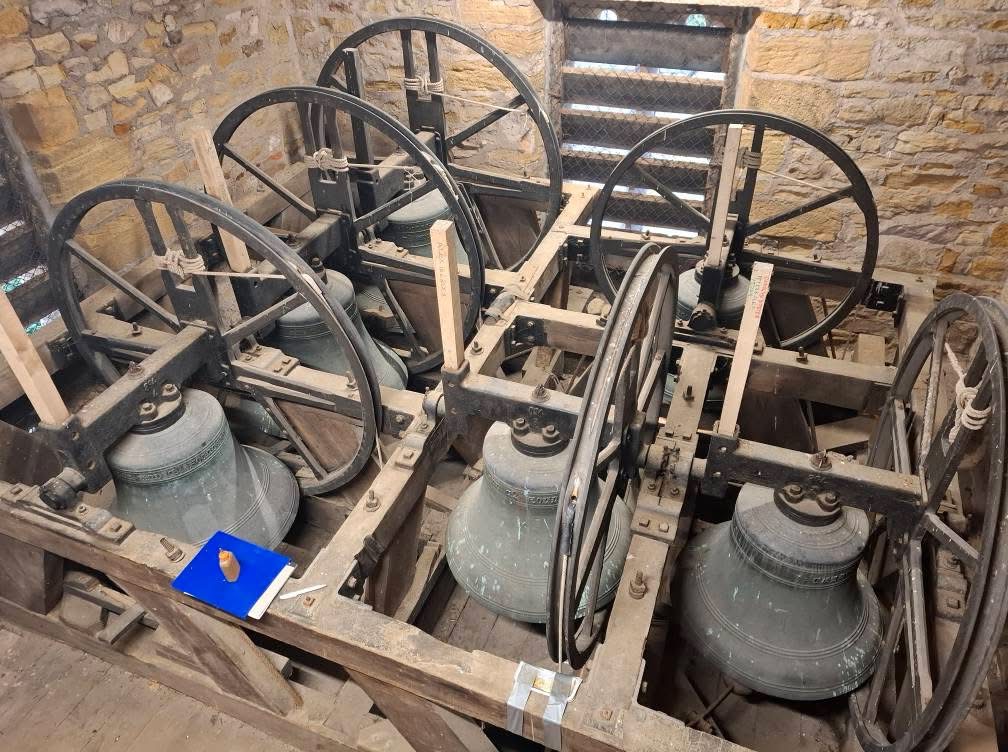
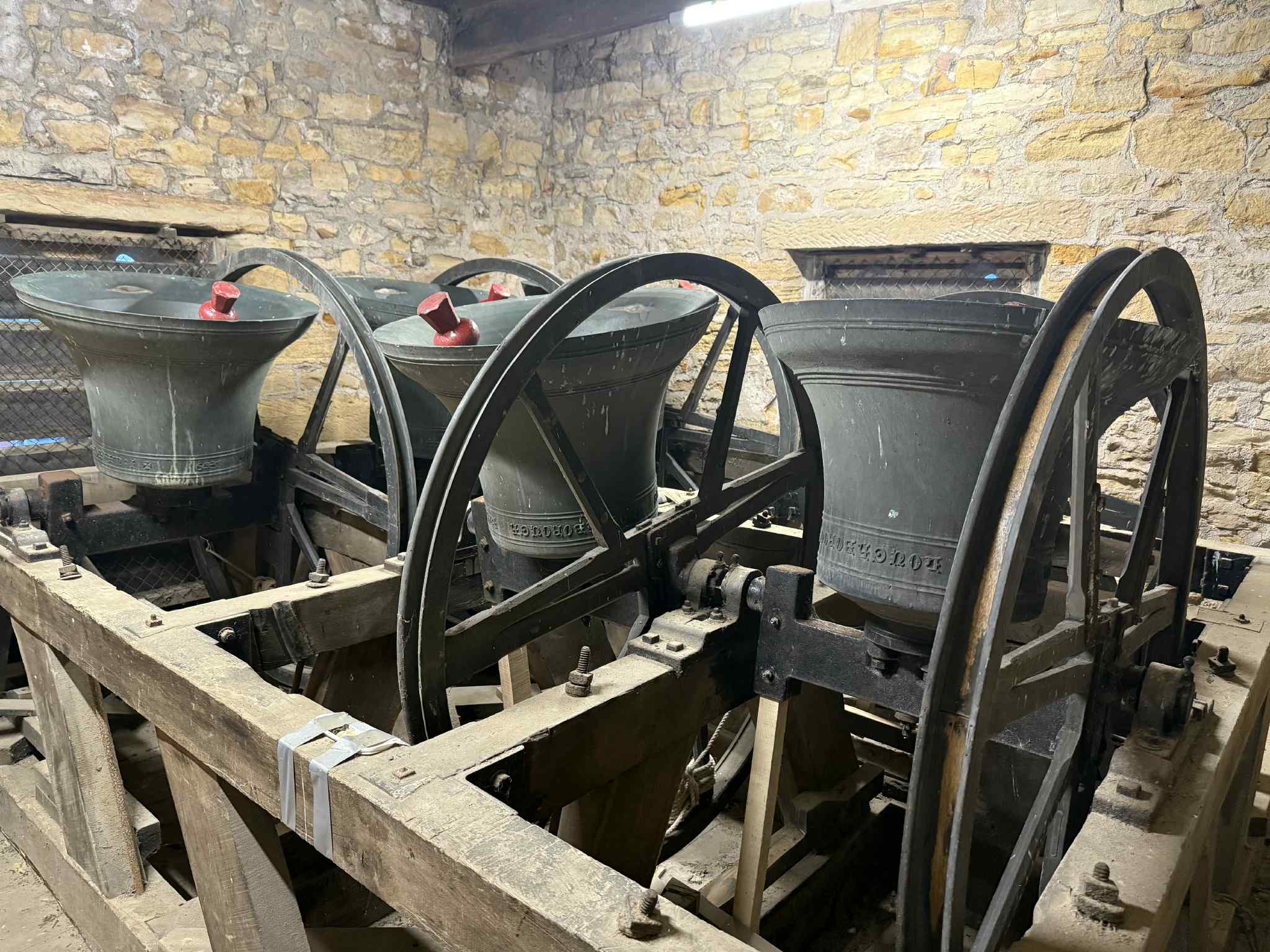
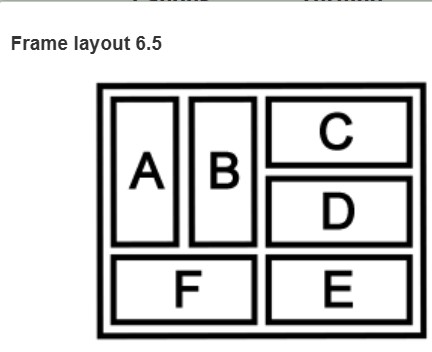
Before 1865 there were three bells; the 15th century treble was sent to Piercebridge and is still there. They are quite loud in the ringing chamber. The Bellframes are of long-headed type and of bolted timber construction; the trusses have straight-sided braces but no centre or end posts (type 6A). The plan is a variant on type 6.6; three parallel pits with a second group of three, one parallel to the others and two at right angles, alongside.
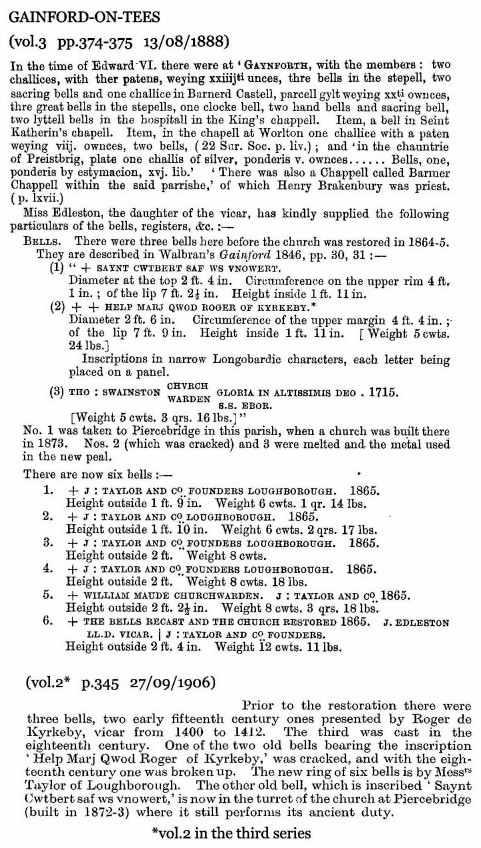
The Society of Antiquaries of Newcastle reported on the bells in 1888
The bells were rehung in 1927 and an article about this appeared in The Ringing World on April 8th of that year:
BELLS REHUNG AT GAINFORD, DURHAM.
The bells of St. Mary’s Church, Gainford, have been away to the Loughborough foundry, where they have been cleaned by the sandblast process and retuned. They are now back in the tower and hung in the old frame with entirely new fittings and on ball bearings.
On Saturday, March 5th, ringers from Darlington (Holy Trinity, St. Cuthbert’s and St. John’s) and All Saints’ , Hurworth-on-Tees, paid a visit to try them, touches of Bob Minor, Kent and Oxford Treble Bob Minor being rung, and also 720 each of London and Cambridge Surprise Minor, and 360 of Cambridge Surprise.
The bells go well, but some difficulty was experienced with the treble and second, through tile ropes slipping off the wheels, but this will, doubtless, soon be rectified.
The Vicar of Gainford (the Rev. R. A. Bidwell) kindly entertained the ringers to tea, and they expressed their thanks to him for his kindness, and for a pleasant afternoon. The bells are a nice ring of six, with a tenor of 14 cwt.
The canons were removed and bells 2, 4, 5 and 6 were quarter-turned. The vicar felt the need to write to The Ringing World to say that the issue was due to stiff new ropes alone and that the church was very happy with the quality of the work done by Taylors.
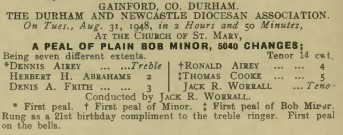
There was a long wait for the first peal on the bells to be rung, this not occurring until 1948. Only 7 further peals have been rung to date. The first peal was reported in The Ringing World thus:
An Ellacombe Apparatus was installed by Taylors in 1950.
1 6-0-15 29.75″ 1865 John Taylor & Co 1405.0Hz E#+10c (6-1-14)
2 6-1-17 31.63″ 1865 John Taylor & Co 1253.0Hz D#+12c (6-2-17)
3 7-2-23 33.75″ 1865 John Taylor & Co 1116.0Hz C#+11c (8-0-0)
4 7-3-16 34.63″ 1865 John Taylor & Co 1052.0Hz B#+9c (8-0-18)
5 8-2-16 37.00″ 1865 John Taylor & Co 937.0Hz A#+9c (8-3-18)
6 11-3-4 40.75″ 1865 John Taylor & Co 836.0Hz G#+11c (12-0-11)
The figures in brackets are the original “as supplied” weights of 1865.
Inscriptions
- J TAYLOR & CO FOUNDERS LOUGHBOROUGH 1865
- J TAYLOR & CO LOUGHBOROUGH 1865
- TAYLOR & CO FOUNDERS LOUGHBOROUGH 1865
- TAYLOR & CO FOUNDERS LOUGHBOROUGH 1865
- WILLIAM MAUDE CHURCHWARDEN J TAYLOR & CO 1865
- THE BELLS RECAST AND THE CHURCH RESTORED.
J EDLESTON, LLD, VICAR
J TAYLOR & CO FOUNDERS.
According to the Newcastle Society of Antiquaries (1887/88) Walbrams’ Gainford (1846) indicates that before the present Taylor six were installed in 1865 there were three bells, with a tenor weighing 5-3-16, inscribed:
- + SAYNT CVTHBERT SAF WS VNO WERT
- + + HELP MAJ QWOD ROGER OF KYRKEBY
- THO SWAINSTON CHURCH GLORIA IN ALTISSIMIS DEO 1715
WARDEN S S EBOR
The first two can be dated reasonably accurately as Roger Kirkby was Vicar from 1401 to 1412. The tenor was clearly by Samuel Smith II of York.
The frame layout