Sunderland, St Andrew (Roker) 10: 22-2-26 in E MAP
 Ringing:
Sunday: 09:00 to 09:30.
Practice: Tuesday 19:00 to 21:00
Nearest Metro Station: Seaburn
Church History
The fact that I learned to ring here in 1974 and attended the church in the 1980s has no influence at all on him stating that these are a magnificent ring of bells in a wonderful church – they just are!
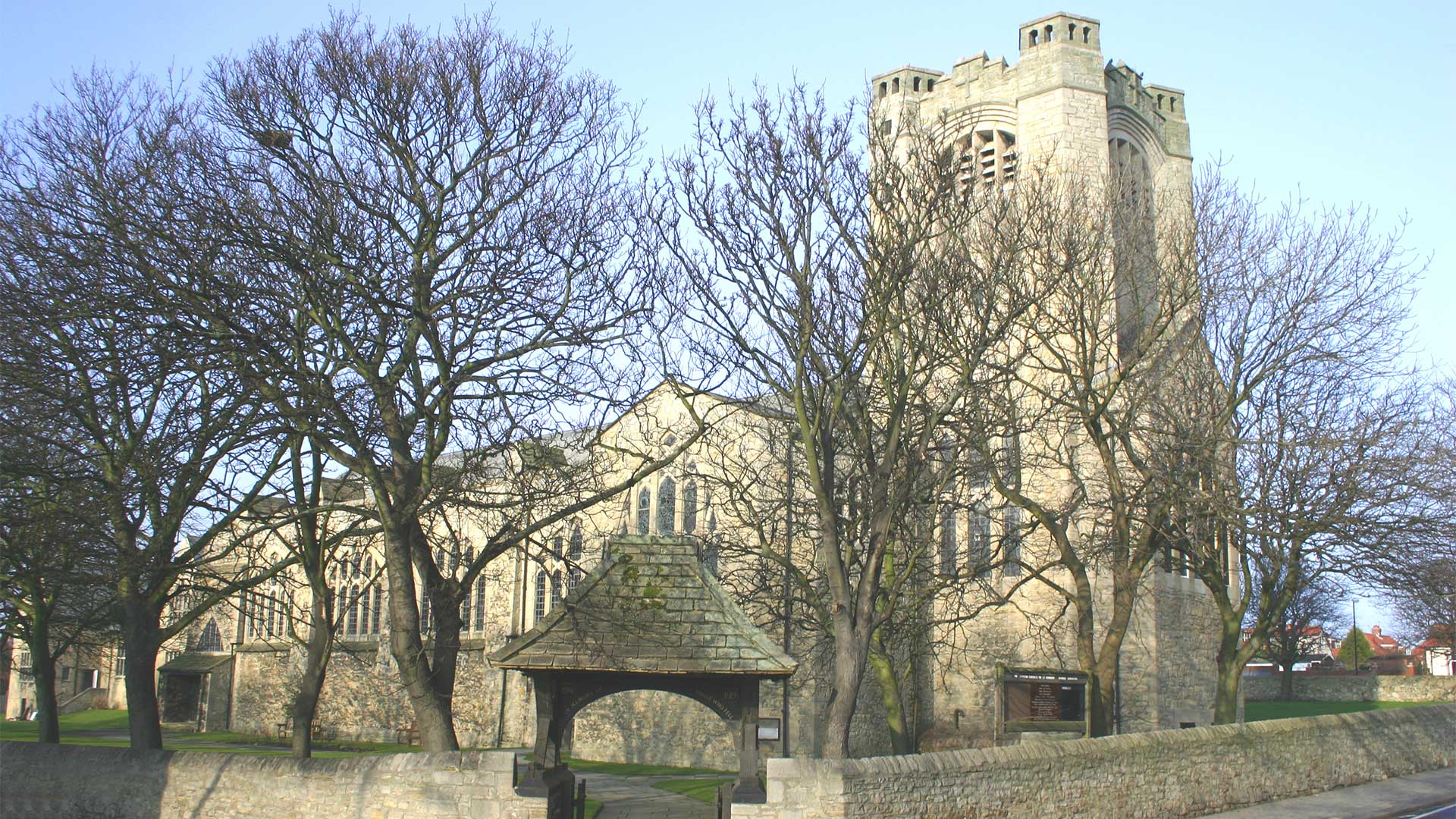
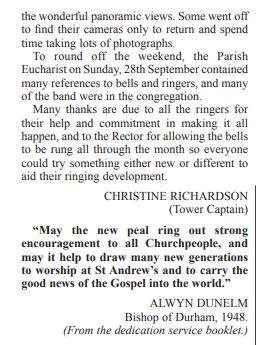
The church is one of the ecclesiastical gems of the 20th century. Designed by Edward Prior and built in 1906/07 and it was much inspired by the Arts & Crafts Movement. It is sometimes known as “The Cathedral of the Arts and Crafts Movement “. The famous architectural historian Sir Nikolaus Pevsner described it as, “One of the architecturally most interesting and successful churches of its date in England.”
It is one of the first large buildings that was made out of reinforced concrete. It was then clad in local stone, making it look an older building to the untrained eye. A local rich benefactor, shipyard owner Sir John Priestman, gave a lot of the money and hence it is fitted out with much of artistic quality. The cost of the church is said to have been £13,177, about £1.5 in today’s values..
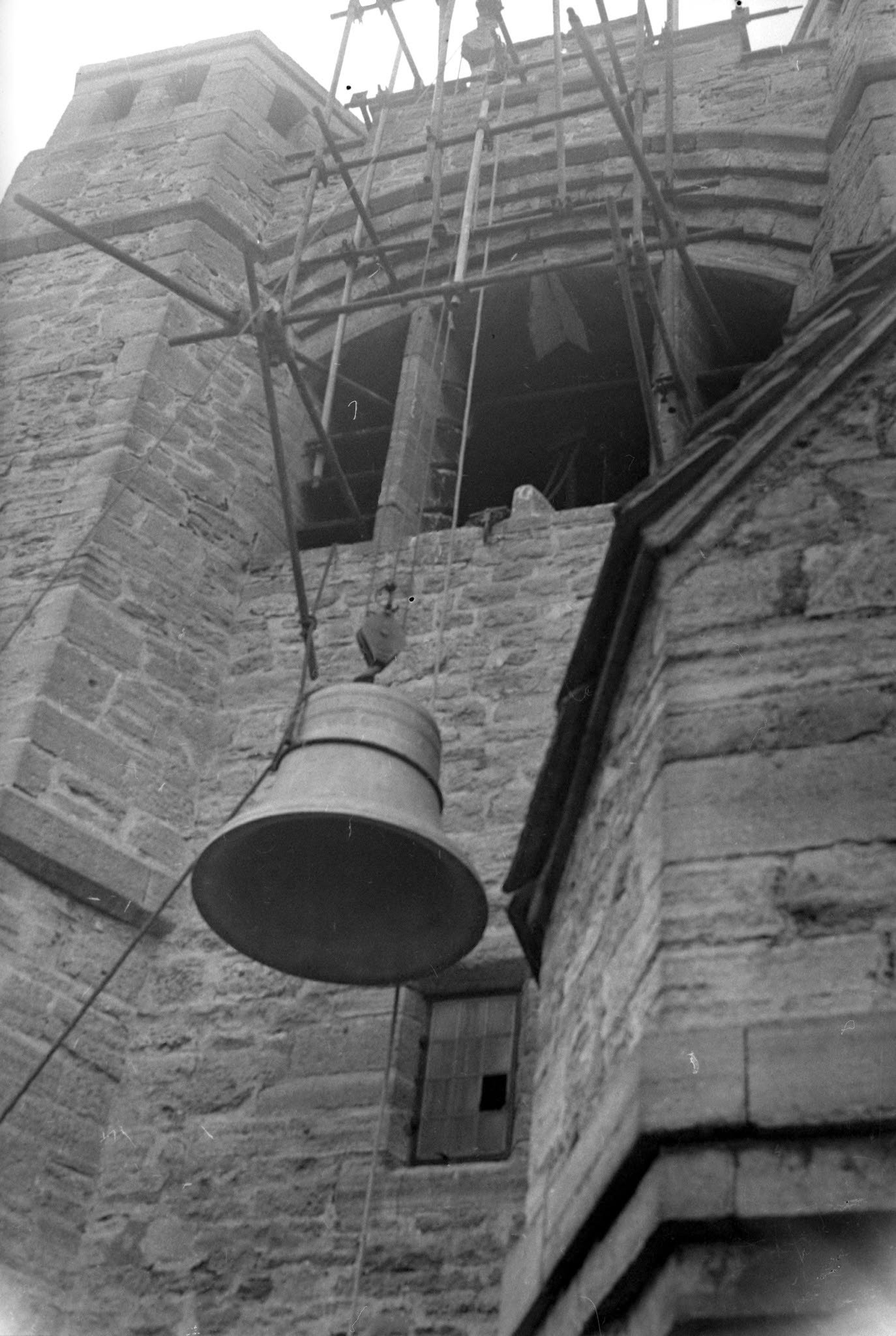
It is unusual in a number of aspects. For instance, the tower is on the “wrong end” – the east. This was deliberately done as, at the time of construction, it was the nearest building to the sea, (about 200 yards from the cliff edge as the seagull flies) and the tower was meant to be visible to those “on the briny fluid”. This did cause one big problem. When the bells were put in 40 years after the church was built there were no bell hatches in the concrete ringing room floor and the bells and fittings had to come inside through the louvers. One set was taken out and the bells and frame put in from the far side towards the now open louvers. The frame could not be put in place and the bells dropped in as is normal as there is simply not enough headroom.
The inside of the church is well worth viewing. The plan was to allow everyone to see the altar and as such there are no internal pillars blocking sight lines. This was done by making the roof like an upturned boat with the weight of the ribs being borne on small pillars at the sides of the nave.
The nave walls are panelled in wood, fixed with hand made nails. The ceiling of the sanctuary is painted with a scene of the sun and stars. There was a much drawn out debate about how to restore this in the 1980s. One expert said one thing, another something different. Safe to say after the argument was sorted out the restoration was eventually done at three times the original estimated cost!
The glass in the windows you can see in the photographs is hand made and translucent. Some windows have had to be restored recently at considerable cost as they were bowing. Only the east window and the windows in the Lady Chapel are of stained glass.
There is an impressive large tapestry of the Magi behind the main altar, the last produced in a series of ten.
There has needed to be quite some restoration in recent years, notably to the tower, which was completed in 2018. However, this has kept faith with the style and materials of the building.
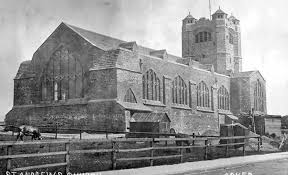
An early photograph of the church. Source: Church website
Note the pyramidical caps on the tower turrets. There was also then a pyramicial roof.
The churchyard has not yet been developed and there is no church hall on the site.
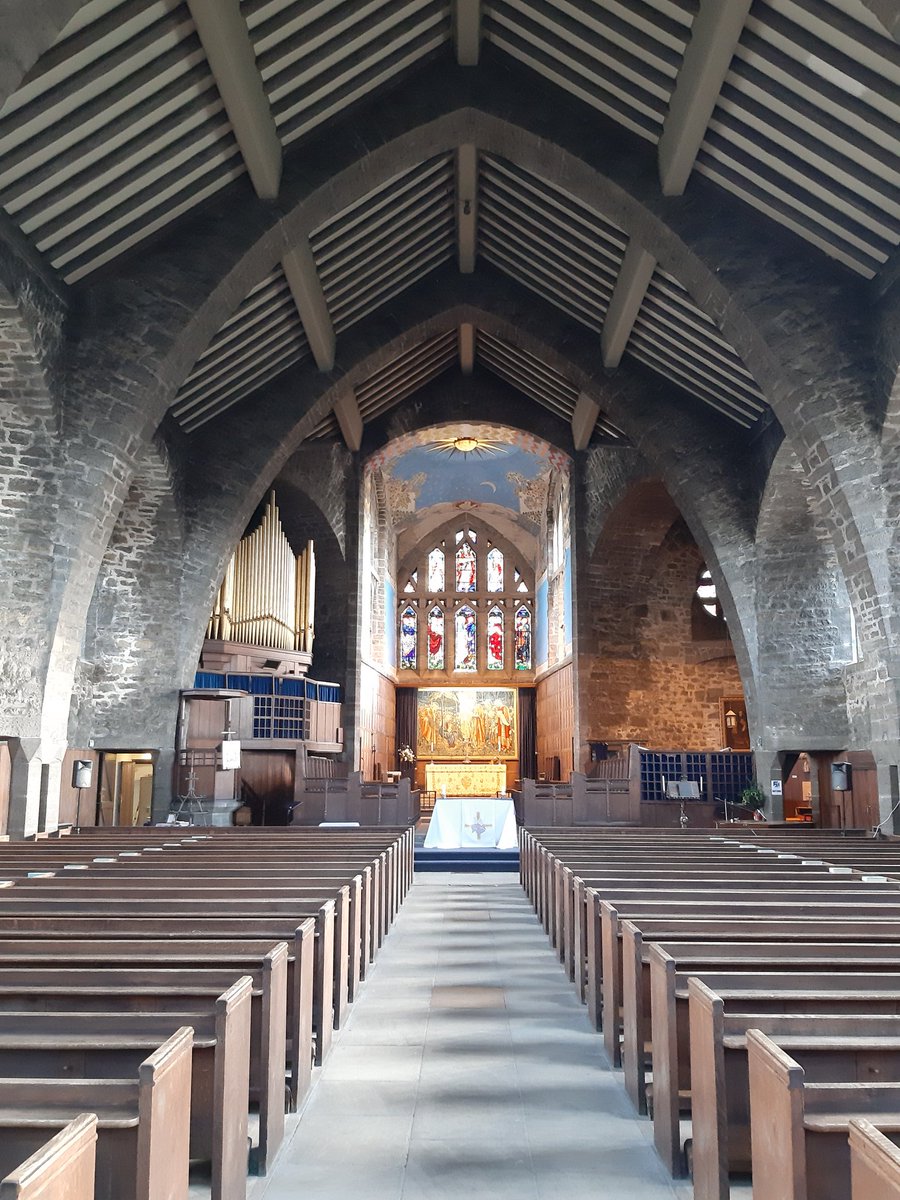
A view looking toward the liturgical east of the church
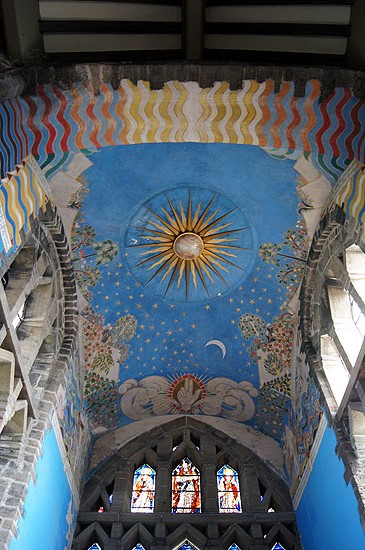
The wonderful ceiling in the sanctuary.
To change the bulb in the alabaster “sun” there is a winch stored
in the ringing chamber that is used to lower it to the ground!
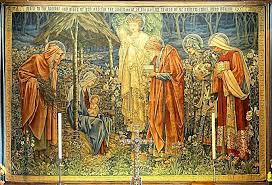
The fabulous tapestry behind the altar.
The Bells
The bells, were installed as a war memorial and are a superb ring cast by Gillett & Johnson, it was originally thought, in the autumn of 1947 and hung the following year. Data obtained from Alan Buswell, suggest that they were actually cast over the end of 1947 and into the early part of 1948. Note from the date of the tuning of the 2nd that New Year’s Day was not a Bank Holiday in England at this time!
Things were not quite smooth in getting the bells installed! The Ringing World of June 27th 1947 reports:
Periodically there are serious challenges at the whole basis and structure of bellringing- and the Church’s use of bells. One such incident took place at Sunderland, where the Chancellor for Durham Diocese, Mr. R. G. S. Bankes, held a Consistory Court to hear a petition from Mr. Friend, a schoolmaster, that no faculty be given for the installation of a ring of ten bells in the tower of Roker Parish Church. The contention of Mr. Friend was that ‘ the noise of bellringing will destroy one of the most valuable amenities of the area.’
The Chancellor overruled the petition. Mr. Arthur Greaves, who appeared for the Vicar of St. Andrew’s, Roker, asked for costs, pointing out that the delay caused by this ‘ frivolous objection ’ had already penalised the parish to the extent of £500 on account of the increased cost of material and labour. The Chancellor ordered Mr. Friend to pay five guineas Court costs.
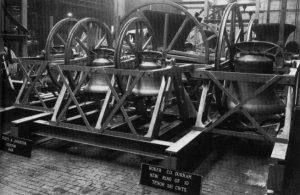
The are hung in a cast iron lowside frame, truss 8.3.A.m and layout 10.5 – the fact that there is no bell opening in the tower meant that the bells had to be installed through the north louvre opening. The lack of usable height meant that the frame had to be installed from the far side and the bells put into their pits as they were completed, rather than then frame being installed as one and the bells then hung it it.
The following notice appeared in “The Ringing World” of September 10th 1948.
ST. ANDREW’S, ROKER, SUNDERLAND.
—The new ring of ten bells installed by Gillett and Johnston, Ltd., will be dedicated on Sunday, Sept. 26th, at 3, by the Bishop of Singapore. All ringers are invited to be present.—John A. Brown, Hon. Sec., 7, Finchdale Terrace, Chester-le-Street, County Durham.
The Bishop of Singapore at the time was Leonard Wilson, a former vicar at Roker. The edition of October 15th 1948 reported the dedication:
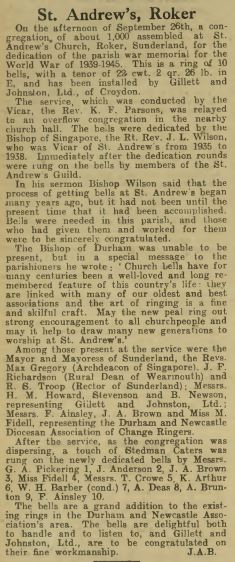
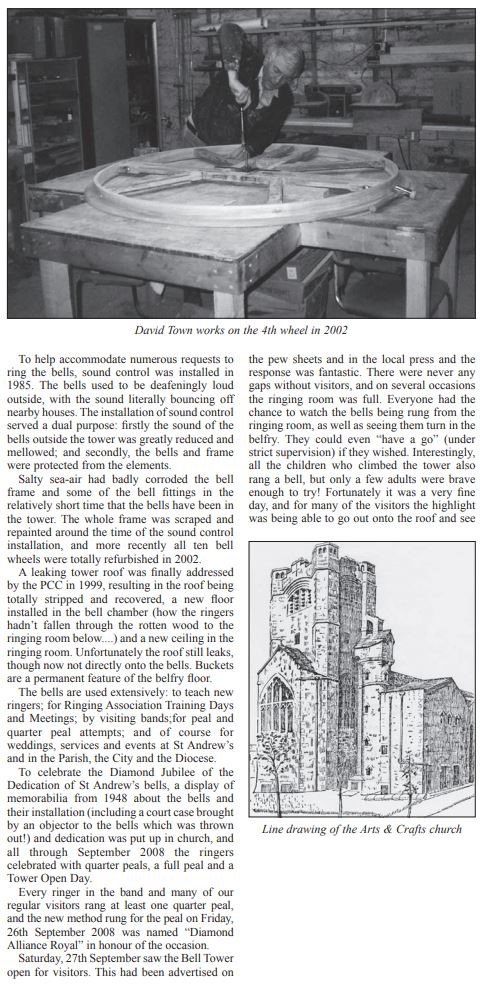
The wheels re-shrouded and re-soled in the early 2000s and the bearings and other fittings were overhauled by Pembletons in 2018.
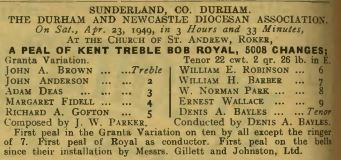
The first peal on the bells was rung in Apri 1949 – Kent TB Royal in the Granta Variation. In this the treble makes seconds over the 4 tenors in turn in the leads where they would have normally “gone into the hunt”. It could be argued that this is really Kent spliced with Bastow Little Bob Royal. Anyway, the peal details as published in “The Ringing World” are:
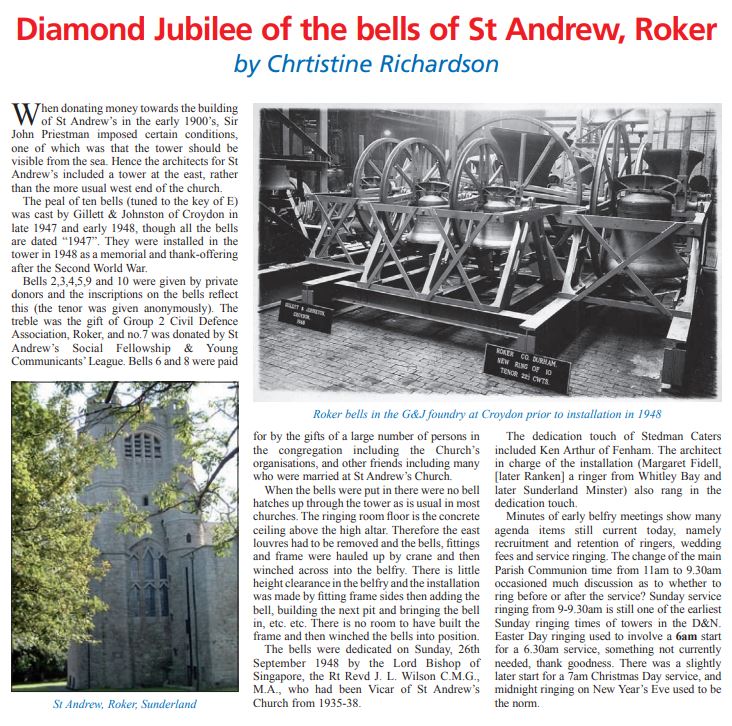
The 50th Anniversary of the bells was reported in The Ringing World of November 7th 2008:
1 3-3-11 24.50″ 1947 Gillett & Johnston 1630.0Hz G#-33c
2 4-1-14 26.13″ 1947 Gillett & Johnston 1468.0Hz F#-14c
3 4-2-26 27.50″ 1947 Gillett & Johnston 1304.0Hz E-19c
4 4-3-19 28.63″ 1947 Gillett & Johnston 1222.0Hz D#-32c
5 6-1-9 31.00″ 1947 Gillett & Johnston 1086.0Hz C#-36c
6 7-1-3 33.50″ 1947 Gillett & Johnston 978.0Hz B-17c
7 9-2-25 37.00″ 1947 Gillett & Johnston 868.5Hz A-23c
8 11-0-18 39.13″ 1947 Gillett & Johnston 815.0Hz G#-33c
9 15-2-4 43.00″ 1947 Gillett & Johnston 734.0Hz F#-14c
10 22-2-26 48.38″ 1947 Gillett & Johnston 652.0Hz E-19c
Inscriptions, Cast Weights and Date of Tuning
- 1939-1945 TO THOSE WHO SUFFERED
GIVEN BY GROUP 2
CIVIL DEFENCE ASSOCIATION
GILLETT & JOHNSTON, CROYDON
1947
Cast weight: 4-2-11
Tuned: 05/01/1948 - TO THE GLORY OF GOD
IN MEMORY OF OUR ONLY SON HARRY ANDERSON
LOST AT SEA THROUGH ENEMY ACTION 24 AUG, 1942
GILLETT & JOHNSTON, CROYDON
Cast weight: 5-0-10
Tuned: 01/01/1948 - GIVEN IN MEMORY OF HANNAH GREENWELL
BY HER FAMILY 3 NOV, 1946
GILLETT & JOHNSTON, CROYDON
1947
Cast Weight: 5-2-9
Tuned: 31/12/1947 - GIVEN IN MEMORY OF
THOMAS WILLIAM GREENWELL
BY HIS SON AND DAUGHTER 19 JAN, 1948
GILLETT & JOHNSTON, CROYDON
1947
Cast weight: 5-1-7
Tuned: 19/01/1948 - THANKS BE TO GOD
WILLIAM BELL MARR AND HILDA MAY MARR
GILLETT & JOHNSTON, CROYDON
Tuned: 23/01/1948
31.000″ - GILLETT & JOHNSTON, CROYDON
1947
Cast weight: 8-0-25
Tuned: 02/02/1948
33.500″ - FELLOWSHIP
GILLETT & JOHNSTON, CROYDON
1947
Cast weight: 11-0-9
Tuned: 27/01/1948
37.000 - GILLETT & JOHNSTON, CROYDON
Cast weight: 13-0-9
Tuned: 18/02/1948
39.125 - TO THE GLORY OF GOD
AND IN MEMORY OF BELOVED PARENTS
PRESENTED BY
JANE AND ARTHUR GREAVES
GILLETT & JOHNSTON, CROYDON
1947
Cast weight: 18-0-19
Tuned: 16/02/1948 - TO THE GLORY OF GOD
GILLETT & JOHNSTON, CROYDON
1947
Cast weight: 25-1-24
Tuned: 20/02/1948
 |
 |
| Two photographs of the bells by Jack Hanlon Note the lack of headroom above the bells. |
|
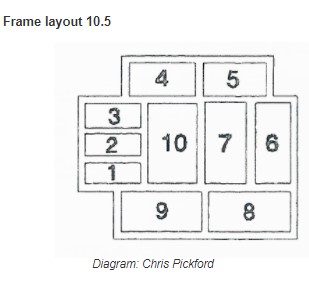
The frame layout.