Staindrop, St Mary 8: 15-0-21 in F# MAP
 Ringing:
Sunday: 09:40 to 10:00
Church History
The church of St. Mary, formerly St Gregory, was originally founded in the late Anglo-Saxon or early Norman period. The church is still contains some fragments of Anglo-Saxon carved stones and some important monumental effigies. An Anglo-Saxon sundial is built into the chancel. What were thought to be traces of the original nave of 10th or 11th century date can be seen, though recently it has been argued convincingly that they are early-Norman.
In the medieval period the church was attached to a college, founded here in 1408 by Ralph, Earl of Westmorland. Although the site stood to the north of the church, no remains can be seen. The church now has a tall tower. Inside, a screen in front of the chancel dates to before the Reformation, it is the only one surviving in Durham.
The village developed under the influence of the Neville family and the Vane family, whose main house was Raby Castle, just to the north of the village. The Lords of Raby were buried in splendid tombs in this church. The Neville’s in the south-west corner of the church and the Vane’s in the north-west. The Neville’s lost Raby castle following their support for the Rising of the North in 1569.
Staindrop’s contribution to the First World War effort can be traced through the memorials of the village; the majority of which can be found within St. Mary’s Church. Plaques and a book of remembrance commemorate those of the village who served and fell in the conflict whilst additional plaques and a roll of honour provide details of those who served during WW2. E
Source: http://www.keystothepast.info/article/10339/Site-Details?PRN=D6888
A history of the church, with images can be found on the church’s website


The church, looking east and then west. Source
The Bells
In 1552 there were three bells at the Church as mentioned in the King’s Commissioners’ reports. The commissioners were appointed to make inquiry respecting church goods and ornaments of all manner of ‘goodes, plate, juells, vestyments, bells and other ornyments within every paryshe belonging or in any wyse apperteying to any churche, chapell, brotherhed, gylde or fraternytye within this our realme of Englond’.
The declared intention of this commission was to stop all private embezzlement of church goods in the wake of the dissolution of the monasteries and to ensure their preservation for church use. The following year, however, another commission directed the seizure of these valuables, ‘for as muche as the King’s Majestie had neede presently of a masse of mooney’, with only the barest essentials being left for the use of each parish church. All plate was to be sent to the Jewel House in the Tower of London to be melted down, and jewels were likewise to be delivered there. Any money arising from goods sold locally was to be sent to Sir Edmund Peckham, the treasurer of the Mint.
This process was reversed by Mary (1553-58) who ordered the return of most of the plate to the churches and appointed a commission to review the disposal of all church and chantry goods taken and inventoried since 1545 and of all property and goods belonging to religious houses which had fallen to the Crown since 1536. Exchanges of land and sales of wood were also to be investigated.
The next information on the bells is that in 1631, a bellfounder called Humphrey Keene from Woodstock in Oxfordshire cast two new bells. That year Humphrey Keene also attempted to tune the “Galilee bell” at Durham Cathedral but only succeeded in cracking it.
In 1685 Samuel Smith I of York cast five new bells the heaviest of which was weighed in at 13cwt. 2qrs. 25lbs.
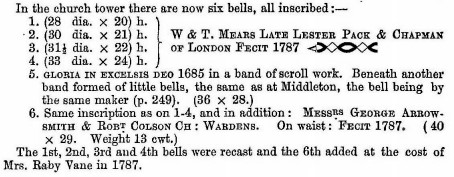
In 1787 William & Thomas Mears of the Whitechapel foundry in London turned the ring of five into a six by casting five new bells and using the old 4th. of the five as the 5th. of the new ring of six. All of the W. & T. Mears bells had mention that the foundry was of the late Lester Pack & Chapman who were the previous founders at Whitechapel.
This was reported thus:

Ringing on the bells is reported in 1842:
On Easter Tuesday the Darlington St. Cuthbert Youths Society of Change Ringers paid a visit Staindrop and rang on the fine peal of six bells in the tower of the ancient Parish Church 2160 changes consisting of Grandsire Bob, Oxford Single Bob, and College Single Bob; which were beautifully struck and scientifically brought round in 1 hour and 20 minutes. Weight of tenor 14 cwt. (Durham Advertiser, Fri. 1 April 1842).
Thomas Mallaby of Masham placed an advertisement in the booklet “Double Norwich Court Bob Major” by Jasper Snowdon in 1874 stating that he had done some work at Staindrop. This is confirmed by this article:
“The fine ring of six bells in this church, which for some time have been out of order, have lately been rehung with new frame and fittings by Mr. Mallaby, Masham, Yorks. As the bells were finished in Lent, and change ringing so little known in this county, no particular opening took place. The tenor is 14 cwt. in G. All the bells except the fifth were east in 1767 [sic – recte 1787] by Chapman, London. The fifth bears date 1680, and was cast by Sellars of York.— Per Letter. (Church Bells, 23 May 1874 p.295)”
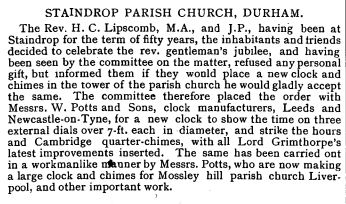
A chiming clock was added in 1896. it being reported in Bell News in their edition of October 31st:
The ring was recast and two trebles added by Taylors of Loughborough in 1925 and the ring hung in a new frame, of cast iron and layout 8.3. They are a good ring of bells. This was noted in The Ringing World of February 20th 1925, in an article about the death of a long-time ringer at Staindrop, Daniel Shipp:
There is to be a new frame and new peal of eight installed and dedicated on Palm Sunday by the Lord Bishop of Durham. They will be rung for the first time on Easter Day. This new frame and peal of eight are by Messrs. Taylor and Co., Loughborough.
The bells were actually cast thus
- 4th December 1924 – bell 6 – one of the old bells being used in the casting. Bell is dated 1925
- 11th December 1924 – bell 7
- 18th December 1924 (first heat) – bells 4 and 5, also dated 1925
- 18th December 1924 (second heat) – bells 3 and 8, also dated 1925
- 17th February 1925 – bells 1 and 2
The opening of the bells was noted in The Ringing World of April 3rd 1925:
STAINDROP, COUNTY DURHAM (2 miles from Winston, L .N .E .R . Station).— By the courtesy of the Vicar (Rev. H. S. C. Spurrier, M .A .), the new peal of eight (tenor 15¼ cwt.) will be available on Easter Monday, April 13th, to all ringers. A bus will meet the 10.11 and 10.29 trains from the north at Bank Top Station, Darlington, and another will leave the Turk’s Head,
Bondgate, Darlington, at 10.30 a.m. Fares 1s. single, 2s. return. The buses will return at any time after 6 p.m. to suit ringers. Cheap fares are usually available to Darlington on Mondays. The ” United ’” bus leaves Bishop Auckland for Staindrop (Route 18) at 10.35 and 2.35 p.m., and returns at 4.52 p.m. Dinner will be provided, 2s. 6d. each, at the King’s Arms, 12.30 to 1 p.m., for all those who notify me by the 7th of April.— Mr. H.Shipp, 6, Duke Street, Staindrop, near Darlington.
Taylors Daybook Daybook on 2nd April 1925 notes “Recasting and rehanging the six bells and two trebles to complete the ring of eight, £377, extra for frame for eight £40, Old bells 4-3-5, 5-2-24, 6-0-18, 6-3-25, 10-2-24, 13-2-25 (total 48-0-9), recast bells 4-2-9, 5-1-13, 6-1-21, 7-2-4, 9-3-7, 15-0-21 (48-3-19), two trebles 4-1-5, 4-2-0 (total 8-3-5), total cost £851.10.3.”
The bells remain in the frame of 1925 and none have been subsequently turned.
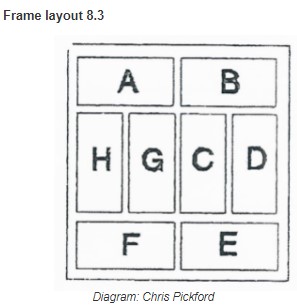
The frame layout
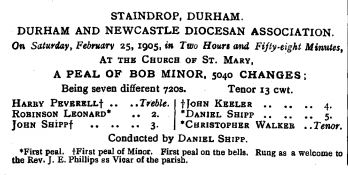
I rang my first peal here in 1982, so these bells have a fond memory for me! The first peal on the bells themselves was on the previous ring of six in February 1905. The report of this peal in “Bell News and Ringers’ Record” is:
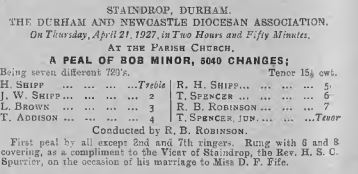
The first peal on the new bells was actually rung on in April of 1927. It was Plain Bob Minor with bells 6 & 8 covering; something that would be frowned upon today. The peal report in “The Ringing World” is:
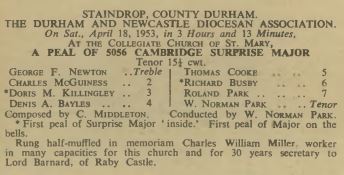
The first “proper” 8-bell peal took over a quarter of a century to be rung:
- 4-1-5 26.00″ 1925 John Taylor & Co 1442.5Hz F#-44c
- 4-2-0 27.06″ 1925 John Taylor & Co 1361.0Hz E#-45c
- 4-2-9 27.94″ 1925 John Taylor & Co 1214.0Hz D-43c
- 5-1-13 30.06″ 1925 John Taylor & Co 1081.0Hz C#-44c
- 6-1-21 32.50″ 1925 John Taylor & Co 963.0Hz B-44c
- 7-2-4 34.56″ 1925 John Taylor & Co 908.0Hz A#-46c
- 9-3-7 38.06″ 1925 John Taylor & Co 808.0Hz G#-48c
- 15-0-21 43.19″ 1925 John Taylor & Co 722.0Hz F#-43c
Inscriptions
- TREBLE AND SECOND BELLS / ADDED TO COMPLETE THE PEAL
- Taylor foundry mark
- W & T MEARS LATE LESTER PACK & CHAPMAN OF LONDON FECIT 1787
RECAST 1925
Taylor foundry mark - W & T MEARS LATE LESTER PACK & CHAPMAN OF LONDON FECIT 1787
RECAST 1925 - W & T MEARS LATE LESTER PACK & CHAPMAN OF LONDON FECIT 1787
RECAST 1925 - W & T MEARS LATE LESTER PACK & CHAPMAN OF LONDON FECIT 1787
RECAST 1925 - GLORIA IN EXCELSIS DEO 1685
RECAST 1925, - H.S.C. SPURRIER M.A.H.C.F VICAR
VALENTINE HODGSON
THOMAS RICHARDSON
JAMES WILLIAMS – CHURCHWARDENS
THOMAS G. FRANKTON HON. SEC.
19 (Taylors mark) 24
The Previous Ring
1 4-3-5 1767 W & T Mears, Whitechapel
2 5-2-24 1767 W & T Mears, Whitechapel
3 6-0-18 1767 W & T Mears, Whitechapel
4 6-3-25 1767 W & T Mears, Whitechapel
5 10-2-24 1685 Samuel Smith I, York
6 13-2-25 1767 W & T Mears, Whitechapel
(Scrapping weights)
The inscriptions are confirmed in the report of “The Newcastle Society of Antiquaries”, published on 26/5/1890: