Ryton, Holy Cross 8: 13-3-18 in E MAP
 Ringing:
Sunday: 09:30 to 10:00.
Practice: Wednesday 19:00 to 20:30.
Church History
The church was completed around 1220, built on the ‘bailey’ of a motte and bailey castle which had guarded the tidal ford across the River Tyne. This strategic position on the river was most likely the reason for a significant settlement developing here in the early middle ages. The church is Grade I Listed. The Churchyard contains Grade II listed table tombs and lamp posts, and the motte is a Scheduled Ancient Monument.
The architectural style of Holy Cross is ‘Early English’. The Nave and Aisles are in four bays, the columns and arches being the original build in good quality sandstone. The fourth bay is the base of the tower which unusually is internal to the oblong of Nave and Aisles. The upper tier of the tower and the lead-clad broach spire, a prominent feature of the Tyne Valley landscape for miles around, were added in about 1360 when the height of the aisle walls was increased. The Nave opens into a substantial Chancel, also 1220, seen through the oak pre-Civil War Chancel Screen.
The only extension to the building took place in 1886, with the addition of a large Organ Chamber and two Vestries, to the north of the Chancel. There are three burial vaults under the Chancel, long since sealed. Most of the window openings have been rebuilt at various stages, though original ‘single lancet’ openings remain in the West wall and in the South wall of the Chancel.
Significant items and furnishings include the following.
- A Frosterley marble effigy, 1310, probably of Alan de Easingwold the fourth Rector.
- A Chancel Screen in oak, pre-English Civil War, a rare survivor.
- An exceptional Holy Table gifted by the then Rector in 1852.
The Victorian restoration, completed in 1886, was achieved to the highest standard of craftsmanship, resulting in the following legacy:
- A really fine listed Lewis Organ
- East Window by Charles Kempe
- Chancel barrel vault,
- Intricately carved oak Pulpit and Reredos with Limewood reliefs and statues
- An extraordinarily bold spiral staircase to the ringing room, and
- A full set of very fine oak pews with heavy relief carvings to the aisle ends, some removed to make space for contemporary liturgical needs.
Source: http://www.holycrossryton.org.uk/heritage/architectural-features/

The interior of the church.
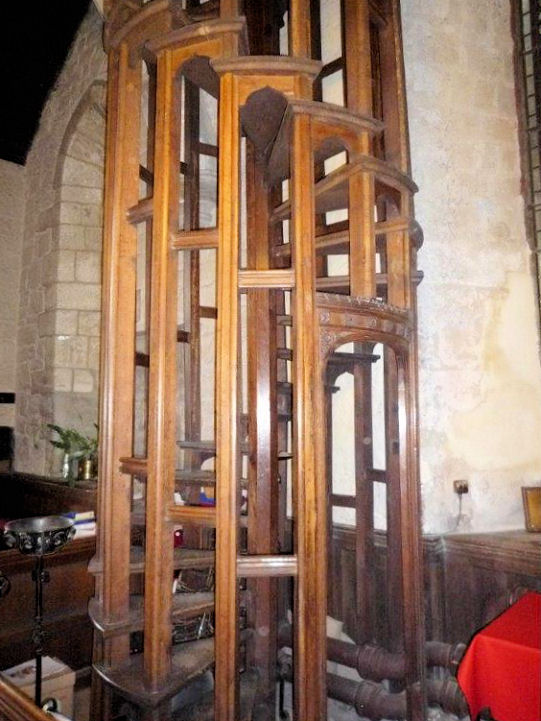
The stairs to the ringing chamber. Source: Bill Henderson
The Bells
Until 1999, these were an unringable ring of 3, with present tenor of 8 additionally hung dead on a beam. Details of these bells are given in the report of The Newcastle Society of Antiquaries on 25/1/1888:
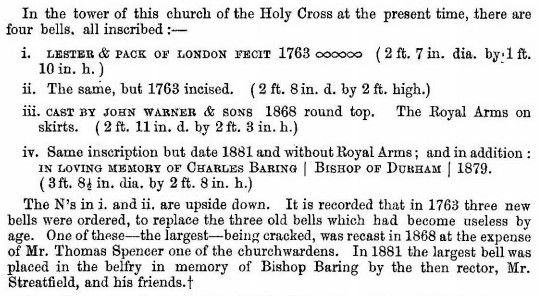
These bells were hung for ringing in a metal frame by Fred Pembleton and three trebles and the “missing” 7th cast by Taylors to complete the octave.
The following appeared in The Ringing World of July 25th 1997:
“Ryton news
The parish of Holy Cross, Ryton (Gateshead) currently has part of a ringing peal hung in the church tower. The four bells form numbers 3, 4, 5 and 8 of an octave and sound out the Westminster Chimes. Three of these are already hung for full-circle ringing but due to the dangerous condition of the frame they have not been rung since 1915.
Tom Jamieson, Rector of Ryton and ringer at Newcastle Cathedral, is hoping to restore and augment the ring to the full octave for the Millennium. The Appeal for the bells was formally launched by the Mayor of Gateshead, and was well attended by parishioners. Tom had set up numerous displays of model bells, ringing artefacts and plans for the new installation and these generated a lot of interest. The President of the Durham & Newcastle D.A. and other Officers and local ringers supported the event. Newbum ringers (across the Tyne) have generously agreed to allow Tom to teach his band on their bells so they will be able to ring straight away when their own bells are ready. Ten parishioners are now learning to handle, with six of them making very rapid progress. The project, when completed, will provide another ring for the Central District of the D&N with an anticipated tenor weight of approximately 15cwt.”
Then, on November 13th 1998:
“Most reports about the millennium project relate to fund raising and work on the bell installations.
At Ryton, Tyne & Wear, arrangements for the removal of the three derelict bells hung for ringing and one hung dead, and extensive work in the tower are in the planning stage under the supervision of David Higdon, an architect living next to the church in the grade two listed Old Rectory. Equally important to record is the progress of the band of potential ringers. Under the leadership of Rector Tom Jamieson (previously a ringer at Newcastle Cathedral) nine adult ringers (including the architect) practise weekly at Newburn and are making good progress. Six Ryton ringers became members of the D&N in 1997.
One of the ringers, Tracy Charlton, learned to handle a bell at Blaydon some 12 years ago and now living in Ryton responded to the request for ringers in anticipation of the Millennium Ring. She has made good progress and was invited to ring her first quarter for the Licensing of the Rector of Blaydon. The Ryton ringers held a practice at Blaydon the previous week and during the period of the practice the Rector designate was speaking to a friend in Washington DC and put the telephone out of the window so that the bells could be heard in Washington. The ringing was recorded in Washington and played the following Sunday as a link with the Licensing. Surely a first – Blaydon bells and a Millennium Band without its own bells being heard in America! N.A.J.”
See http://www.holycrossryton.org.uk/heritage/millennium-bells/
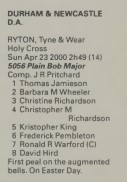
The first peal on the bells was Plain Bob Major on 23rd April 2000:
1 4-1-24 26.75″ 1999 John Taylor Bellfounders Ltd 1346.0Hz E+36c
2 4-1-27 27.38″ 1999 John Taylor Bellfounders Ltd 1271.0Hz D#+36c
3 5-0-1 28.63″ 1999 John Taylor Bellfounders Ltd 1128.0Hz C#+30c
4 5-2-2 30.88″ 1763 Lester & Pack 1011.0Hz B+40c
5 6-1-0 32.88″ 1763 Lester & Pack 902.0Hz A+43c
6 7-0-24 35.88″ 1868 John Warner & Sons 849.0Hz G#+38c
7 12-0-0 39.63″ 1999 John Taylor Bellfounders Ltd 756.0Hz F#+37c
8 13-3-18 42.88″ 1881 John Warner & Sons 674.0Hz E+38c
Inscriptions
The Taylor bells all have the Millenium Badge cast on them.
1. FOR EACH / GENERATION OF / YOUNG PEOPLE / RYTON / COMPREHENSIVE / SCHOOL,
2. IN LOVING MEMORY / OF / JANET RENTON YATES / 1904-1997 / ALBERT YEATS / 1904-1983,
3. Millenium Badge
4. LESTER & PACK FECIT 1763
5. LESTER & PACK FECIT 1763
6. CAST BY JOHN WARNER & SONS 1868
7. DIANA ELIZABETH FURSDON / ERNEST WILLIAM DUNN / CHURCHWARDENS / IN THE YEAR / THE MILLENNIUM BELLS / WERE CAST
8. IN LOVING MEMORY OF CHARLES BEARING / BISHOP OF DURHAM / 1879