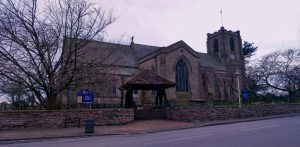
 Hurworth, All Saints 6: 16-3-15 in F MAP

Ringing:
Sunday: 10:00 to 10:30.
Practice: Thursday 19:30 to 21:00.
Church History
The village had certainly been founded by the late Anglo-Saxon period as the village takes it name from the Old English for ‘farmstead enclosed by hurdles’. There was certainly a church here by the 9th century. Fragments of at least two 9th century stone carvings have been found in the churchyard.
Source: http://www.keystothepast.info/article/10339/Site-Details?PRN=D6839
The church is Grade II listed and its listing tells us:
The parish church has a partly medieval nave arcade; refaced, a possibly 15th century tower, heightened 1845. It was largely rebuilt in 1831-2 by T. Tibbetts. The nave aisles were added and the tower repaired and heightened in 1845/6. The transepts and chancel aisles were added and the church was restored in 1870 by J.P. Pritchett. The church is built from tooled dressed sandstone, with graduated green slate roofs. It is “cruciform” with aisles and a west tower; a chapel on north aisle and a porch on the south aisle. It is built in the “Geometrical” and “Decorated” styles.
The angle-buttressed, 4-stage tower has three 15th century shields on the west side, a stair turret on the north, There are pointed 2-light bell openings and embattled parapet with corner pinnacles. The 4-bay nave has steep roof. The 2-bay north aisle and projecting chapel at east have windows with Decorated tracery, parapets and low-pitched roofs. There is a similar 4-bay south aisle with buttressed bays and gabled porch. There are taller, diagonally-buttressed, transepts with Geometrical-tracery windows, parapets and low-pitched roofs. There is a tall 3-bay chancel, with aisles on west and centre bays, has elaborate detailing and Geometrical-tracery windows; the chancel has steep roof with iron crest on ridge; low pent aisle roofs.
The Nave has alternating round and octagonal piers supporting 4 chamfered pointed arches; a mid-height floor was inserted into the 3 west bays in 1985. There are 2 mutilated recumbent effigies of knights in niches at west end (one is possibly Robert Fitzwilliam, who died in 1316; the other with cylindrical helmet). There is an aedicular wall monument to James Bland, died 1769. There are pointed arches into the transepts. The chancel is elaborately-detailed: with an arch of 2 roll-moulded orders; enriched 2-bay aisle arcades, with pointed arches on compound piers, and identical single arches on west returns of aisles facing transepts. Arch-braced roof trusses can be found in the nave and chancel. There are rear arches with detached colonnettes, a pointed piscina, a 3-arch sedilia and and encaustic-tiled floor. The Crucifixion east window of 1865 is by Wailes. There is a small pre-Conquest cross shaft fragment, with interlace, in the porch.
Source: https://historicengland.org.uk/listing/the-list/list-entry/1299450
The Bells
These are a complete ring of six which were cast by Taylors of Loughborough in 1872. The inscription on the tenor shows that they were given to the church by Lucy Jane Collings in memory of her husband, Thomas. Taylor’s Daybook 3 on p.113 notes – “27 July 1872. Mrs Colling. Hurworth on Tees, near Darlington/ To new peal of six bells for All Saints, Hurworth on Tees, 1. 5-3-9, 2. 6-1-21, 3. 7-3-13, 4. 9-0-23, 5. 11-2-8, 6. 17-2-0, total 58-1-18 £429.6.4½. Inscriptions 150 letters £1.17.6, clappers 25s each £7.10.0., Hangings £6.10s each £39, Oak frame £60, Ropes 10s each £3, carriage & fixing £25.0.0., total £565.13.10½”. Settled 2 August 1872”. (The weight of the 5th was later altered to 12-2-8)
There were canons on all the bells, except the two tenors. Bells 4, 5 and tenor cast 15 May 1872, and 1, 2 and 3 cast 11 June. The wooden frame was Pickford Plan 6.4, with all the bells swing north to south. Bells 6, 1 and 2 were on the north side and 3, 4 and 5 on the south.
The dedication of the bells was reported in the magazine “Church Bells” on August 17th 1872:
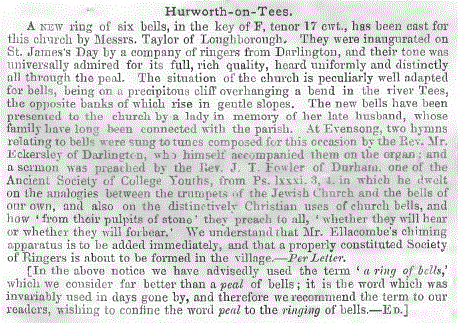
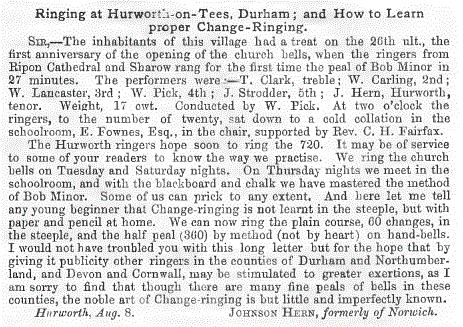
A local band was started immediately and their progress was reported in the same magazine one year later:
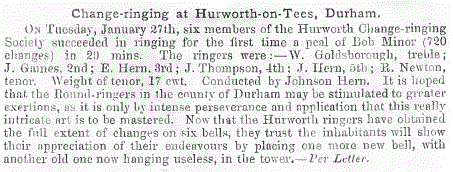
By January 1874 the local band was able to ring their first 720, reported in the edition of February 14th
There is an indication in the records of Taylors that the fifth required recasting in 1877 – “a new bell cast 16 Oct 1877”. However, the invoice for the work is not in the daybooks.
The Society of Antiquaries of Newcastle reported in 1888:
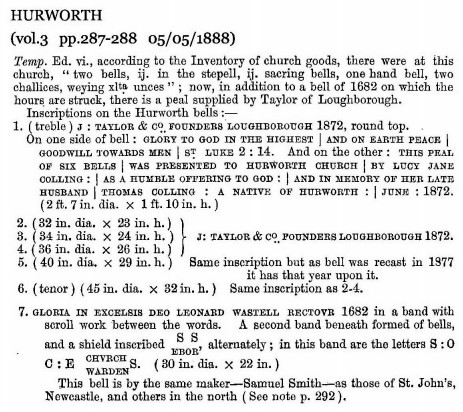
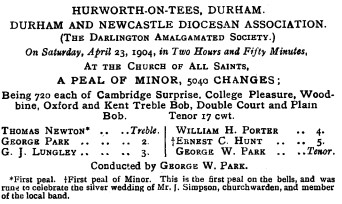
The first peal on the bells was not rung until April 1904, and was reported in “Bell News and Ringers’ Record” thus:
The notebook of Frederick E. Collins, who worked for Gillett & Johnston between 1926 and 1936 has this entry – March 1931. Hurworth-on-Tees, Co Durham. Rehang peal of 6, on ball bearings, existing wood stocks, and frame. Re-bush rollers and clapper tops, refix and re-wire Westminster Quarter clock hammers – 8 hour. Tenor -17 cwt.
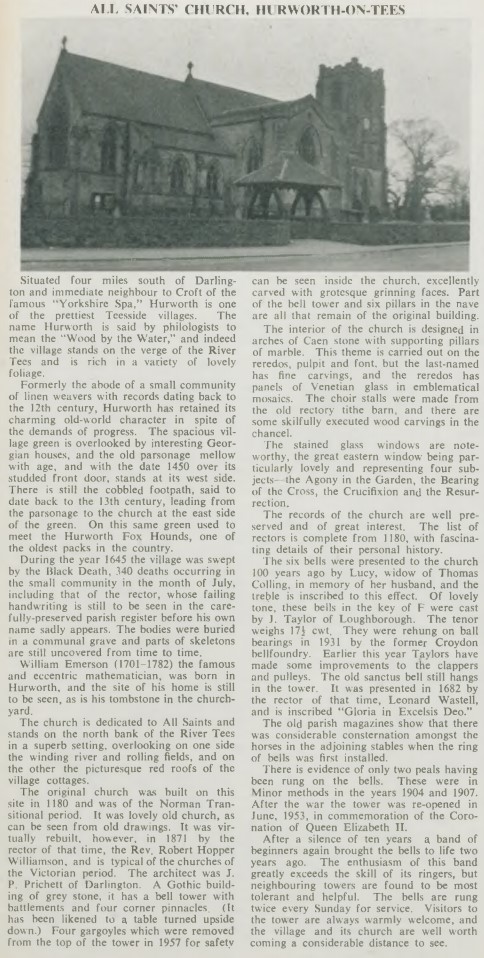
The church was featured in an article on August 27th 1971 that was published in The Ringing World. From this article we find that the bells were presented to the church by Lucy, widow of Thomas Colling.
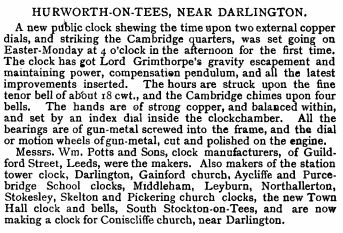
A chiming clock was added to the church in 1892 and reported in Bell News on April 23rd that year:
The restoration by by Fred Pembleton in 1997, sub-contracting the retuning to Taylors, is reported in The Ringing World of Feburary 6th 1998. At this time the bells were were tuned. The tenor was previously was quoted as being 17-0-2. The canons have been removed from the bells, probably at the earlier restoration, hence the difference in weight with the 1872 value.
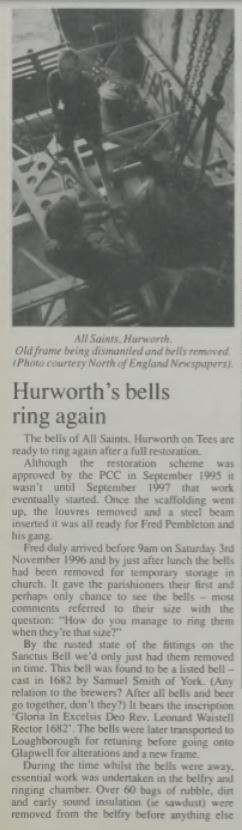
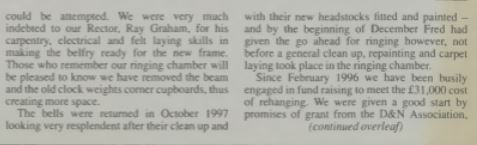
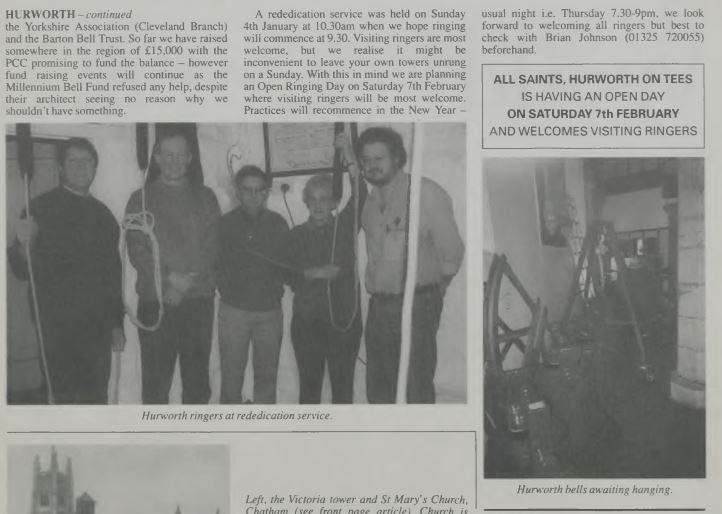
Note that is was pointed out later that Hurworth had already started their work before asking about a grant and therefore could not qualify for a Millennium Fund grant.
1 5-1-27 30.38″ 1872 John Taylor & Co 1176.0Hz D+2c (5-3-9)
2 6-0-16 32.88″ 1872 John Taylor & Co 1048.0Hz C+2c (6-1-21)
3 7-0-24 34.50″ 1872 John Taylor & Co 933.0Hz Bb+1c (7-3-13)
4 8-2-18 36.63″ 1872 John Taylor & Co 882.0Hz A+4c (9-0-23)
5 12-0-0 40.00″ 1877 John Taylor & Co 785.0Hz G+2c (12-2-8)
6 16-3-15 45.38″ 1872 John Taylor & Co 696.0Hz F-6c (17-2-8 in F#)
(The figures in brackets are the 1872 weights)
Inscriptions
All are inscribed: “J. TAYLOR & CO FOUNDERS 1872. The treble bell has in addition:
GLORY TO GO IN THE HIGHEST AND ON EARTH PEACE GOODWILL TOWARDS MEN. ST LUKE 2: 15
and on the other side:
THIS PEAL OF SIX BELLS WAS PRESENTED BY LUCY JANE COLLINGS AS A HUMBLE OFFERING TO GOD AND IN MEMORY OF HER LATE HUSBAND THOMAS COLLING: A NATIVE OF HURWORTH
There is also a Sanctus Bell, diamater 29.38″, a listed bell of 1682 which was cast by Samuel Smith I it is inscribed:
GLORIA IN EXCELSIS DEO LEONARD WASTELL RECTOR
S O C CHURCHWARDENS