Houghton-le-Spring, St Michael 8: 12-0-0 in G MAP

Ringing:
No Regular Ringing
Church History
St Michael’s is composed of a late 12th and early 13th century chancel, with a primarily 14th century nave, to which has been added 19th century aisles. There are two vestries; one 15th century, and a second 19th century version. The building is of sandstone, topped with a roof of slate from Westmorland.
The first Christian church here dates to the late Saxon period. The original Saxon doorway with its carved tympanum can be viewed through a glass panel set into the floor of the church. The first Saxon/Norman church was destroyed by Scots under Black Douglas in 1318/19. The church was rebuilt, much of it on the original foundations.
Another interesting window is on the north wall, near the servery, where one panel shows Jesus wearing what appears to be a stetson, or cowboy hat!
The font is Norman, the choir stalls Victorian, and there is a small Norman window in the chancel. Also in the chancel is a curious carving of intertwined serpents known as the Houghton Beasts or Houghton Dragons. This carving is probably older than the church and was brought here from someplace else. There is a small consecration cross on the north wall, while on the south wall is the tomb of Marjorie Bellasis, a friend of Bernard Gilpin.
In the south transept, also known as the Gilpin Transept, is Gilpin’s table tomb. This was originally set before the high altar. Beside the tomb are a pair of small tombstones known locally as ‘the twins’. These were brought inside the church from their original place in the graveyard and commemorate a pair of local girls who died young. Also in the south transept are a pair of knight’s effigies. One is Sir John le Spring, the other is Sir Roland Bellasis, who fought for Henry III at the Battle of Lewes in 1264.
The west window is known as the Gilpin Window, for the stained glass panels illustrate scenes from the life of Houghton’s most famous rector. Here you will see depictions of Gilpin founding Kepier School, feeding the poor, preaching in remote areas of Northumberland, and offering his horse to a woman whose own horse had died.
Church renovations in 2008 revealed that large whinstone boulders lay under the church floor. Currently accepted theory is that these boulders formed part of an ancient stone circle or burial cairn, suggesting that perhaps St Michael’s was built on a site that already had deep religious or ceremonial significance to the local inhabitants. Further excavation under the tower revealed very large Roman stones, perhaps originally part of a temple or other civic building. Though the presence of the stones is not conclusive, it does suggest that the site was in use for thousands of years, and had a special significance, such that it was used in turn by several different religions and cultures.
Excavations under the church also revealed large numbers of bones, originally contained in a series of brick and stone vaults. A Norman south doorway and threshold stone were also rediscovered. One of the most interesting features was evidence of fire. This suggests that there is some truth to the theory that St Michael’s was burned by James Douglas (‘Black Douglas’, or ‘guid Sir James’ to the Scots) who ravaged the region on a raid towards Hartlepool in 1319.
Known as the Apostle of the North, and the Father of the Poor, Gilpin is Houghton-le-Spring’s most famous resident. Gilpin was a native of Westmoreland, raised at Kentmere Hall, near Kendal. A nephew of Cuthbert Tunstall, Bishop of Durham, Gilpin was educated at Kendal and Queen’s College, Oxford. Originally a strong adherent to traditional Catholicism, Gilpin seems to have undergone a conversion to the new Protestant teachings. His future seemed secured when, in 1552 he preached a sermon before Edward VI at Greenwich. He became an active campaigner against abuses by church officials in Durham Diocese, and as a result was accused by those same officials of theological heresy. The charges were dismissed as being more likely brought about by malice than by any theological malfeasance.
Gilpin was appointed rector of Houghton le Spring in 1557 or 1558, at a time when Houghton was one of the largest parishes in all of England, including 16 villages and covering 24 square miles. He served the parish from 1557 to his death in a curious accident in 1583. At a time when many northern parishes were in the hands of absentee rectors, Gilpin was famed for his generosity and care for not only the people of his own parish, but for the wider community. He was known to ride far and wide to preach in places where most inhabitants had never seen a priest before. Stories abound of his generosity, including one famous episode where he is said to have given his horse to a local woman whose own animal had died just when it was needed for ploughing the fields.
Source: https://www.britainexpress.com/counties/tyneside/churches/Houghton-le-Spring.htm
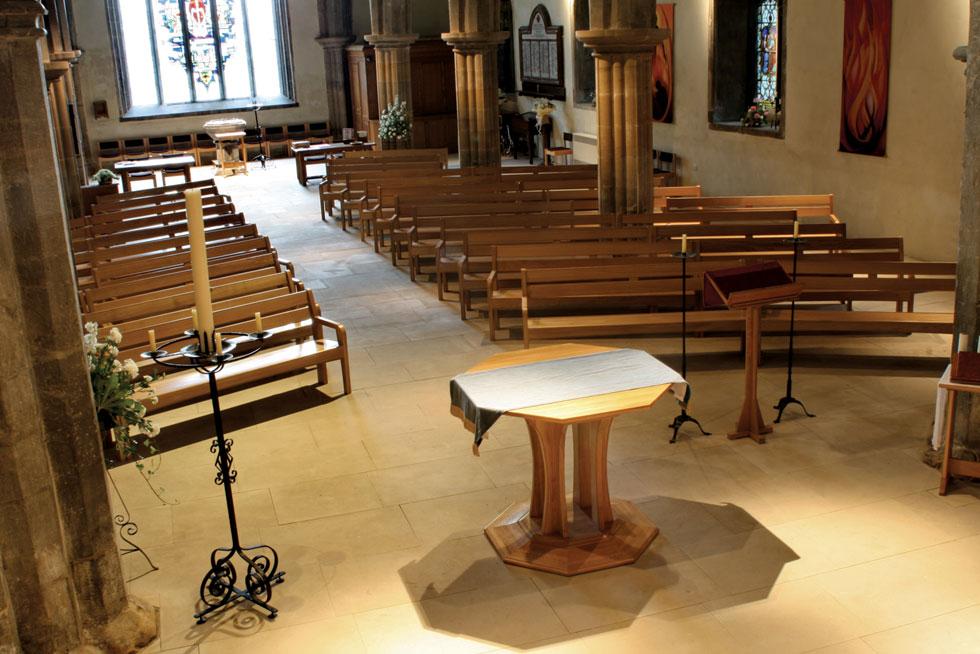
The interior. Source: Treske Church Furniture
The correct pronunciation of “Houghton” is in 2 syllables, “Hoe-ton” (or “Hoe-tonne” if you are metric!), with a soft “t”.
There is a good article about this church on the Fabulous North website
The Bells
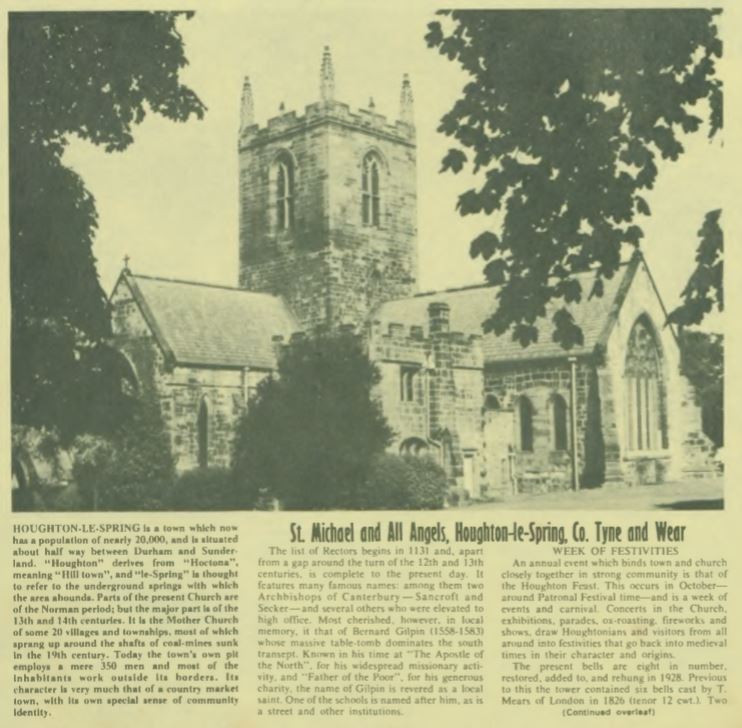
This ring is based on a compete ring of 6 that were cast by Thomas Mears II of Whitechapel in 1826. Before 1826 there were five bells. The earliest records refer to three bells in 1553. Numerous entries can be found in the old accounts related to the bells – e.g. payments for ringing for special occasions, for new ropes, for grease and “swine seam”, etc. In 1615 Robert Oldfield, bell-founder, was paid £14 for casting the “little bell”, and in 1676 £40 was paid to a founder for casting the “great bell”. It seems that these were the two bells added to the old three to make the five found in the tower before 1826.
The Bell News of July 4th reports a visit by the local Association, noting that the bells could do with a little work on them.
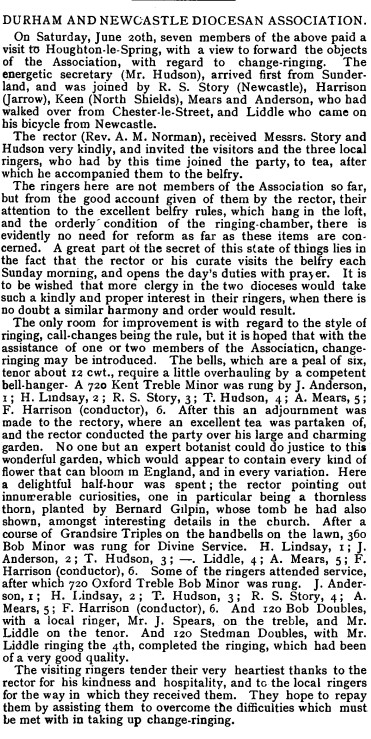
The Ringing World reports on December 26th 1919, that the bells were rehung and quarter-turned in 1919. However, by 1928 Gillett & Johnson were required to rehang the bells, this time in a new cast iron frame. They also retuned the bells and added two trebles to complete the octave. The Mears bells have had their canons removed, the Gillett bells being cast with flat tops.
In The Ringing World of December 26th 1919 it is reported:
HOUGHTON BELLS REHUNG.
At Houghton, Durham, the bells have just been rehung and quarter-turned, and are running well. On November 30th, for evening service. the first 720 Plain Bob Minor by a local band was rung. Mr. R. Parkinson, who hails from Chorley. Lancashire, being conductor: J. Spearman 1, T. Masters 2. S. Robinson 3, R. Parkinson 4. .T. Masters 5, A. Spearman 6.
In The Ringing World of March 9th 1928 there was a report of the “All England Gathering” that had taken place at the Croydon foundry. Houghton’s bells were there at the time, being worked on, the report states:
“……, there were other activities in the foundry. The back six of the Houghton-le-Spring peal (having false harmonics) were run, followed by six bells of similar weight and pitch from the Rochester carillon, with accurate five-tone harmonic tuning, by way of contrast: and the marked difference in the effect must have made an impression upon any who were wavering in their opinions.”
The edition of March 30th 1928 carried this notice:
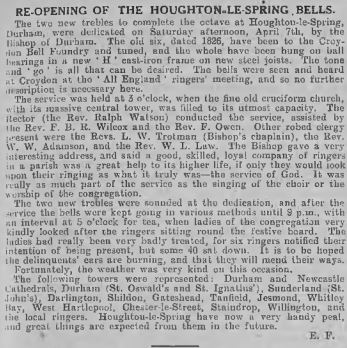
DURHAM AND NEWCASTLE DIOCESAN ASSOCIATION .— Houghton-le-Spring.— The Lord Bishop of Durham will dedicate the two new trebles at Houghton-le-Spring on Easter Eve, April 7th, at 3 o’clock. The local ringers will ring at the dedication; after the service bells will be open to all ringers. Tea will be provided in the J Kiepier School at 5 p.m., 1/6 (7½p) per head, to those who notify Mr. R. Artingson, North View Terrace, Fencehouses by Tuesday, April 3rd.— E. Ferry, Hon. Sec.
The edition of April 27th 1928 reported the dedication:
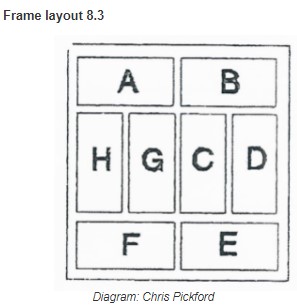
The frame is a standard one in cast iron, layout 8.3 and truss 8.3.C.e – an “H-frame”.
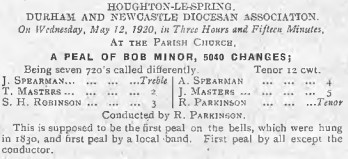
The first peal on the bells was rung on 12th May 1920 and was reported in The Ringing World thus:
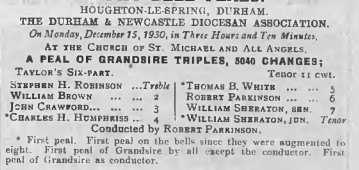
Three peals were rung on the six, the first peal on the eight was rung on 15th December 1930:
A note in The Ringing World of March 25th 1955 tells us that the bells were silent for about a year from October 1954 due to issues with the tower’s movement and a leaning parapet that needed to be dealt with.
The way up the the ringing chamber is unusual – as reported in The Ringing World of August 25th 1944, the ground floor entrance is “round the back” of the church, where the north transept and chancel meet:
The central tower of St. Michael’s, Houghton-le-Spring, Durham, has, like many other similar towers, no direct ascent to the ringing chamber and belfry. It is thus described : ‘ A short flight of stone steps leads to a small square stone platform. From this, entry is made to a spiral staircase, which is situate in the angle formed by the north and east wings of the church. This stairway is very steep and narrow, consisting of some 35 steps. These steps appear to be of some age, being very much worn. The staircase terminates with a door opening directly on to the chancel roof, which at this point is fairly narrow. A wooden cat-ladder with a hand-rail is laid up the roof, giving access-from the spiral stairway to the ringing room, which is entered through a door let into the north-east corner of the tower. The ringing chamber is fairly lofty, and a wooden staircase leads up to a trapdoor, through which one enters the clock room, and a further wooden ladder leads up to the bells.
Houghton was the featured tower in The Ringing World of December 8th 1978:
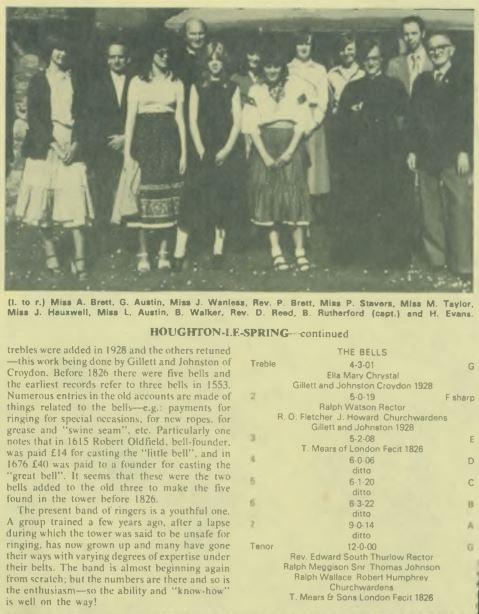
1 4-3-21 26.50″ 1928 Gillett & Johnston 1536.0Hz G-36c
2 5-0-19 27.50″ 1928 Gillett & Johnston 1440.0Hz F#-47c
3 5-2-8 30.38″ 1826 Thomas II Mears 1280.0Hz E-51c
4 6-0-6 31.88″ 1826 Thomas II Mears 1152.0Hz D-34c
5 6-1-20 33.63″ 1826 Thomas II Mears 1024.0Hz C-38c
6 6-3-22 35.00″ 1826 Thomas II Mears 960.0Hz B-49c
7 9-0-14 38.25″ 1826 Thomas II Mears 864.0Hz A-32c
8 12-0-0 42.63″ 1826 Thomas II Mears 768.0Hz G-36c
The weight of the treble is given in some places as 4-3-1.
Inscriptions
- ELLA MARY CHRYSTAL 1926
- RAPLH WATSON RECTOR
O.N. FLETCHER AND J. HOWARD. CHURCHWARDENS 1926 - T. MEARS OF LONDON FECIT 1826
- T. MEARS OF LONDON FECIT 1826
- T. MEARS OF LONDON FECIT 1826
- T. MEARS OF LONDON FECIT 1826
- T. MEARS OF LONDON FECIT 1826
- T. MEARS OF LONDON FECIT 1826
REVD EDWD. SOUTH THURLOW RECTOR
RALPH MEGGISON
THOMAS JOHNSON CHURCHWARDENS
RALPH WALLACE
ROBT HUMPHREY

Source: Church Website