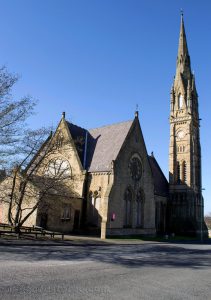
 Hebburn, Wat Phra Dhammakaya Meditation Centre (Formerly St Andrew’s URC) 6: 7-0-22 in A MAP
Ringing:
No Regular Ringing
Nearest Metro Station: Hebburn
Church History
This building was built as a Presbyterian church, which became part of the United Reformed Church when the Presbyterian and Congregational churches merged in 1972.
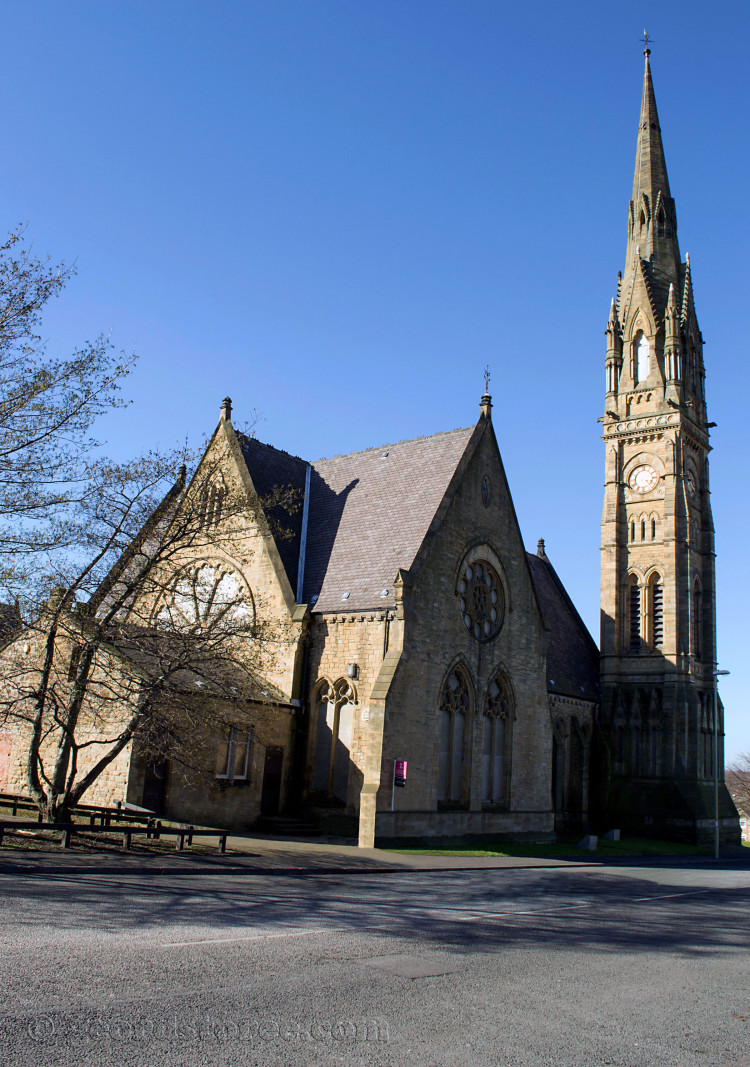
It was built 1870-3 by R J Johnson of Newcastle, with coursed sandstone rubble and Welsh slate roofs. It has a Nave and transepts; west entrance porch and a north-west tower.
It is in the Decorated Gothic style. Porch has 3 crocketed gables, the central one high with bud finial and having marble shafts flanking double door; east gable has large round spoked window, both transepts have windows of 2 lights and a large 10-foiled round window over. It has a broad, 5-bay, nave.
The tower is very tall and slender and has much decoration, including tall crocketed gablets to belfry openings with marble shafts.
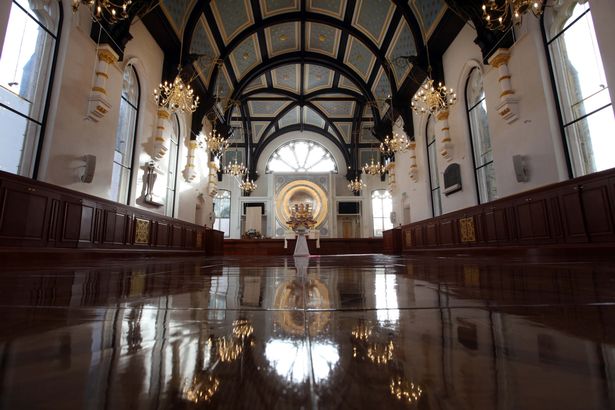
The interior has a semicircular panelled wooden ceiling rising from ornate shafted corbels.
The building was the gift of Andrew Leslie, whose shipbuilding firm dominated Hebburn in the 19th Century. It is prominent landmark at the top of the river valley.
Source: https://historicengland.org.uk/listing/the-list/list-entry/1025195
Some time after the merger, the building was closed, as it was in need of a major restoration, the congregation moving to the form Congregational church. It was bought by South Tyneside Council, who part restored the building.
The church was subsequently sold and is now leased by a Meditation Centre. They spent a reported £500,000 to bring the building back to use. These are now effectively the only ring of bells in a Buddhist building. The interior now looks like this:
The Bells
When the Council bought the building the bells were in a poor state and barely ringable. They had the bells restored. Taylors recast the back 3 of the 13cwt Warner 6 of 1872, to become the front 3 of a lighter ring. They are hung in a cast iron frame of 1986.
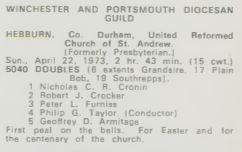
Previously, they were hung in a two-tier wooden frame that was coeval with the bells. The fittings by the time the council took over the building could perhaps be described as being “somewhat delicate”, though a peal was rung on them on 22 Apr 1973, the only peal before the restoration took place.
There is a report of an Association meeting here in The Ringing World of February 8th 1924 that states:
” …..several members proceeded by motor-bus to Hebburn Presbyterian Church. Here they were welcomed by one of the elders and three or four ringers, and after inspecting the beautiful church, the peal of six steel bells (tenor 19 cwt.) were rung in various methods. The local ringers were very interested in seeing scientific change ringing for the first time, and it is hoped that they will take it up.
While it does show that there was some ringing by local ringers here at the time, the fact that the bells were certainly not made of steel is “interesting”. They were not 19cwt either, but this was the “known” weight at the time. There was also meetings here in 1928 & 1930.
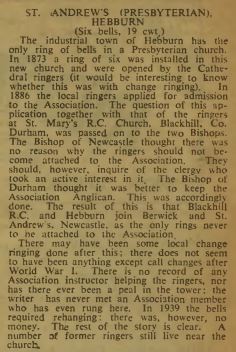
In early 1966 there was a series of articles about ringing in the area and this was said about Hebburn in the January 7th edition:
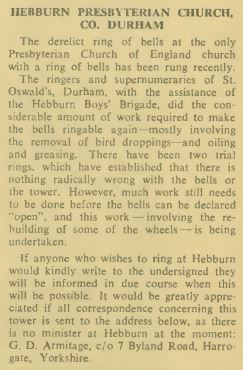
The next we hear is from the edition of August 20th 1971:
The church was featured in The Ringing World of May 4th 1973, written by the same author. It states that ringing stopped during WWII and that no ringing was then done before the 1971 work.
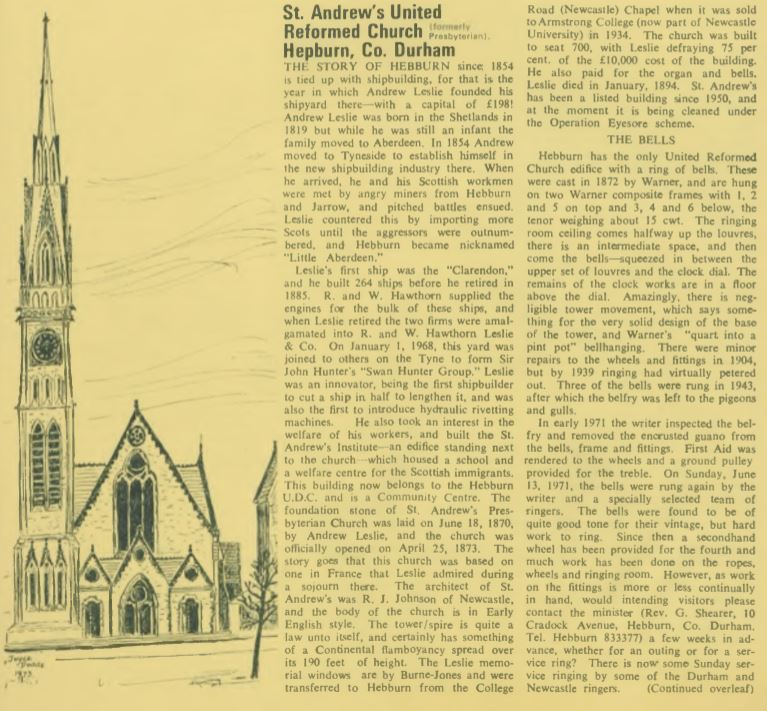
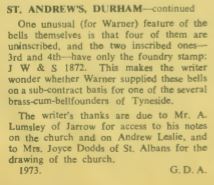
The restoration work on the bells and church was reported in The Ringing World of June 9th 1989:
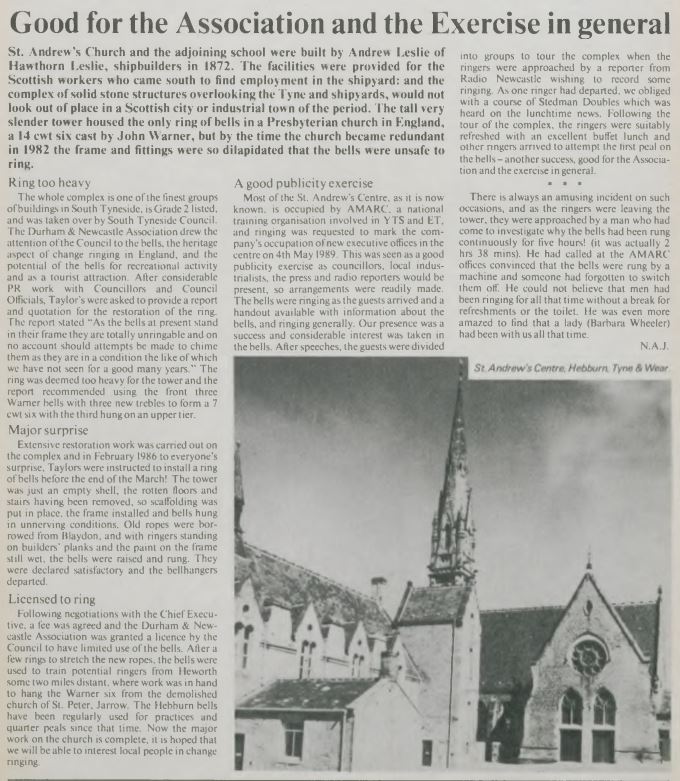
The canons were removed from the Warner bells and the Taylor bells were cast flat. The tenor of the previous ring was broken up in the tower and its exact scrapping weight was not recorded.
The first peal on the remodelled ring was rung the same year:
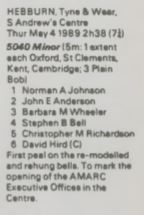
1 3-2-2 24.75″ 1986 John Taylor & Co (Bellfounders) Ltd 1466.0Hz F#-16c
2 3-3-7 25.75″ 1986 John Taylor & Co (Bellfounders) Ltd 1320.0Hz E+2c
3 4-2-18 28.25″ 1986 John Taylor & Co (Bellfounders) Ltd 1176.0Hz D+2c
4 5-3-11 31.25″ 1872 John Warner & Sons 1104.0Hz C#-7c
5 6-2-1 32.75″ 1872 John Warner & Sons 995.0Hz B+13c
6 7-0-22 34.50″ 1872 John Warner & Sons 882.0Hz A+4c
Previous Ring
The bells were inspected by Taylors in 1950, they note:
“Cast iron sides (light) to 5th and tenor. Bells 1, 2 (parallel) and 5 (transverse) in top frame. Bells 3, 4 (parallel) and tenor below”
1 6-0-24 31.25″ 1872 John Warner & Sons D
2 6-3-16 32.75″ 1872 John Warner & Sons C
3 7-2-12 34.50″ 1872 John Warner & Sons Bb
4 8-2-24 36.50″ 1872 John Warner & Sons A
5 10-2-10 40.00″ 1872 John Warner & Sons G
6 13-3-17 44.00″ 1872 John Warner & Sons F