Haughton le Skerne, St Andrew 3 Bells c.5cwt in Db
 St. Andrew’s Church is Grade 1 listed built in c.1125 and therefore of Norman origin but probably on a Saxon site, and has been at the heart of the community for more than a thousand years, making it the oldest Church in Darlington.
It is noted for 17th Century Cosin woodwork, oak-gated pews, pulpits and wall panelling, examples of which are now rare in Co. Durham. It is said to hold the best collection of early 17th century furnishing left in the county, particularly following the fire at Brancepeth.
The windows are from four architectural periods. Some Saxon stone relics are present within the church. Changes of rooflines and transept additions occurred in 1895. Look out for hatchments, the Royal Coat of Arms, the Parkinson brass (a sad story), Maundy money and the Emmaus window.
The church’s Grade I listing states:
“Circa 1100, built on site of earlier Saxon church. There is a west tower of 2 stages, an aisleless nave and chancel. It was restored and largely refenestrated in C15. The transepts, vestry and south porch were added in 1795. It is built from roughly coursed rubble with freestone quoins. Norman windows remain in chancel south wall and the west and south doorways are Norman with single – nook shafts, simple cushion capitals and heavy impost blocks. The interior has pews, pulpit and lectern dated 1662, but still largely Jacobean in style; and 6 Warder’s stalls, with more Gothic decoration, all representing the earlier style of Bishop Cosin’s patronage. Church is fully wainscoted (panelled), having naively applied classical motifs in the chancel. A rough niche to south of chancel arch is plastered and painted in gridiron pattern. of curved oak, probably 15th century. The font cover and 3 restored arches above reredos of carved oak are probably 15th century.”
Source: https://historicengland.org.uk/listing/the-list/list-entry/1160229

The interior of the church: Source: church website
The Bells
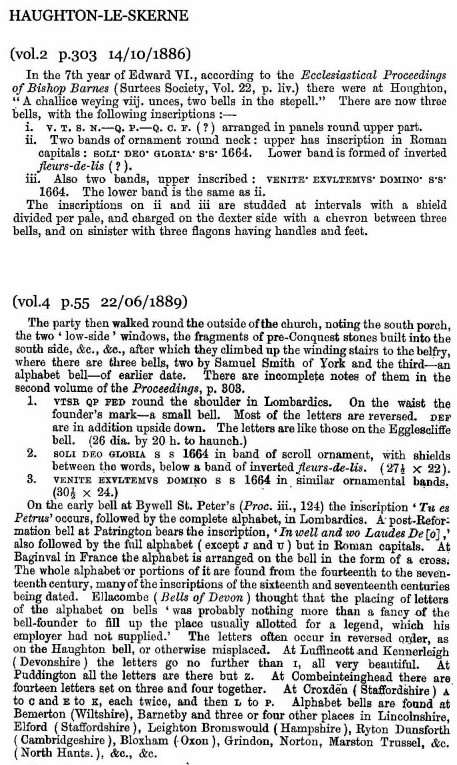
The Newcastle Society of Antiquities reported on their visit here in 1886.
Peter Rivet tells me
“Haughton-le-Skerne, St Andrew (1976) – Hung for ringing in an old wooden frame with what I thought were probably seventeenth century fittings, including a stay integral with the wheel, possibly the work of the bellhanger employed by Samuel Smith when he recast two of them in 1664. They were by then clocked, with wooden boards put through the wheels to prevent them being rung.”
http://www.haughtonhub.co.uk/village-groups/st-andrews-church-of-england/architectural-features.aspx notes
“The Bell Frames were originally are of short-headed type 3 b (Pickford 1993) with curved braces from sill to king post, later converted to type 3 c by having short struts bolted between the braces and the head; there is a single transom on each side, with a cut for a second (or an earlier position) adjacent to it; in plan the frames are of type 3.1 (three parallel pits). The frames presumably date from 1664 when a ‘Sesse’ was charged on the Parishioners to defray the cost of the casting and hanging of the bells (Gouldsmith 31). The bells are now hung on a modern beam and chimed; two of the old bell wheels are hung on the west wall of the belfry.”
The same page shows that the faculty for this work was granted on 2nd August 1990. The work, involving the installation of deadstocks and trigger action clappers was completed that year, by Taylors.
1 3-0-0 25.00″ C15th Unknown 1307Hz E-15c
2 3-3-20 27.25″ 1664 Samuel Smith I 1220Hz Eb-34c
3 5-1-4 30.13″ 1664 Samuel Smith I 1109Hz Db+0c
Inscriptions
- VTSR QP (then upside down:) DEF
- SOLI DEO GLORIA S S 1664
- VENITE EXULEMUS DOMINO S S 1664
The inscriptions on the Smith bells are studded at intervals with a shield divided per pale, and charged on the dexter side with a chevron between three bells, and on sinister with three flagons having handles and feet (Newcastle Society of Antiquaries 14/10/1886)

The bells