Hartlepool, St Hilda 3: 7cwt in Db MAP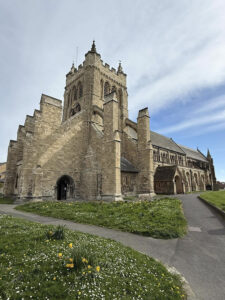
Ringing:
Bells are derelict and the tower is unsafe – unringable.
Church History
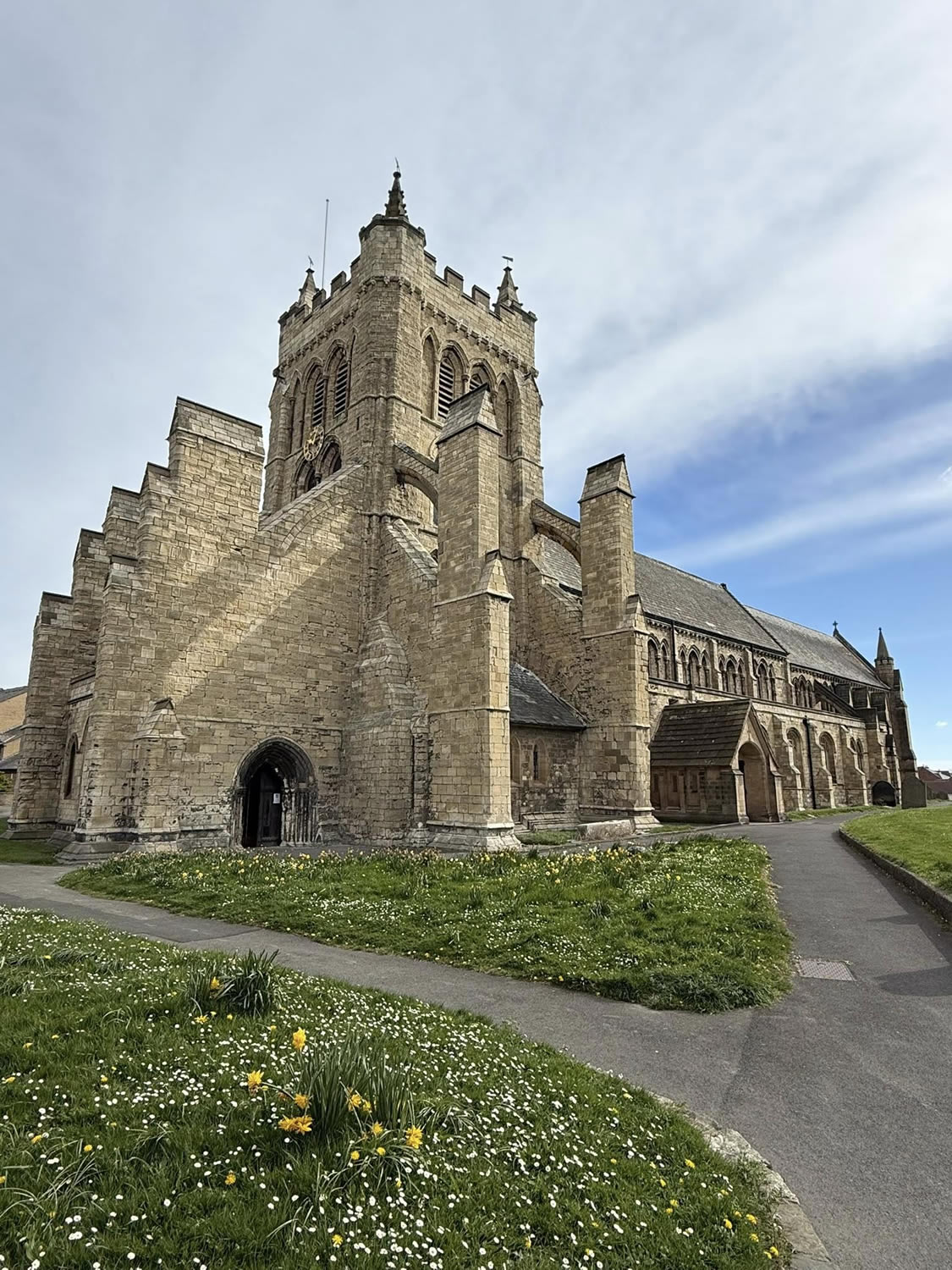
This is a wonderful church, with history. It was built on the site of the medieval Hartlepool Abbey. Building of the current church started around 1200. A state-of-the-art design showing the very beginnings of the Gothic style was constructed by the best stone masons available – among them, some who are thought to have worked on Byland Abbey in North Yorkshire. This is an unconventional building. The great buttresses around the tower may be, in part, a response to structural failure, but the western ones flank the ‘Galilee’, once a two-storey porch that perhaps had a courtroom on its upper floor. (http://www.bl.uk/onlinegallery/onlineex/durham/bravehart/sthilda/030add000042016u00012000.html)
St Hilda’s Church is recorded in the National Heritage List for England as a designated Grade I listed building.
Alec Clifton-Taylor includes it in his list of “best” English parish churches and describes it as “a glory of Early English architecture in its earliest and purest phase” and as an “architectural gem”.
The church’s listing details state that it was bulid c.1200, incorporating remains of early 12th century church, on site of a 7th century monastery. The aisles were partly rebuilt in the 15th century. It was restored in c.1724 and the mid-19th century by C. Hodgson Fowler. The chancel was partly rebuilt in c.1870 by J.B Pritchett (Darlington) and 1925-32 by W.D Caröe, in Early English style, when whole church was restored. The mid-13th century tower was restored in 1838, 1893 and 1930. The late 13th century Galilee chapel was restored 1928 and the south porch in 1932. It is built from dressed limestone with roofs of Westmorland slate; stone slates to porch. There is a clerestoried and aisled nave and chancel, Bruce chapel (ambulatory), south porch, west tower with north and south aisles, and the Galilee chapel.
The three-stage tower has angle buttresses, massive late 13th century shoring walls on three sides and flying buttresses to south side. The “Vice” at southwest angle is carried up as a turret. Above the tower aisles with renewed windows, are blind four bay arcades. There is a mid-12th century west doorway of four chamfered orders, flanked by earlier doorway remains: two orders of shafts with stiff-leaf capitals and dogtooth moulding between them. The north, south and west faces of the middle stage have paired lancets behind two bay arcades with clock faces in spandrels. The east face of the upper stage has two lancets, the other faces have two lancets behind four bay arcades. The embattled parapet has crocketed angle pinnacles. The Galilee chapel adjoining west side of tower, has a late 13th century doorway of four chamfered orders.
The buttressed six bay nave and four bay chancel have mid-13th century lancets, set behind partly blind three bay arcade in each bay of clerestories. The nave aisles have mid-19th century windows. There is an altered early-12th century round-headed south doorway of two lozenge-and-chevron moulded orders, those below springing moved outwards to allow third order of nook shafts. The two bay chancel aisles are spanned by flying buttresses and have paired lancets.
The single-bay Bruce chapel has tall grouped lancets and octagonal angle turrets. The tower has quadripartite vaulting to the lower stage and tower arches on three sides, that to east being shouldered and of three orders; others of two orders; all with filleted keel and roll mouldings. The north arcade of nave has five rolled and keeled orders on compound piers with circular abaci and octagonal bases. The south arcade has five keeled orders and compound piers, each with circular abacus and chamfered circular plinth. There are round wall-shafts to clerestories.
The chancel arcades are similar to the nave; two east bays rebuilt and blank, but for lancets. The chancel arch of c.1200 has four moulded orders and compound responds of keeled, and filleted round shafts with waterleaf capitals and square abaci. A three bay lancet arcade divides Bruce chapel from chancel.
The font of c.1728 has a scalloped marble basin and baluster shaft, with wood crown cover. The oak rood screen, 1894, is by C. Hodgson Fowler. the piscina in south aisle of chancel, has nailhead ornament. The late 16th century brass on the north aisle wall has a female figure and inscription. There is a late-7th century grave marker with runic inscription on the south wall of chancel. There is a worn medieval grave slab with effigy, on a late-13th century chest tomb in Bruce chapel. Many Saxon and medieval architectural fragments are found throughout church.
Source: https://historicengland.org.uk/listing/the-list/list-entry/1263355
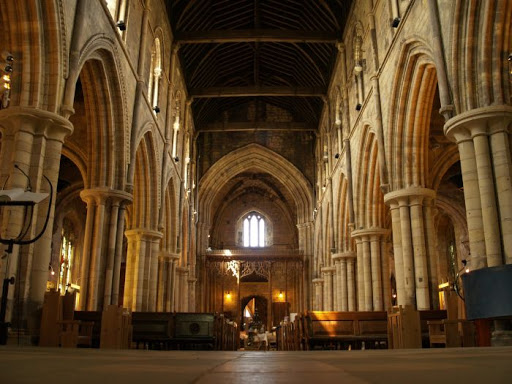
The interior of the church. Source: Doc Brown
An article about this church, with some good photographs, is available on the Fabulous North website
Bells
Peals: None
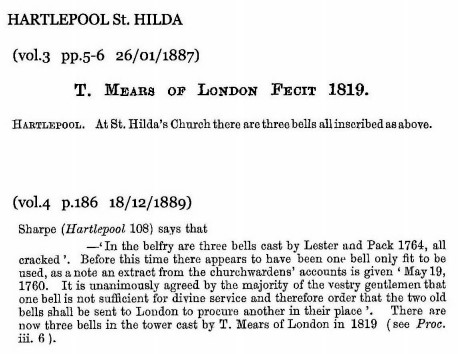
The bells are a complete ring of three by Thomas Mears II of Whitechapel. They are in a derelict condition and the tower is unsafe for change ringing bells. The Society of Antiquaries of Newcastle notes that these three bells replaced an earlier ring of three, cast by Lester and Pack of London in 1764.
A Durham Diocesan Archaeological Survey of 2005 notes:
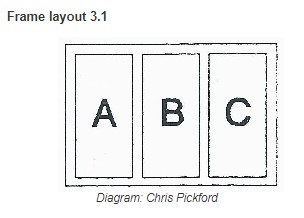
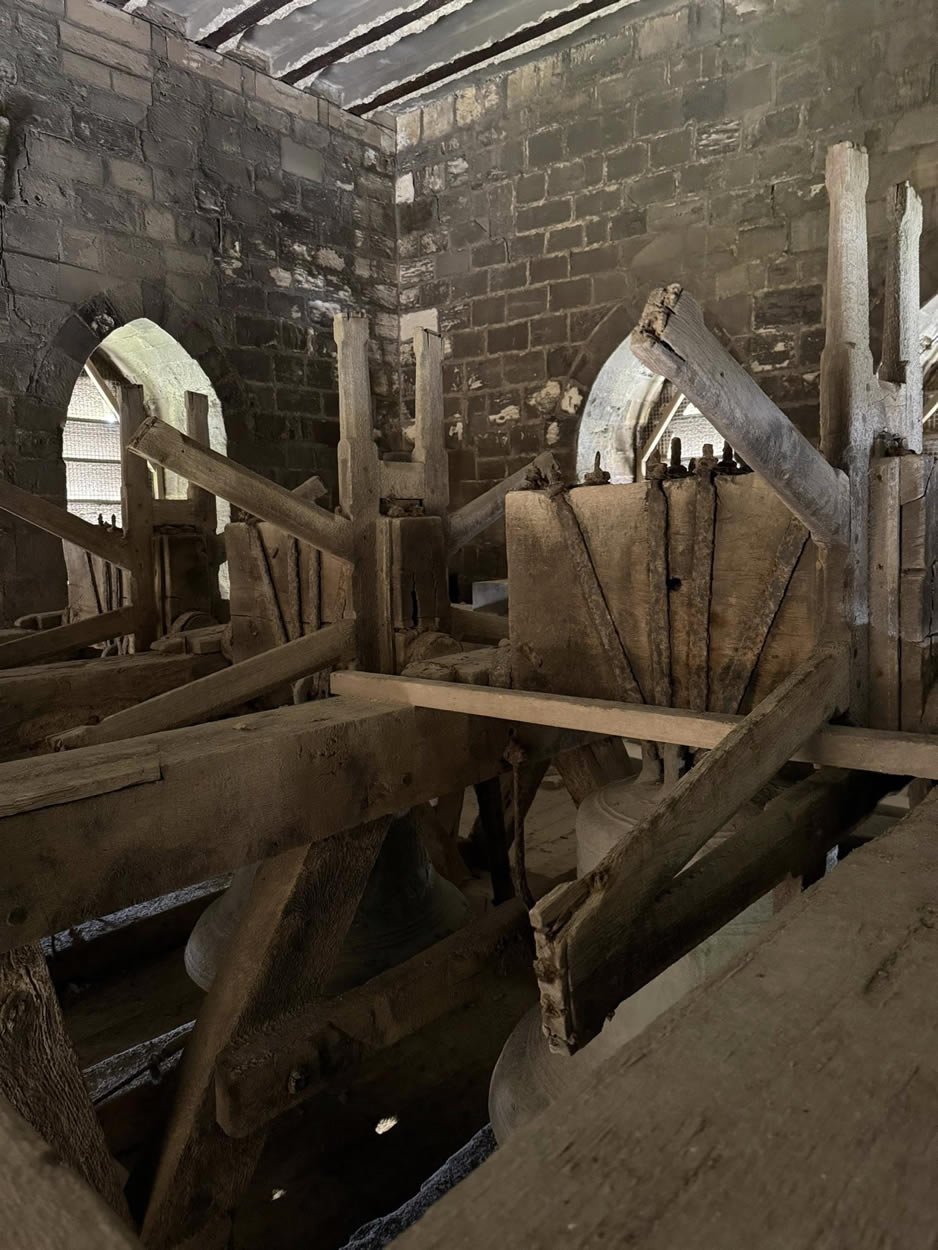
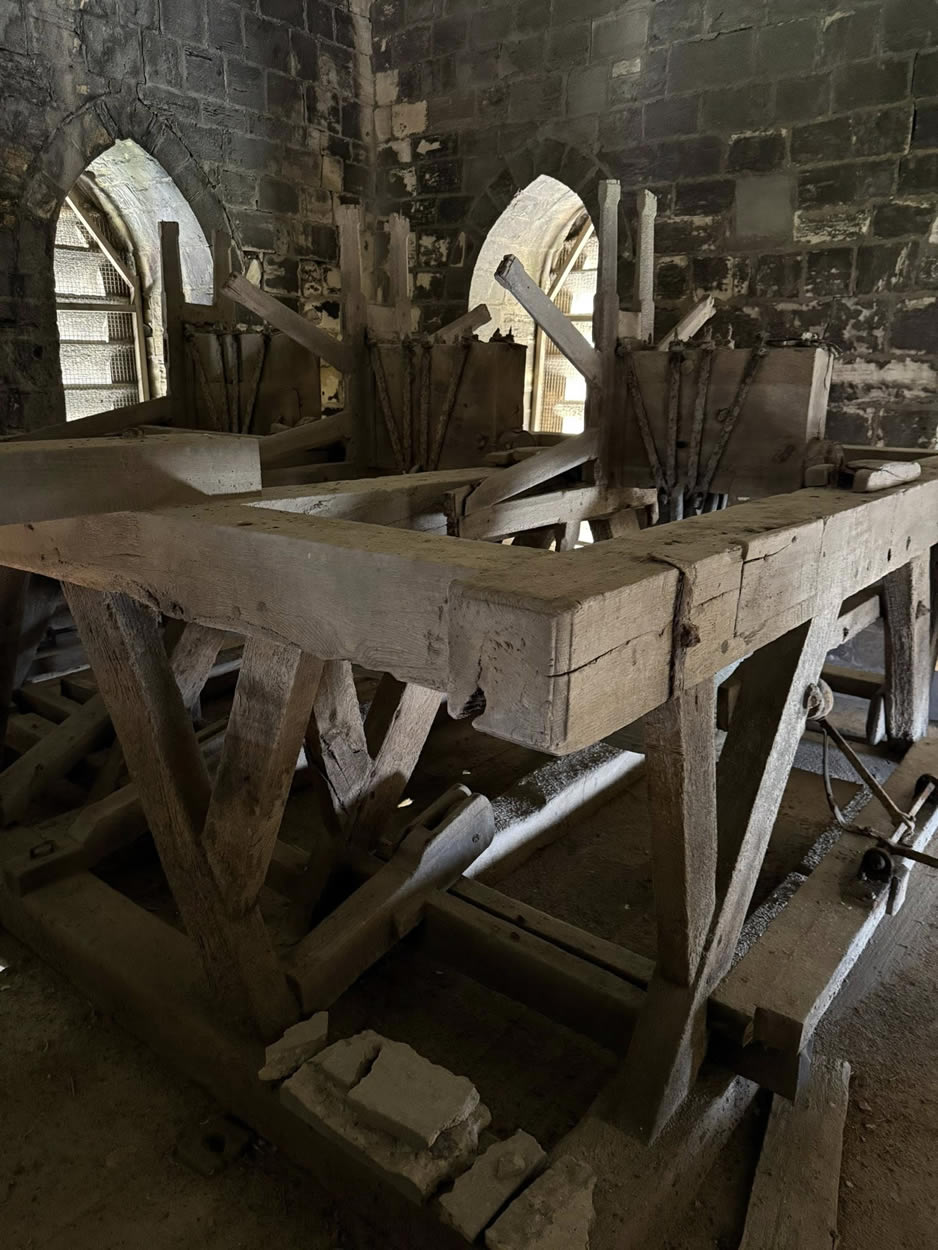
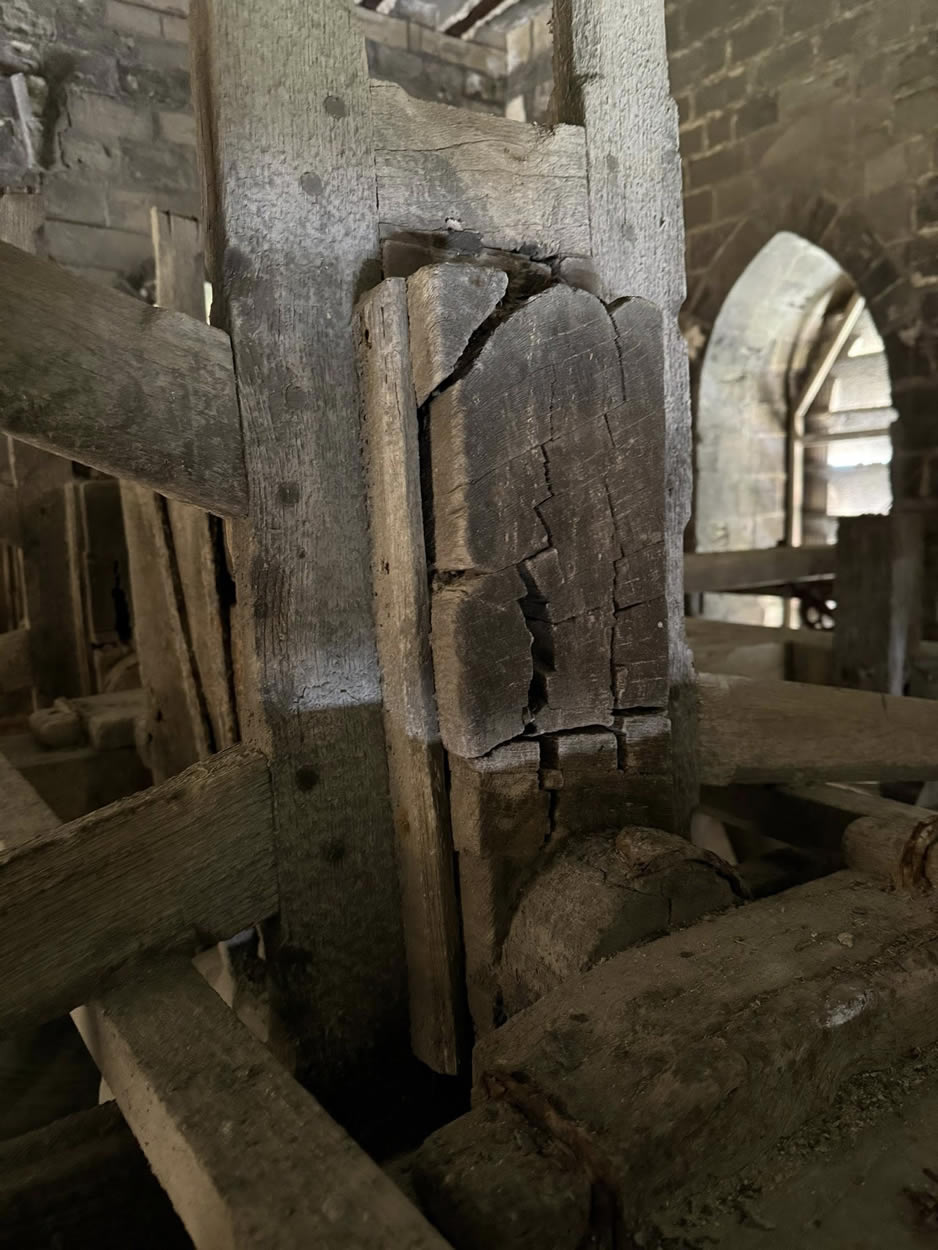
“The bell frames are of timber, and of the long-headed type, enclosing three parallel pits . They have braces from sill to head, and jack braces from brace to head, without end posts (Pickford layout 3.1 and truss type 6B, 1993, 53 & 26) . They are of pegged construction, with metal bolts used in various later modifications; they would appear to be post-medieval, and possibly of the 18th century. “
As the report also states, “within a few years of its initial construction, drastic measures had to be taken to prevent the collapse of the tower. ” and a survey of 1895 found a fissure of 1.5″ across in the foundations, it is very unlikely that these bells will ever be rehung for ringing.
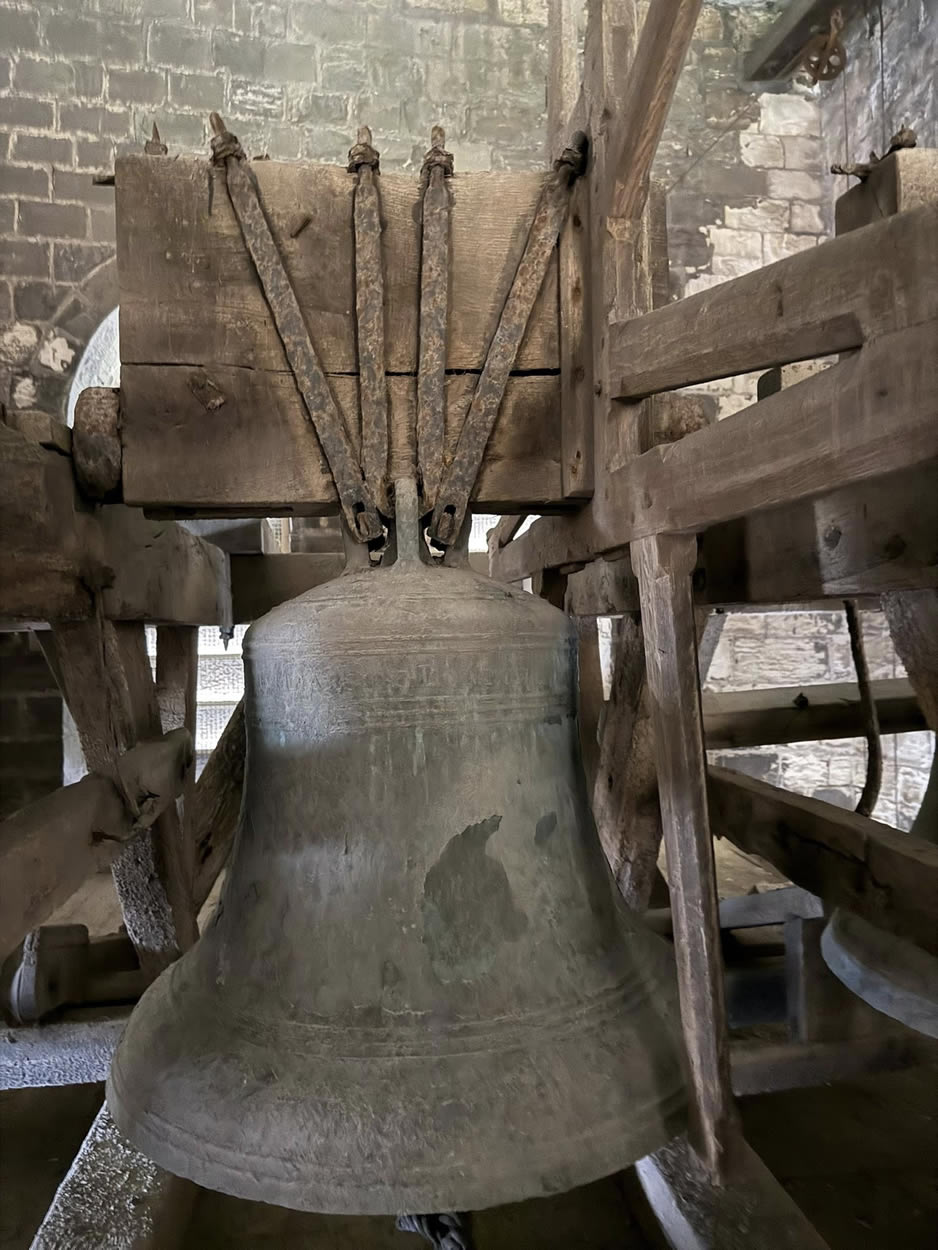
The bells retain their canons and none have been turned.
1 5cwt 29.38″ 1819 Thomas II Mears 1414.0hz F+21c
2 6cwt 31.38″ 1819 Thomas II Mears 1245.5hz Eb+1c
3 7cwt 33.13″ 1819 Thomas II Mears 1116.5hz Db+12c
Inscriptions
- T MEARS OF LONDON FECIT 1819
- T MEARS OF LONDON FECIT 1819
- T MEARS OF LONDON FECIT 1819
 |
 |
 |
 |
 |
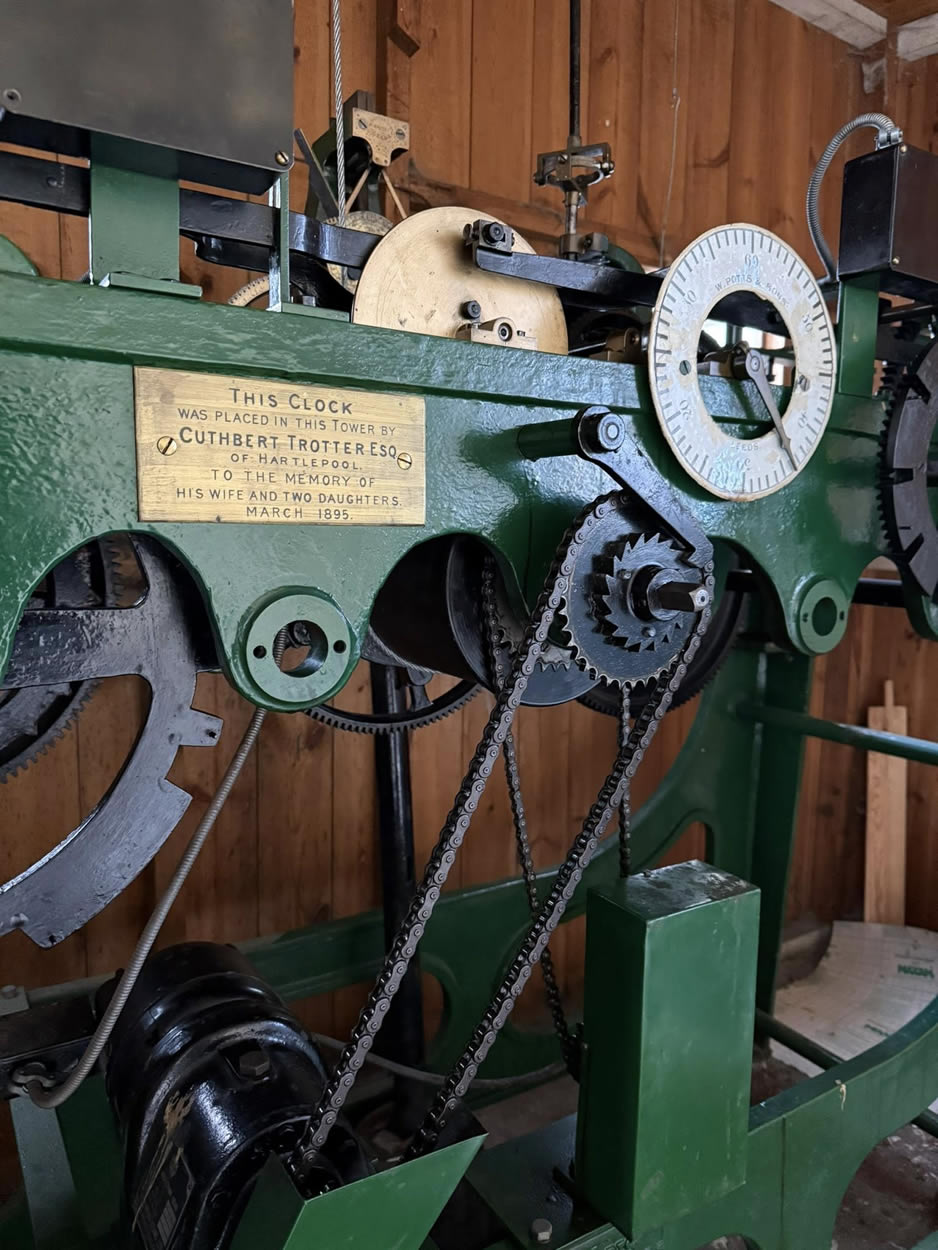 |
| Pictures of the bells and the clock, taken by ©Jack Hanlon | |
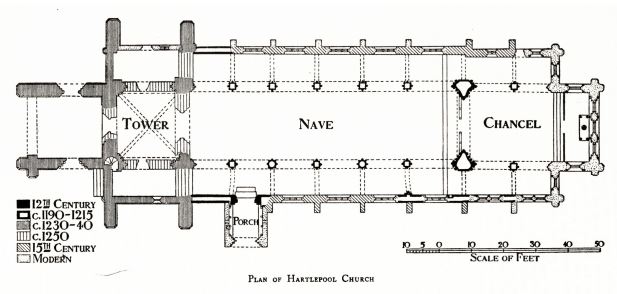
A plan of the church |
|