Fenham, SS James & Basil 8: 14-0-10 in F9 (+9 chiming bells) MAP
 Ringing:
Sunday: 09:30 to 10:00, Festivals and Special Occasions 18:00 to 18:30.
Practice: Thursday 19:00 to 20:30 (confirm)
Monthly practice on 1st Wednesday
Nearest Metro Station: Central Station – Fenham is not on a Metro line. The Number 36 bus runs from the city centre to Fenham
Church History
The church was built in 1927-31 by E.E. Lofting. It was paid for by Sir James Knott in memory of his sons who were killed in the First World War. His sons were Major James Leadbitter Knott DSO, killed on July 1st 1916 during The Battle of the Somme, and Captain Henry Basil Knott, who on 6th September 1916 received a bullet to the head and who died in the Casualty Clearing Station at Remy Siding the following day; hence the church’s dedication. Sir James himself was born in 1855 and left school at 14 to work as a shipping clerk on Newcastle Quayside. By 19 he was a shipbroker, owned his first ship at 23, by 31 had seventeen ships, and set up Prince Line Ltd in 1895. Eventually it was the third largest shipping company in the world. He sold the company after the death of his sons, and seems to have retired to Jersey. His wife died in 1929, when he was 74 – three years later he married a 25 year old – and died two years later.
It is built of snecked, tooled sandstone with ashlar dressings, a moulded plinth and large quoins; graduated There is a Lakeland slate roof with roll-moulded gable copings. There is a nave and a south aisle. The tower is at the south-east corner. There is a tall north vestry. It was built in the “Free Gothic” style.
There are double doors, boarded and studded, in 2-centred arches, that at the west end is moulded and shafted, and that at south is under a corbelled shallow gable. There are tall traceried windows of 2 lights to the twin-gabled west front and to the nave and aisle. There are smaller, similar, windows to the tower south front; and 3-light windows on east of tower and in the chancel, the last very tall. The aisle and the nave have a corbel table. The tower has 2 small windows above a drip mould of east window; a Lombard frieze is above these. There are paired belfry openings with pierced shuttering under the battlements. There is a buttressed stair turret at the south west, with an octagonal top and stone spirelet.
The interior is plastered, with ashlar dressings; a king-post roof and a ribbed vault to tower memorial chapel. There is a 4-bay arcade of chamfered arches on tall octagonal columns and a similar archesto chapel. There are arches with Moorish wood screens at the north to the organ chamber. There is one similar arch and oriel screen, above the tower chapel, for the organ pipes. There is a corbelled arcaded stone frieze below the sills. There is a marble-flagged chancel floor, inlaid wood altar and retable, and an elaborately-carved reredos. The church’s glass is of high quality.
Historical, note: the church said to be built with stone from Dobson’s 1830 Newcastle prison, in Carliol Square, which was demolished at that time.
Source: https://historicengland.org.uk/listing/the-list/list-entry/1024896
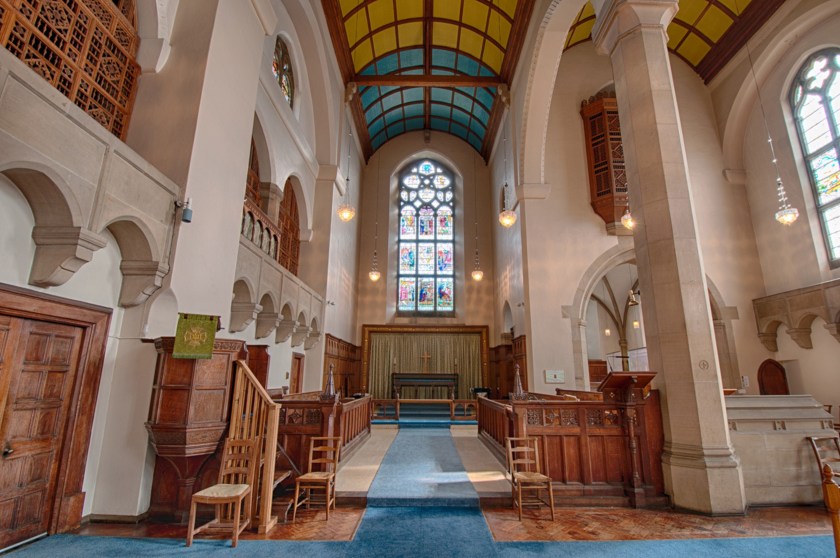
The east end of the church. Source: Church website
The Bells
There is a ring of 8 bells and also 9 chiming bells, to allow for tune ringing on 17 bells, all cast by Mears and Stainbank in 1930. They are a fine ring. All the bells were cast with flat heads and none have been turned. The chiming bells are hung above the ring. There is a practice clavier in the ringing chamber.
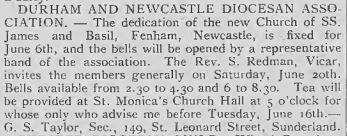
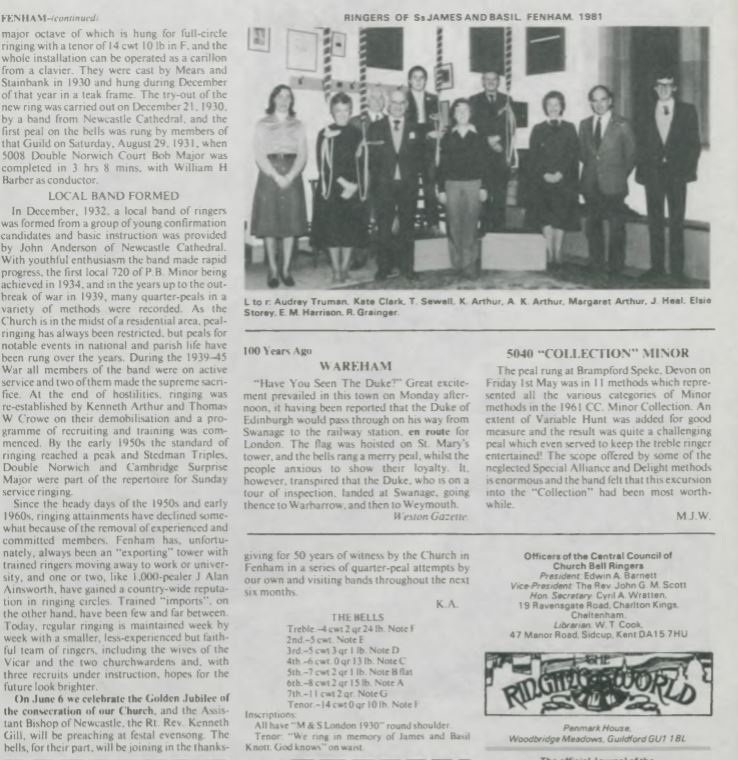
The bells were not dedicated until June 6th 1931, as show in this notice, published in “The Ringing World” of May 29th.
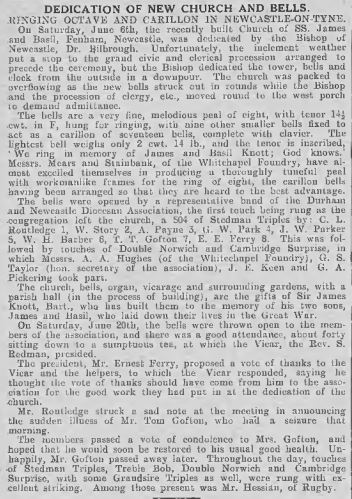
The dedication was reported in the edition of July 3rd 1931:
It appears not everyone was completely happy living within earshot of the new bells as a footnote to a peal rung on the back 6 o March 19th 1937 states, “First peal on the bells using the new set of silencers, which give entire satisfaction.” I assume that this is most likely to be “Davis Silencers”
As an addendum to the CCCBR Towers and Belfries Committee report for 1935-36, the committee said:
At the Council meeting of 1935, a request was made that the committee should inquire about the so-called ‘silencers’ and make a recommendation as to their use.
The ‘Davis silencers’ have now been used over a considerable period in several towers with success, and your committee think that they are well worth a trial in towers where it is desired to reduce the volume of sound during practices and peals without taking any permanent steps such as blocking up louvres.
The silencers consist of a leather pad resembling a muffle, with a thin steel plate attached to the face. The result of their use is to give an effect rather like muffled ringing, while retaining a certain amount of metallic tap of the clapper. To get the best effect in each individual case, it is evident that experiments should be made with different thicknesses of leather. For this purpose the committee are obtaining samples of different thicknesses which can be lent to towers for this purpose at no cost other than postage both ways. These silencers are not expensive and have shown little wear after twelve months’ use.
In The Ringing World of May 14th 1937 it is reported about a meeting at Fenham:
The Vicar, in replying, referred to the fine effect produced by the use of the new silencers. The bells were almost inaudible at the foot of the tower, but at a distance they are sweetly and clearly heard.
A series of articles about local ringing was published in The Ringing World in early 1966. This was said of Fenham in the January 14th edition:
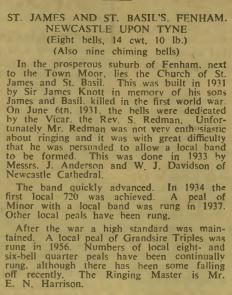
The church was featured in The Ringing World of May 29th 1981:

The stairs to the ringing chamber are located inside the church at the base of the tower.
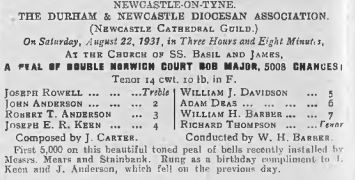
The first peal on the bells was rung in August of 1931 and below is the record of it in “The Ringing World”. However, the peal board in the tower gives the date as being 29th August 1931.
C = number of the bell in the chime R = number of bell in the ring.
C1 2-0-14 20.25″ 1930 Mears & Stainbank 2148.0Hz C+45c
C2 2-3-17 21.50″ 1930 Mears & Stainbank 2028.0Hz B+45c
C3 2-2-25 22.00″ 1930 Mears & Stainbank 1909.2Hz Bb+41c
C4 3-0-4 22.75″ 1930 Mears & Stainbank 1790.0Hz A+29c
C5 3-0-25 24.00″ 1930 Mears & Stainbank 1612.0Hz G+48c
C6 3-3-17 25.50″ 1930 Mears & Stainbank 1520.0Hz Gb+46c
R1/C7 4-2-24 27.00″ 1930 Mears & Stainbank 1432.0Hz F+43c
R2/C8 5-0-0 28.00″ 1930 Mears & Stainbank 1342.5Hz E+31c
C9 5-1-9 29.00″ 1930 Mears & Stainbank 1274.0Hz Eb+41c
R3/C10 5-3-1 30.00″ 1930 Mears & Stainbank 1193.2Hz D+27c
R4/C11 6-0-13 31.75″ 1930 Mears & Stainbank 1074.0Hz C+45c
C12 7-1-0 33.00″ 1930 Mears & Stainbank 1014.0Hz B+45c
R5/C13 7-2-1 34.00″ 1930 Mears & Stainbank 954.7Hz Bb+41c
R6/C14 8-2-15 35.75″ 1930 Mears & Stainbank 894.0Hz A+27c
R7/C15 11-2-0 39.00″ 1930 Mears & Stainbank 806.0Hz G+48c
C16 11-2-7 40.50″ 1930 Mears & Stainbank 760.0Hz Gb+46c
R8/C17 14-0-10 43.00″ 1930 Mears & Stainbank 716.0Hz F+43c
Inscriptions on the Ringing Bells
- M & S LONDON 1930
- M & S LONDON 1930
- M & S LONDON 1930
- M & S LONDON 1930
- M & S LONDON 1930
- M & S LONDON 1930
- M & S LONDON 1930
- M & S LONDON 1930
WE RING IN MEMORY OF JAMES AND BASIL KNOTT
GOD KNOWS.
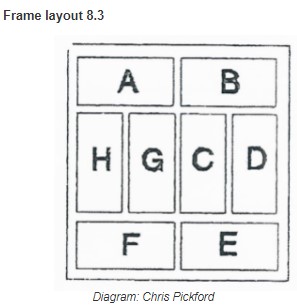
The frame layout, (the truss is 6.A)
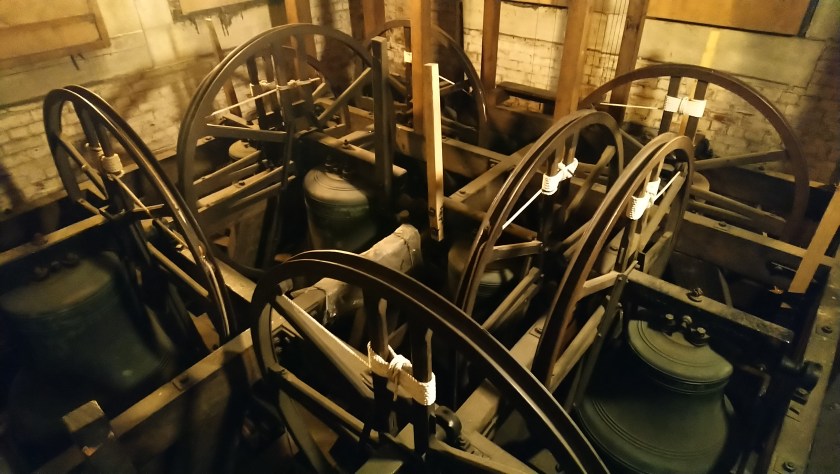
The bells
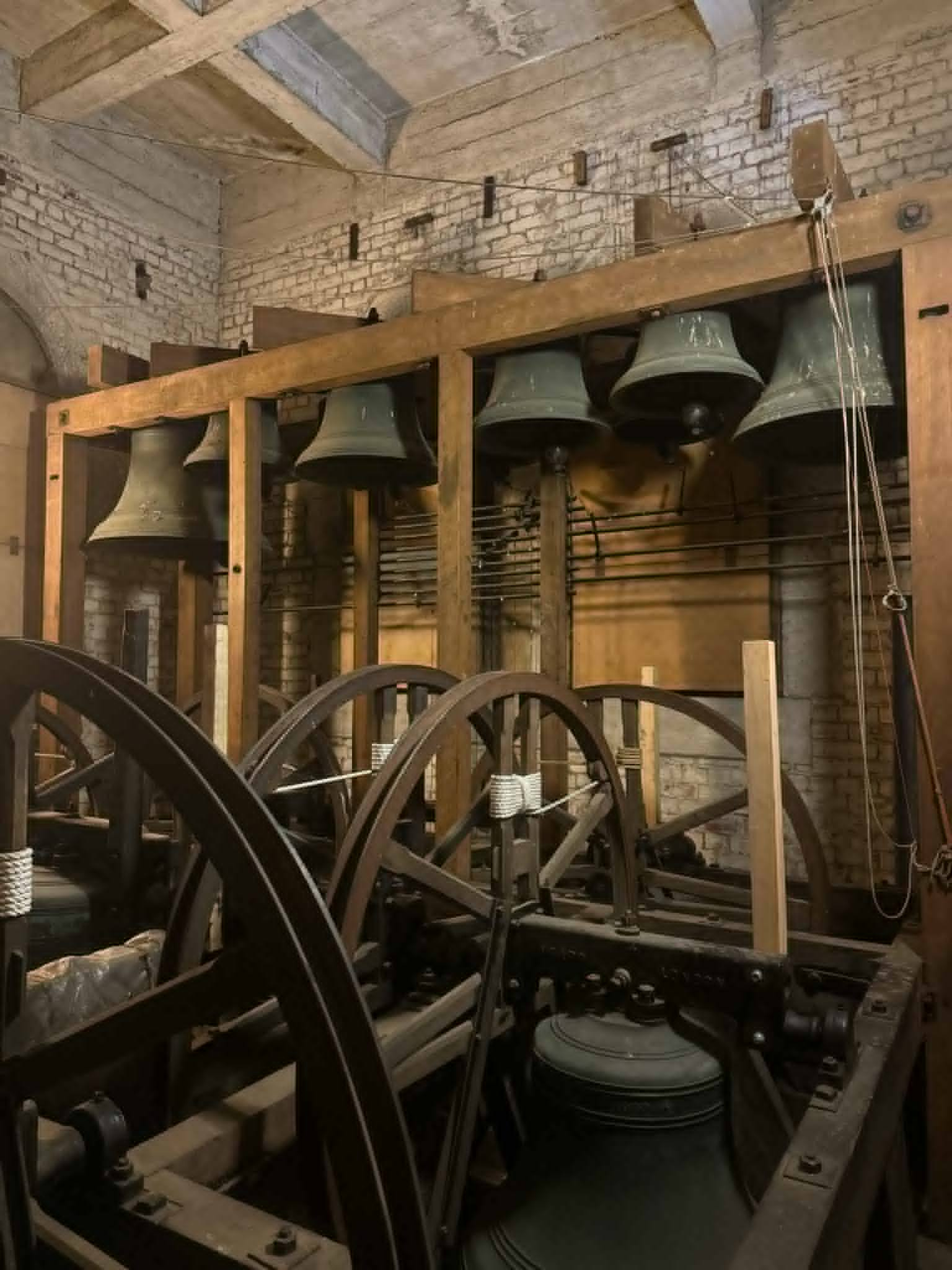
The chime bells
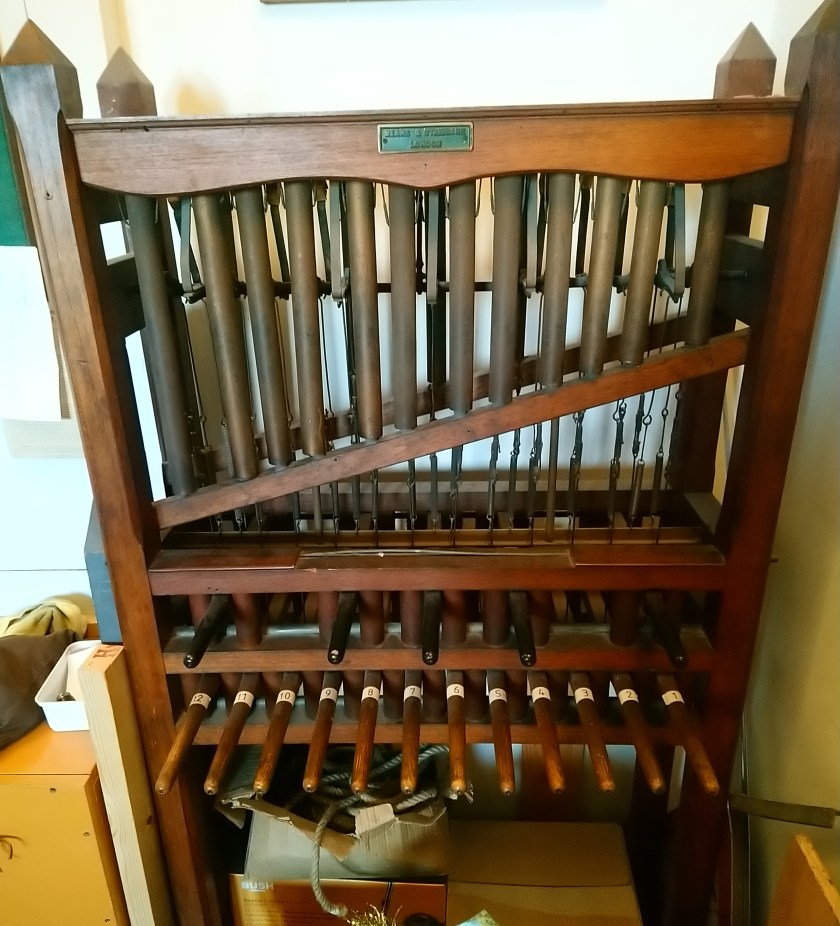
The practice clavier – source: Church Website