Darlington, Holy Trinity, 6: 6-3-9 in Bb MAP
 Ringing:
Sunday: 09:30 to 10:00.
Practice: Monday 19:30 to 21:00
Church History
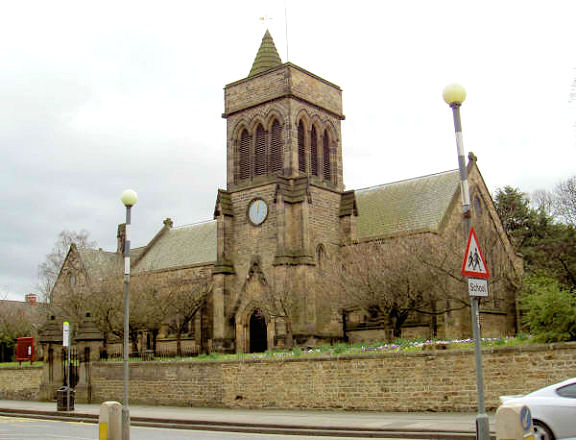
Holy Trinity was built as a chapel of ease to St Cuthbert’s in order to meet the needs of the expansion of Darlington after the arrival of the railway. It was assigned a parish in 1843. Plans for the church were in place at least by June 1834 when application for a grant was made to the Incorporated Church Building Society. The foundation stone was laid on 4 October 1836. At that time it was expected that the church would have 1,010 seats of which 600 would be free. The final cost was £3,404.
The architect, Anthony Salvin (1799-1881), was a significant figure in the late Georgian and early Victorian Gothic Revival. Born in Worthing, he was a pupil of a little-known architect named John Paterson (d 1832) and worked in the office of John Nash. He set up in independent practice in 1828 and early on showed his ability to create buildings in an impressively authentic medieval style. He is also well known for a range of country house work. At Holy Trinity he demonstrates a faithfulness to medieval Gothic that was unusual for its time. Salvin’s biographer, Jill Allibone, says the church `was quite the best thing Salvin had done up to this date.’
Various changes too place during the later 19th and early 20th centuries. In 1867 a chancel with a transeptal organ chamber and vestry was added by the local architect, J Ross. This was further extended c.1898. The seating was renewed in 1883 and again in 1909 when the flat ceiling over the nave was removed, this work being supervised by the Durham architect C Hodgson Fowler (contractor R T Snaith and Son). The chancel was refitted in 1917-18.
Source: https://historicengland.org.uk/listing/the-list/list-entry/1121226
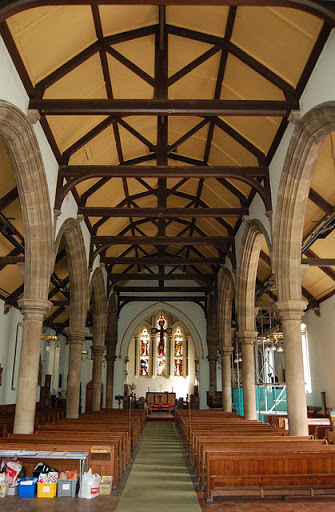
The interior of the church
The Bells
The bells are a complete ring from John Warners, Cripplegate. They have typical Doncaster canons for a ring from this founder. They were overhauled by Taylors in 1946.
They were given to the church in the will of Henry Allan.
The Bell News of December 18th 1886 reported:
The Allan Request .— At a meeting of the sidesmen of Holy Trinity Church, Darlington, held on Wednesday, it was announced that the £300 left by the late Mr. Robert Henry Allan, Blackwell Hall, to provide a peal of bells for the church was now available, and it was therefore decided to proceed with the project at once.
It has been said that he gave out more money in his will than he had at his death and that the ring of bells is consequently lighter, and fewer, than it might be! This is explained in an article that appeared in The Ringing World of December 23rd 1938. The existing Whitechapel bell of 7-0-6, cast in 1844, was taken in part payment for the new ring.
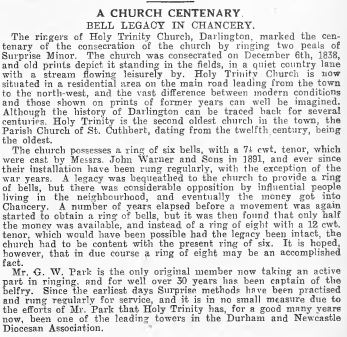
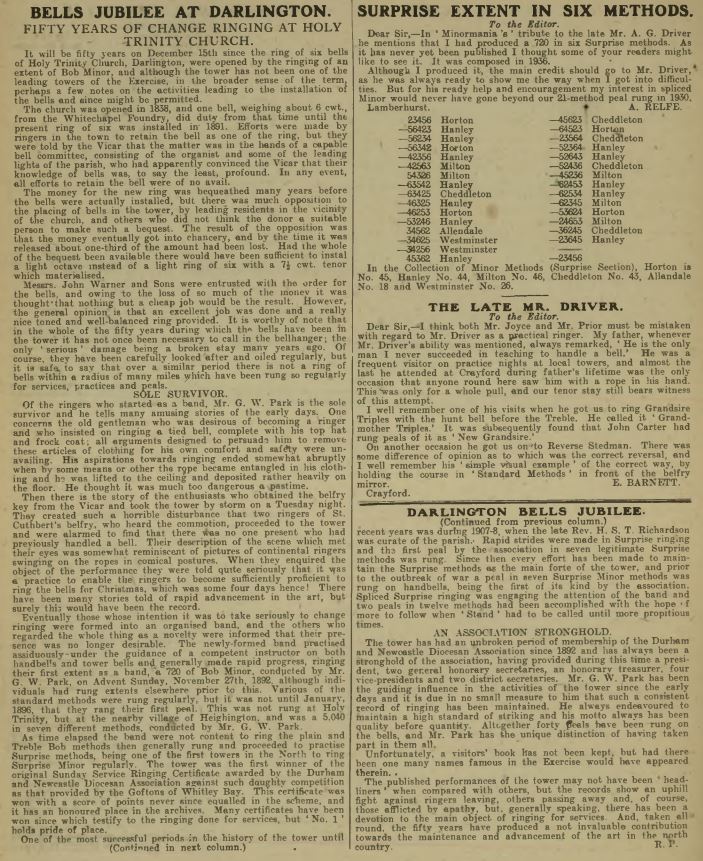
A longer article appeared in The Ringing World of December 12th 1941, the 50th anniversary of the bells:
The ringers visited Cotherston in 1893: Holy Trinity Society, Darlington, Durham .— On Saturday, July 8th, the members of the above society journeyed to Cotherstone for an afternoon’s ringing, and succeeded in ringing a 720 of Bob Minor. E . Cox, 1 ; G . J. Lungley, 2 ; T . Lungley, 3 : R. B. Wilson, 4 : G . W . Park, 5 ; G . A. Overton (conductor), 6. And 720 Grandsire Minor. E . Cox, 1 ; G . W . Park, 2 ; T . Lungley, 3 ; J. W . H . Lynn , 4 : R. B. Wilson, 5; G . A . Overton (conductor), 6. Afterwards the company had a stroll through the village to view the surrounding scenery, and having done so they returned to the tower and rang a touch o f Oxford Treble Bob Minor. The next move was made to station en route for Barnard Castle.
The Park family have been mainstays of ringing at this church and are still represented in the band of ringers today.
The first peal on the bells was rung in October of 1903 and reporting in “Bell News and Ringers’ Record” thus:
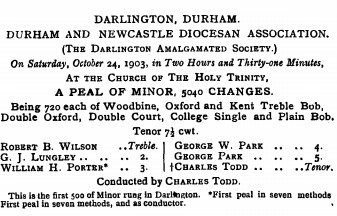
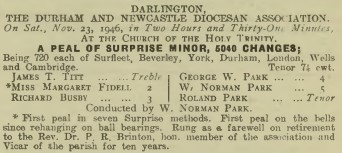
The first peal on the bell after their restoration reveals that the bells were rehung on ball bearings. Members of the Park family still ring here:
1 3-2-18 25.13″ 1891 John Warner & Sons 1565.0Hz G-3c
2 3-2-11 26.00″ 1891 John Warner & Sons 1395.0Hz F-2c
3 3-3-23 27.50″ 1891 John Warner & Sons 1242.0Hz Eb+7c
4 4-2-11 28.63″ 1891 John Warner & Sons 1173.0Hz D-2c
5 5-1-26 31.13″ 1891 John Warner & Sons 1044.0Hz C-4c
6 6-3-9 34.00″ 1891 John Warner & Son 930.0Hz Bb-4c
Inscriptions
All of the bells are inscribed:
DEDICATED TO THE CHURCH OF THE HOLY TRINITY DARLINGTON
PERSUANT TO A CODICIL TO THE WILL OF HENRY ALLAN, ESQUIRE
OF BLACKWELL HALL DARLINGTON, 1891
One of the bells. There are signs of an old Ellacombe Appartus here:
