Corbridge, St Andrew 6: 6-2-23 in A MAP
 Ringing:
Bells are unringable
Church History
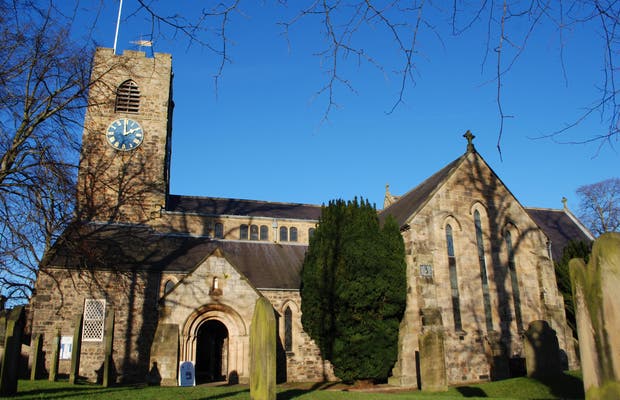
The Nave is late 7th or 8th century, with a 2-storey west porch raised into tower in the early 11th century. There was a 3-phase 13th century remodelling: the chancel was rebuilt and the north nave aisle added; the north chancel aisle, the south nave aisle and the transepts were added. The south aisle was widened and the north transept aisle added.
The belfry windows were remodelled in 1729; the south-west vestry was added in 1835 and the east lancets 1853. The aisle and transept walls were largely rebuilt in 1867. The nave clerestorey, north vestry and organ chamber are early 20th century and the south porch was added in 1919.
The church is built of rubble with re-used Roman material, except for squared stone of chancel and snecked stone in the 19th/20th century parts. There are Welsh slate roofs except for stone slates on south porch.
The west tower shows massive quoins. There is a 19th century 3-light window set in original arched doorway, with worn saltire crosses on voussoirs of relieving arch, and round-headed window above. Similar window above nave roof on east is the original west window of taller Pre-Conquest nave, now incorporated in tower wall. There is a band below the altered bell openings, with later imposts and pointed heads on old jambs. There is a string course above and a tall crenellated parapet with blocked openings below on east and west.
The South porch has clasping buttresses, a moulded Romanesque arch with small arched window over, and a window of 3 round-headed lights on west. The is anaisle wall to east with 2 trefoil- headed lancets. There is a former vestry to west, with metal-latticed sash and basket-arched doorway on west. The north aisle wall is from the 19th century, except for west bay, former vestry or anchorage, with tiny lancet on north and slit with lancet above on west. Clerestorey windows of 1, 2 or 3 round-headed lights.
The transepts have gable ends with triplets of renewed lancets and finial crosses. The east wall of south transept has a 3-light 13th century window, with intersecting tracery, and a square-headed light to north. There is a 4-bay chancel with chamfered and moulded plinth, buttresses with gabled setbacks, and moulded strings at sill and window head levels. Lancets, trefoil- headed in central bays. There is an inserted 2-light low-side window in first bay and trefoil-arched priest’s door in second. Similar buttresses at east end, shortened beneath lancets. There are coped gables with finial crosses. The eastern half of chancel aisle, with trefoiled lancets, is 19th century; but with 13th century walling and 2 single-light windows (one now hidden by organ chamber) survive further west.
In the interior the south porch has ribbed segmental vault. The 12th century south door has round arch of 2 chevron-moulded orders on shafts with fluted caps. There is an unmoulded round-headed tower arch on moulded imposts (southern cut back) is thought to be re-set Roman feature. The 3-bay nave arcades have double-chamfered pointed arches with broach stops and chamfered hoodmoulds, on octagonal piers with moulded capitals; over north arcade remains of two Pre-Conquest windows. The similar 2-bay west arcade in north transept, and double-chamfered arch to chancel aisle; similar 4-centred arch between south transept and nave aisle. Segmental-arched tomb recess on north of north transept with inscribed medieval slab; trefoiled piscina in south transept.
There is a pointed double-chamfered chancel arch on double-shafted jambs cut back,with insertion of additional lower moulded capitals,when arch widened. 4-bay north arcade of similar form to nave arcades. The moulded sill string on south is carried up over segmental rear arch of priest’s door. There is a trefoiled piscina. Late 13th century slab with foliate cross and shears re-used as lintel of low-side. The 2-bay transverse arcade in the north aisle is a 20th century feature carrying organ chamber wall.
Fittings and furnishings are of good quality, largely late 19th or 20 century. There are several medieval cross slabs in paving including an important inscribed example in the south transept. 17th and 18th century floor stones include one of 1708 in the chancel which is a medieval altar slab re-used. There is good early 20th century glass in the south transept (‘Dorcas window’) and a south porch.
Source: https://historicengland.org.uk/listing/the-list/list-entry/1303508
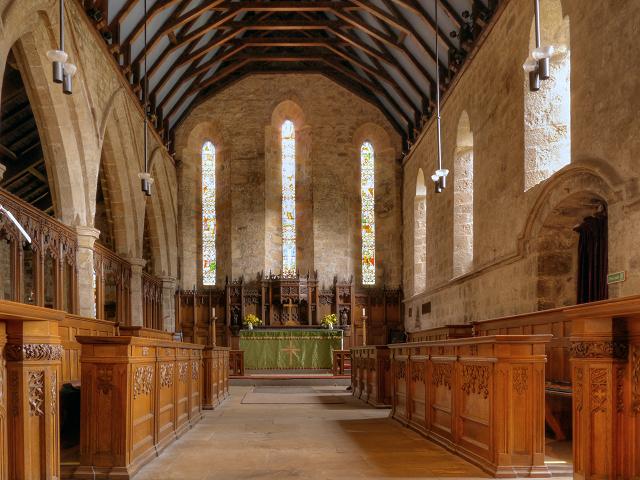
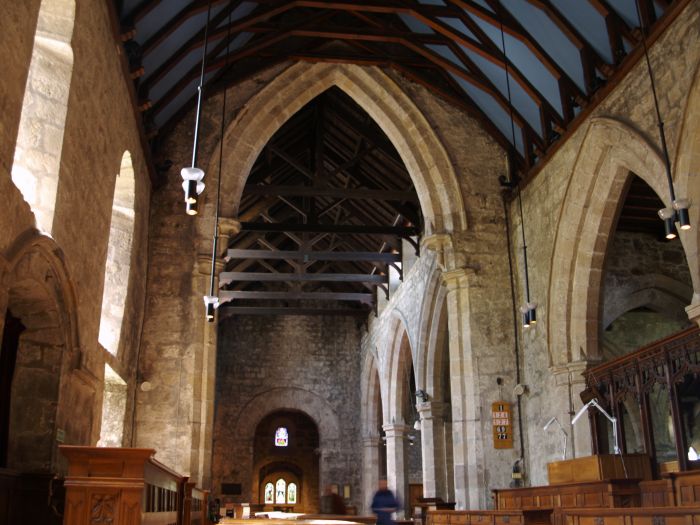
Views of the interior
An article about this church, with some good photographs, can be found on the Fabulous North website
The Bells
(The clock chime from inside)
Peals: None
This is a complete ring of six by Gillett & Co. of Croydon. They are not rung due to the excessive movement they cause to the Saxon tower. The inscription on the tenor shows that they replaced three earlier bells. They hang in a timber bellframe.
Details of the bells and the previous bells are given in reports published by The Newcastle Society of Antiquaries”
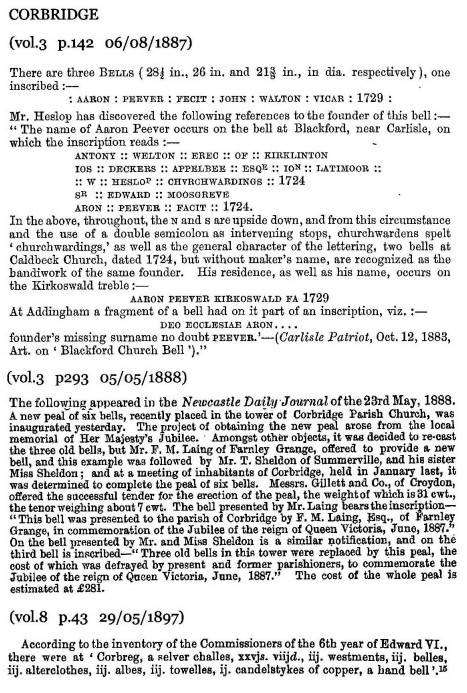
A report of the dedication of the bells was reported in the Bell News in their edition of June 2nd 1888:
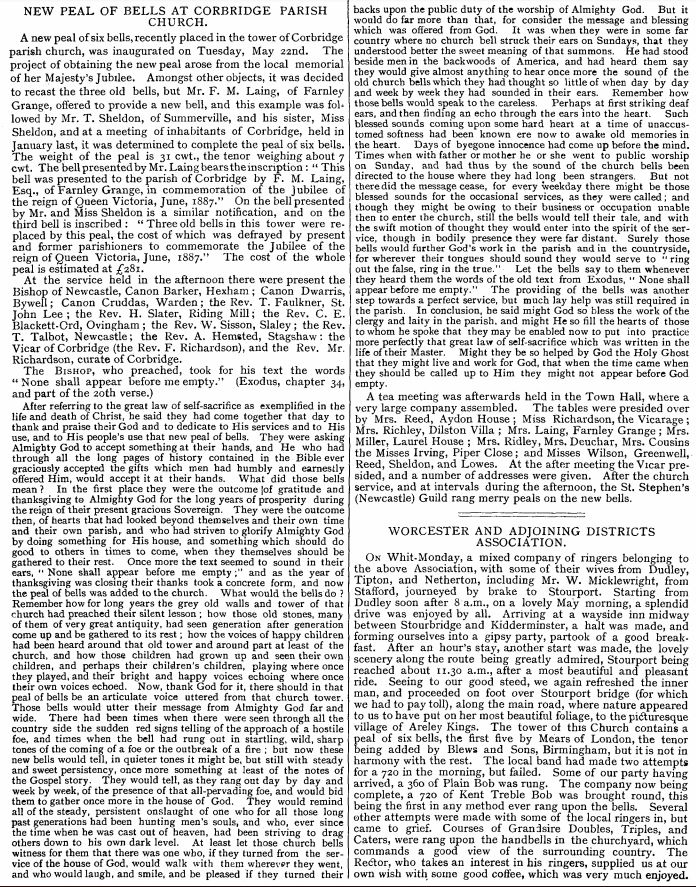
They were rung by a party in April 1893 and they reported:
“…… left the train at Corbridge, for a ring on the pretty peal of six at St. Andrew’s, but they found them in very bad order, apparently never having been screwed up since the opening some seven years ago. They only succeeded in ringing about 240 after several changes in position. The band was W. Fraser, T. Gofton, and J. Thompson of Whitley, R. Mordue of Whicfeham, E . Wallis and J. Lincoln, Newcastle. The Vicar (Rev. F. Richardson), most kindly granted the use of the bells for the afternoon, but he had not seemingly been aware of the shaky state into which his bells had fallen. An hour or two spent amongst them with oil and screw-key would do wonders.”
The Bell News and Ringers’ Record notes that the bells were available for a meeting held on May 25th 1896 and a 720 was rung: Corbridge.— On Whit-Monday, at the parish church, 720 Oxford Treble Bob Minor. F. Sheraton, 1; C . Ward, 2; R. Story, 3; F. Lees, 4; F. Harrison, 5; W. Holmes (conductor), 6.
The bells were also available for an Association meeting on 27th 1912, when two 720s were rung. They were included in Gillett adverts in Bell News well into the 20th century. The bells were available for an Association meeting on July 29th 1922. It was noted that there were no Corbridge ringers at an Association meeting in 1924, so the must have been rung then. However, I have not yet found out when ringing was stopped. I understand that they were tried out be “maverick” ringers in the 70s or 80s.
The church clock does still chime on the bells.
1 4-0-2 25.50″ 1887 Gillett & Co. 1535.0Hz F#+63c (1089)
2 4-0-14 26.50″ 1887 Gillett & Co. 1391.5Hz E+93c (1087)
3 4-1-9 28.00″ 1887 Gillett & Co. 1219.5Hz D+65c (1088)
4 5-1-0 29.50″ 1887 Gillett & Co. 1127.0Hz C#+28c (1083)
5 5-2-9 31.50″ 1887 Gillett & Co. 1019.0Hz B+56c (1090)
6 6-2-23 34.00″ 1887 Gillett & Co. 904.5Hz A+48c (1084)
The bell numbers are in brackets
Inscriptions
The inscription on the tenor bell is:
THREE OLD BELLS IN THIS TOWER WERE REPLACED BY THIS PEAL.
THE COST OF WHICH WAS DEFRAYED BY PRESENT AND FORMER
PARISHIONERS TO COMMEMORATE THE JUBILEE OF THE REIGN OF
QUEEN VICTORIA, JUNE 1887.
One of the three old bells is still in existence at Farley Grange, inscribed:
AARON : PEEVER : FECIT : JOHN : WALTON : VICAR : 1729