Barnard Castle – St Mary 8: 17-0-0 in F MAP
Ringing:
Sunday 09:20 to 10:00.
Practice Monday 19:30 to 21:00.
Church History
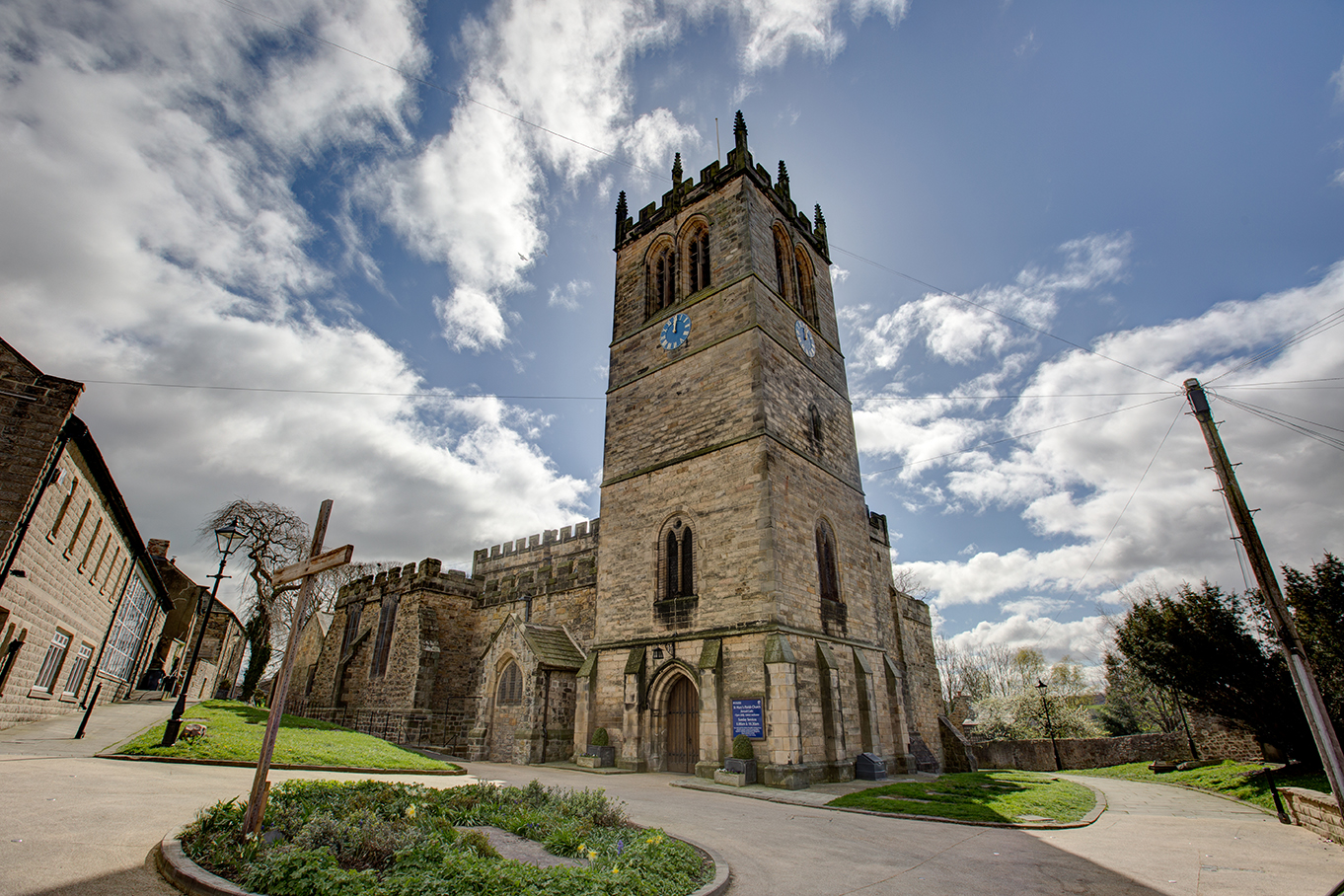
Dedicated, like many local churches, to the Blessed Virgin Mary, the church owes its foundation in about 1130 AD to Bernard de Baliol, who built the Castle. It forms part of an important town centre group near the Market Cross and Marketplace, contributing to the charm of the unspoilt town centre.
There are some interesting monuments, including that of Robert de Mortham, a 14th century vicar of Gainford in the North Transept. The entrance porch has memorials to Sir John & Lady Hullock, a local man who became a judge and Baron of the Exchequer, and to an officer who died of wounds received in the charge of the Light Brigade at Balaclava.
Originally a daughter church of the parish of Gainford, Barnard Castle was in the gift of St. Mary’s Abbey at York until after the Dissolution of the Monasteries in 1539. Trinity College, Cambridge, then became the patrons, and have appointed the incumbents ever since, In 1866 Barnard Castle became a separate parish with its own Vicar, instead of a Perpetual Curate from Gainford.
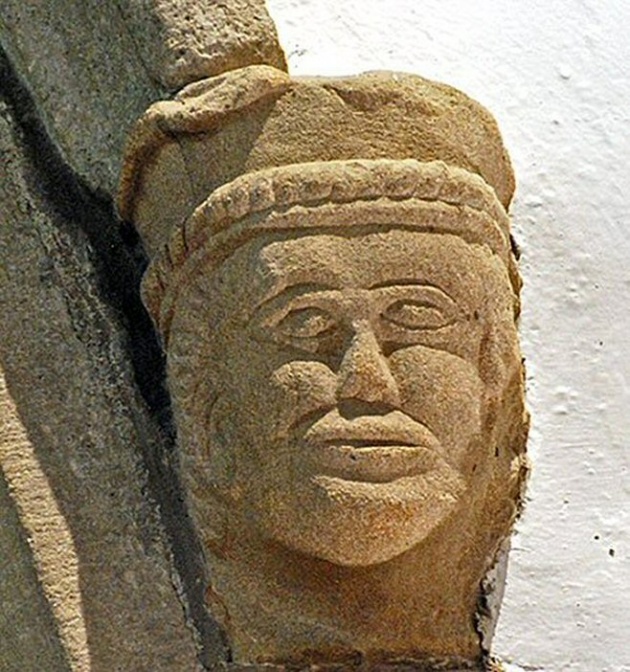
A great benefactor of the church was Richard, Duke of Gloucester (afterwards Richard III), who was Lord of Barnard Castle from 1477-85. He greatly extended and beautified the church at his own cost and intended to found a college of priests here, although the plan was apparently not put into effect. His supposed effigy is on the south side of the Chancel arch, and his wild boar emblem is carved on the outside of the east window in the South Transept .
The church plate includes two fine silver chalices dated 1670 and 1680, both still in weekly use. The font, of stone from the local river known as Tees Marble, is unique, and dates from 1485. The markings on it defy historians’ attempts at interpretation, but are probably a Medieval Guild or Brotherhood Mark.
The South Doorway, which was plastered over in the wall of the South Aisle until the restoration works of the 19th century, is of the Transitional Period between the 12th & 13th centuries. The bases are Early English. The upper order of mouldings has Norman characteristics. Drawings of the early 18th century indicate the presence of an outer porch of Georgian design.
Outside to the west of the South Door stands the interesting table tomb of Humphrey Hopper, of Black Headley, Northumberland.
The bells will have hung in the previous tower. The original tower was much lower and once had a tall spire. The church website notes:
When created in the first of of the 12th Century, the church was a rather simple rectangular building, but by the second half of the 14th Century it had both tower and spire. The tower itself may have been quite squat, but the spire, which was roofed in lead, was very tall, slender and elegant. The spire survived for about 450 years before it became unsafe and had to be dismantled. The Church’s spire must have been impressive to many generations of inhabitants of the growing town, and during that time the roof-level of the church was considerably raised.
In an attempt to compensate for the loss of a tall spire, the tower itself was raised to sixty feet high, and on top of that a towerlet was built with a pyramidic roof.
The new tower, nevertheless, lacked the distinction of the old spire and, moreover, the towerlet, with its pointed roof, was removed after only a few years. The tower itself stood for about another hundred years as a feature of the church until 1868.
Towers do not merely enhance the appearance of their church, but perform the important function of housing the clock and the bells. The bells were, however, silent by necessity from 23rd October 1868 until 17th July 1874, the condition of the old tower having been found to be so weak that it was considered unsafe to ring the bells. The whole church was undergoing restoration at that time and extra funds for a new tower could not be quickly raised, but after the foundation stone was laid, on 17th July 1873, progress was so rapid that the tower was completed within a year.
It was eighty feet high (twenty feet higher than its predecessor) and, unlike the old tower, it had an external door which gave access to the main building, so the entrance to the tower became the entrance to the church; the font was moved there so the tower’s ground floor became the baptistry, thus becoming the symbolic as well as the physical entrance to the church.
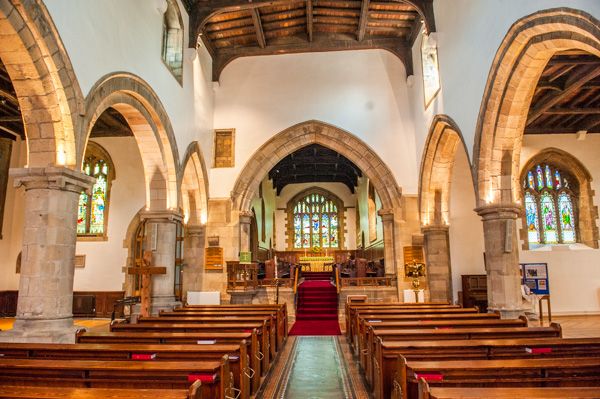
The interior of the church
The Bells
The tower contains 8 bells, with a tenor of 17-0-0 in the key of F. They comprise complete Mears ring of 6 of 1823 hung in an 8 bell frame, to which John Warner & Sons added the trebles in 1866.
They were overhauled by Taylors in 1952. A sound control system was added in 2004, which means that the bells are more available to ringers than they once were.
The church website states:
There is a belief that St. Mary’s first bell came from Egglestone Abbey in about 1690 which raises the question of where the bell had been since 1539 when the disestablishment of religious houses, including Egglestone Abbey, was completed by Henry VIII.
What is certain is that six bells were hung in the tower in 1824, replacing the existing four bells, two of which had become unserviceable.
A contemporary account shows that spaces were left for two further bells, to be purchased by public subscription. The original six bells (now 3-8) were cast by Mears of London and arrived in Barnard Castle amidst scenes of great rejoicing. The wagon which carried the bells was “decked out with flags and escorted by hundreds of the town’s inhabitants.”
The cost of the bells and their installation was defrayed by money from the sale of the old bells and by generous personal donations. The bells alone had cost £526.
The following was published by the Society of Antiquaries of Newcastle.
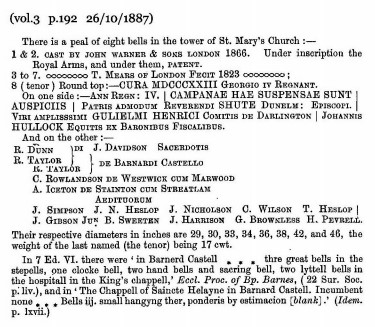
This was reported in Bell News of May 24th 1902
Barnard Castle (Durham).— St. Mary. Durham and Newcastle Diocesan Association. Eight bells. All by Mears, the back six 1822, trebles 1874. Tenor 17 cwt., diameter 4 ft. The ring were rehung in a new tower by Mallaby, 1874. Timber frame. Bells go well. Ropes new 1899. No half-pull ringing, Sunday ringing 10 to 10.30 and 6 to 6.30 No regular practice.
(Details of the bells are incorrect, especially with respect to founder of the trebles.)
It is reported in the edition of November 4th 1911 that Taylors had rehung the bells in that year. In The Ringing World of January 19th 1912 it is noted:
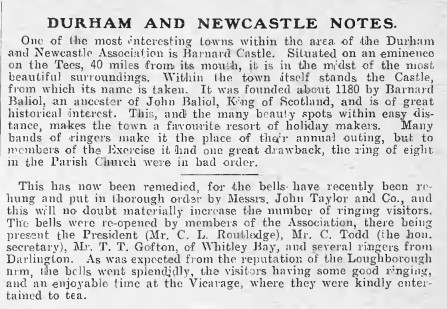
Taylor’s daybook notes. Rehanging the eight bells. New fittings for the eight £80.0.0. Taking off and fixing £38.0.0., Carriage £4.0.0., total £122.
The bells were rehung on ball bearings in 1952, again by Taylors. The daybook states, “Rehanging the ring of eight. New gudgeons and ball bearings £88, new ball bearing pullies £24; rebushing clapper joints etc. £32, sundries, taking off, fixing and carriage etc, total £398.4.0.”
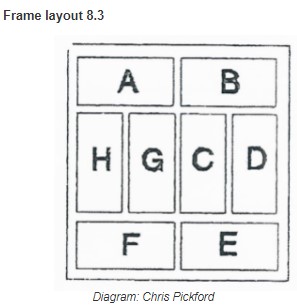
The bellframes are timber; they are of type 6b (long-headed, with braces from sill to head, and jack-braces from brace to head) and layout type 8.3. The two trebles have been one-eighth turned and the others one-quarter turned. The canons have been removed from all the bells.
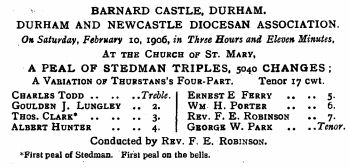
The first peal on the bells was not rung until 1906, when the first ringer to ring 1000 peals, Rev. F. E. Robinson, organised a peal tour in the area, where he arranged 11 peals, losing only one due to a broken rope at Consett, and guided “no less than forty members of the Durham and Newcastle Association” through a peal.
1 5-1-0 29.00″ 1866 John Warner & Sons 1386.5Hz F-13c
2 5-3-0 30.00″ 1866 John Warner & Sons 1302.5Hz E-21c
3 6-1-16 31.50″ 1823 Thomas II Mears 1172.5Hz D-3c
4 7-1-21 33.63″ 1823 Thomas II Mears 1051.5Hz C+8c
5 8-3-2 36.25″ 1823 Thomas II Mears 943.0Hz Bb+20c
6 9-0-11 37.75″ 1823 Thomas II Mears 878.0Hz A-4c
7 12-1-14 41.50″ 1823 Thomas II Mears 785.0Hz G+2c
8 17-0-0 46.50″ 1823 Thomas II Mears 688.0Hz F-26c
Inscriptions
| 1 |
CAST BY JOHN WARNER, LONDON 1866 |
| 2 |
CAST BY JOHN WARNER, LONDON 1866 |
| 3 |
T. MEARS OF LONDON FECIT 1823 |
| 4 |
T. MEARS OF LONDON FECIT 1823 |
| 5 |
T. MEARS OF LONDON FECIT 1823 |
| 6 |
T. MEARS OF LONDON FECIT 1823 |
| 7 |
T. MEARS OF LONDON FECIT 1823 |
| 8 |
AD MDCCCXXIII GEORGIO IV REGNANTE Opposite side CURA |
Translation of tenor inscription:
In AD 1823, George IV being King, in the fourth year of his reign, these bells were hung under the patronage of : The Right Reverend Father Shute, Bishop of Durham : The Right Hon. Henry, Earl of Darlington : Sir John Hullock, one of the Lords of the Treasury. Trustees : Reverend J. Davidson, Priest …. etc.)
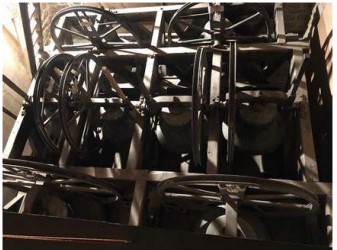
The Bells.