Cullercoats, St George 4: 22½cwt in Eb MAP
Nearest Metro Station: Cullercoats
 With its spire which rises 180ft above the ground overlooking the Long Sands, Tynemouth, St. George’s is an iconic landmark on the North East Coast. It is an integral part of the Coastal Heritage Trail stretching 3 miles from the mouth of the River Tyne to St. Mary’s Island at Whitley Bay. It is the first landmark to be seen by visitors travelling by sea, and clearly visible to those arriving by air to Newcastle airport.
As a Grade I listed building, the church’s heritage rests mainly on the splendour of the work of the renowned architect, John Loughborough Pearson (1817-1897). It is further enhanced by the magnificent stained glass the work of Charles Eamer Kempe (1837-1907) and more recently Leonard Charles Evetts (1909-1997). In addition, there is a well known organ by Thomas Christopher Lewis (1833-1915).
In the 1880s the sixth Duke of Northumberland began the planning for a church here in Cullercoats in memory of his late father, George, the fifth Duke. The foundation stone was laid in 1882 and the church was finally dedicated in 1884. The stone vaulting is “magnificent” and the world renowned organ by T.C. Lewis is in its original state.
Source: http://www.stgeorgescullercoats.org.uk/our-heritage/our-heritage.php
The church is built from rregularly-coursed squared sandstone with ashlar dressings and plinth. There is a graduated slate roof with stone gable copings. There is an aisled nave with transepts and a tower on south transept and a 5-sided apse to chancel with north vestry. It is built in the “Early English” style.
There are 2-centred-arched doors with elaborate hinges in open west bays of aisles (that on north now glazed). There are tall 2-light plate-traceried clerestory windows in the 5-bay nave; lancets to aisles and to the west baptistry under 2 groups of 3 stepped lancets divided by gabled buttress. There are similar buttresses with octagonal spirelets flanking 8-foil roundel in west gable peak. The apse has 2-light windows and there are 3-light windows in first stage of tower. There are slit openings under paired 2-light belfry openings in upper stages and flat east stair turret. The broach spire has tall lucarnes.
The interior is of ashlar, with groined vaulting. There are moulded double-chamfered nave arcades on round piers with moulded capitals. There is a shallow blind triforium; quatrefoil-pierced parapet to the west gallery above groined-vaulted, arcaded baptistry; high double-chamfered arches to crossings have dog-tooth moulding. There is a high blind apse arcade. Ther are steeply sloping sills, wide splays and moulded rear arches to all windows. The chancel has a Terrazzo and marble floor and there is a stone communion rail and pulpit. There is a “Stanhope” marble base to square font on pedestal and 4 columns. There are Art Nouveau copper light fittings in aisles. The east pier of south arcade has a brass plate commemorating laying of foundation stone on 4th August 1882.
Source: https://historicengland.org.uk/listing/the-list/list-entry/1355000
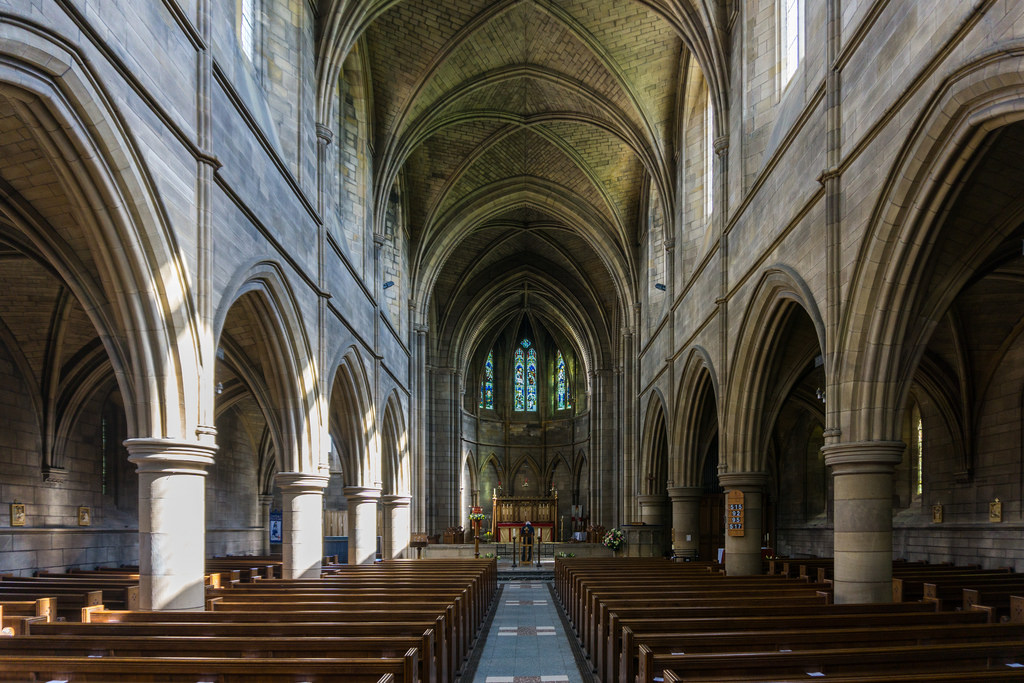
The Interior of the church
The Bells
1 6¼cwt 30.88″ 1887 John Warner & Sons 1254.4Hz Eb+14c
2 12¼cwt 41.25″ 1887 John Warner & Sons 773.0Hz G-24c
3 15½cwt 45.00″ 1887 John Warner & Sons 693.0Hz F-14c
4 22½cwt 50.00″ 1887 John Warner & Sons 614.5Hz Eb-22c
There are four bells in the tower. According to the inscription I have for the tenor, from Peter Rivet’s excellent booklet, there were to be 10 bells in total. Elsewhere, it is stated that these bells are 1, 6, 7 & 8 of a ring of 8. If anyone has a photograph of the inscription, having braved the rather scary ascent up the tower, I would love to receive a copy of it.
The bells were hung dead in 1961, according to the “lost rings” spreadsheet that is available from the Keltek Trust Website.
Co-Curate reports: “The church has four fixed bells which are struck by hammers operated by bell ropes from the ringing chamber. Two of the bells’ hammers require repair (damaged due to wear and tear 2005). The smallest bell is most used as it has a second pulley in a more convenient location.”
The Friends of St George’s report that the framework is “fragile”.
There have been moves to put a ring back into this tower in recent years, but everything appears to be on hold at the moment.
The inscription I have for the tenor is:
CAST BY JOHN WARNER & SONS LONDON 1887
TO THE GLORY OF GOD
THIS PEAL WAS COMMENCED AND
THE TREBLE, 7TH, 8TH AND TENOR BELLS
WERE HUNG IN THE TOWER OF
ST GEORGE’S CHURCH, CULLERCOATS
IN THE YEAR OF GRACE 1887
JONATHAN JACKSON SEAVER M.A. VICAR
GEORGE RIX DUNCAN
EDWARD GREEN CHURCHWARDENS