Jesmond, St George 8: 18-0-20 in E MAP
 Ringing:
Sunday: 09:00 to 09:30.
Practice: Friday 19:45 to 21:00
Nearest Metro Station: West Jesmond
Church History
Visiting bellringers should note that this church is not Jesmond Parish Church, which is elsewhere and of limited interest for its bells, at least, it having but one chiming bell. It is well worth viewing this church, if you are able to.
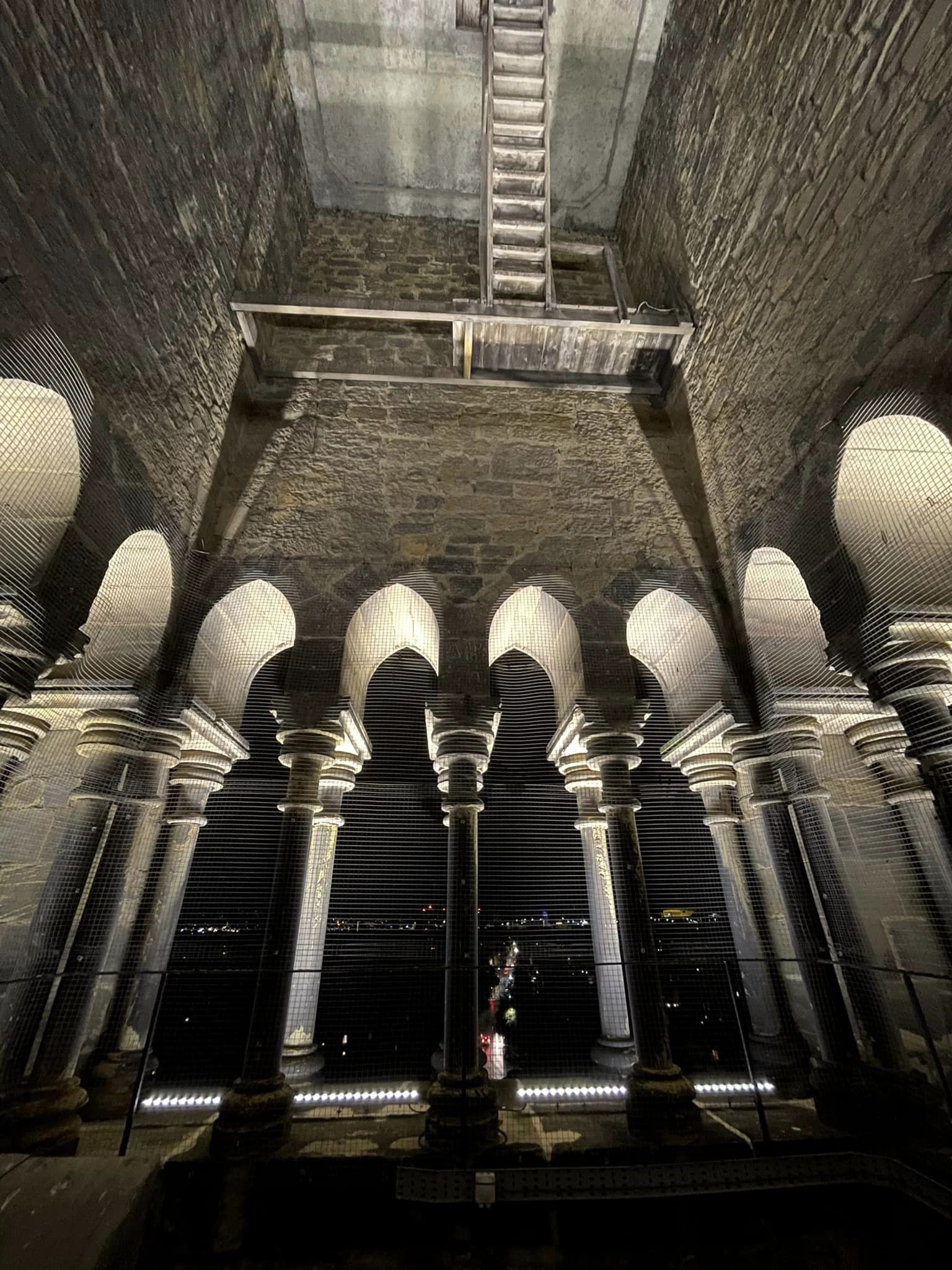
This church was built 1888 by T.R. Spence, paid for by Charles Mitchell. It was built from sandstone ashlar with a plinth, a graduated Lakeland slate roof with stone gable copings. There is aisled nave with a south porch and a west baptistry, an aisled chancel, a south-east tower and a vestry. The church is 13th century in style with a distinctive Venetian 154 foot tall campanile.
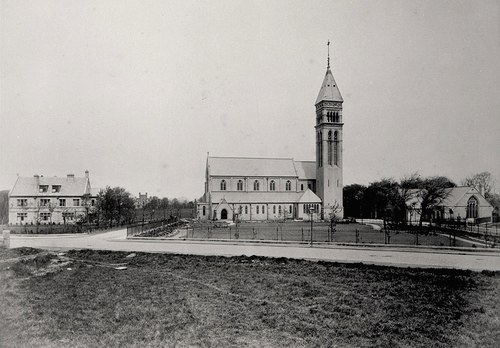
Source: jesmondhistory.uk.net
There is a panelled and glazed recessed double door in the gabled porch with ornate iron gates. Tall 2-light west and 3-light east windows have bar tracery; there are lancets in the aisles, baptistry and vestry. Thre is plate tracery to the 2-light clerestory windows. The tall tower has long, transomed belfry lancets with shafts; a corbel table under a pyramidal roof and a similar roof to the vestry.
Internally, the 5-bay arcades have round piers with high moulded plinths and moulded capitals with moulded 2-centred arches. It is enriched throughout with Arts-and Craft decorative work of outstanding quality including a bronze statue of St. George in canopied niche, designed by Spence, in the west wall which is filled with Caen stone carved in crocketed tracery and niches.
The whole of west window and figures of east window were designed by John W. Brown (from Newcastle but then at Church St., Stoke Newington); other glass is by C. W. Mitchell, son of the donor. The 2 west aisle windows were made by O’Neil Bros., London and other windows made by Gateshead Stained Glass Co. The mosaic lining of the chancel is by Spence, with figures designed by C. W. Mitchell and executed by Rust and Co., London.
The wrought iron, brass and copper is by Alfred Shirley, Cable Street, London and the marble altar, reredos and font by Emley and Co., Newcastle. The oak pulpit is by Ralph Hedley, the screens are by him and Messrs. Robson and Co., Newcastle. There is stencilled decoration to the wagon roof of nave and a painted, square-panelled, chancel roof. There are also stencilled aisle roofs. There is a bronze memorial tablet signed by Frampton that commemorates Charles Mitchell, who was partner to Lord Armstrong, which has marble and enamel decoration.
Source: https://historicengland.org.uk/listing/the-list/list-entry/1024784
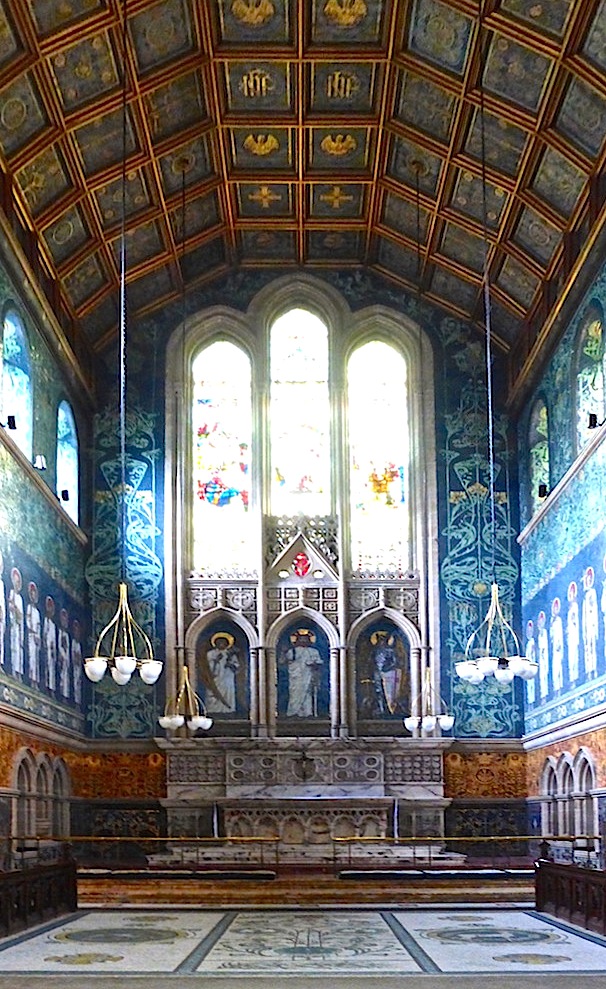
The fabulous mosaics in the chancel
Click on this source for more details – worth a read!
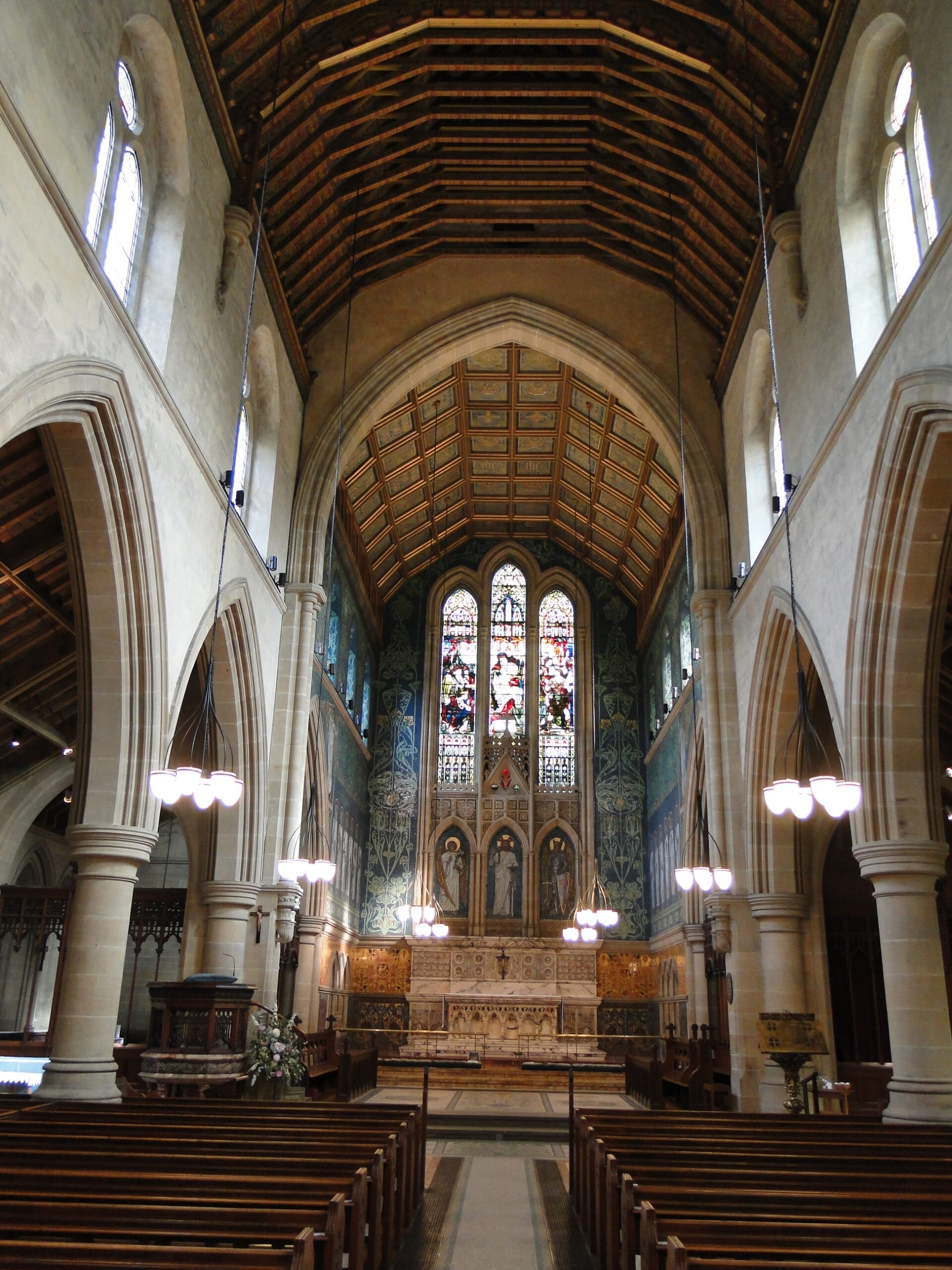
The interior of the church. Source: Northern Vicar
The Bells
These were a complete ring by Taylors, 1888. They were hung in the cast iron frame from the same date. This is a “High A -Frame” and the job was completed on 7th February 1889.
The “Bell News and Ringers’ Record” reported in their edition of February 23rd 1889:
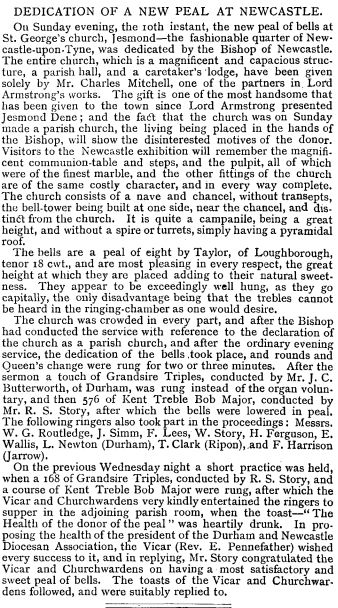
This note about ringing here appeared in Bell News on January 2nd 1904:
St. George. Durham and Newcastle Diocesan Association. Eight bells. All by Taylor, 1889. Tenor 18cwt., diameter 3 ft. 10 in. Iron frame. Bells go well. Ropes new 1889. No half-pull ringing. Sunday ringing : 10.15 to 10.40, and 6 to 6.25. Practice: Tuesday, 7.30. except in summer.
It appears that the local band did indeed ring “only” call changes, as this appeared in The Bell News of August 30th 1913:
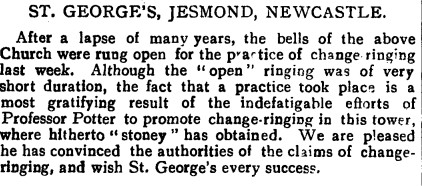
The bells were recently rehung in 1937, according to a report of a district meeting. I cannot currently find a report of what work was done. This would be interesting to locate, as there is a note on the church website of the bells being rehung with new fittings and retuned in 1922. Could the District Secretary be thinking that 15 years was “recent”?
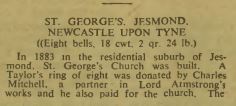
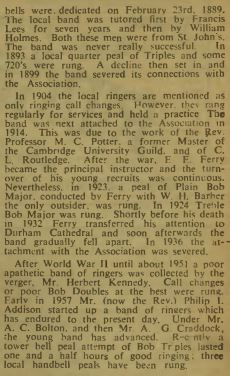
A series of articles about ringing in the locality was published in The Ringing World in early 1966. The January 14th edition said about Jesmond:
 |
 |
They were overhauled by the same firm in 1991, at which time the second bell was recast and the bells tuned. The tenor was previously 18-2-24 in F. The canons for bells 1,2 and 4, at least, were removed at this time. They hang in a two-tier frame, with the trebles above the other 6 bells.
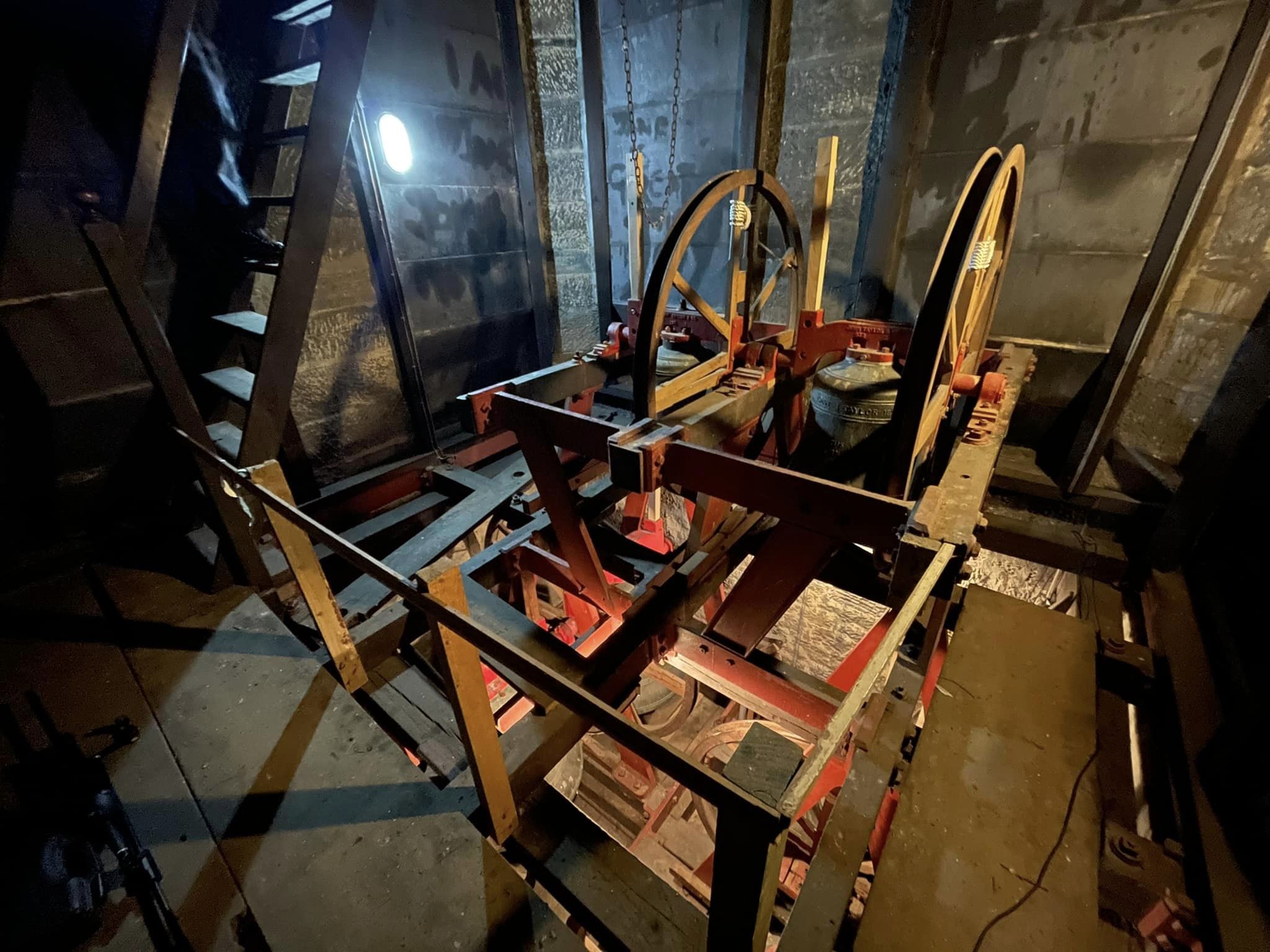
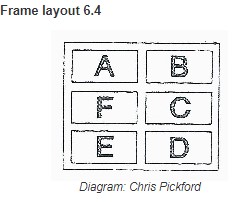
The framework remains the cast iron one that was installed with the bells by Taylors in 1888. Th lower frame’s truss is: 8.3.C.b – which makes them cast iron “high-A Frames” with timber top and bottom beams, and the layout is 6.4. The upper frame has the trebles side-by-side. It is also composite timber and cast iron, has truss: 7.A.a and layout 2.X1 Previously, the bells had been rehung on new fittings and also retuned in 1922.
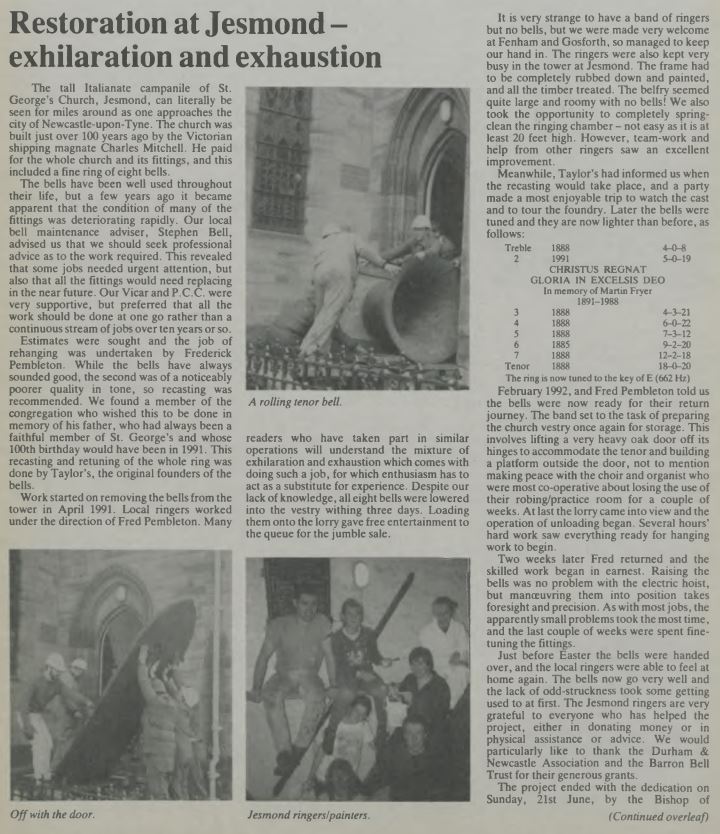
The 1992 restoration was reported in The Ringing World of August 14th 1992:
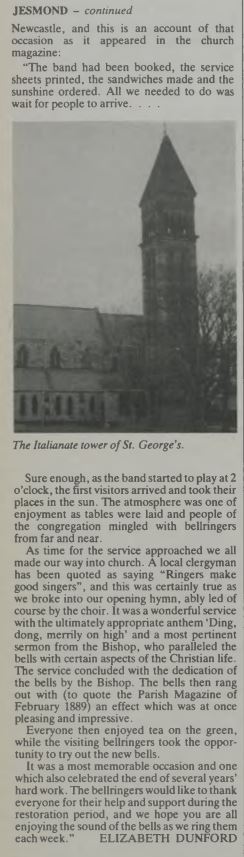
The bells were not inscribed, but there is a maker’s stamp on each bell. The new second bell is inscribed
| CHRISTUS REGNAT GLORIA IN EXCELSIS DEO IN MEMORY OF MARTIN FRYER 1891-1988 |
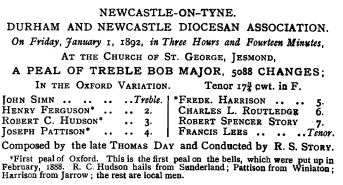
The first peal on the bells was rung on New Year’s Day 1892 and reported in “Bell News and Ringers’ Record” thus:
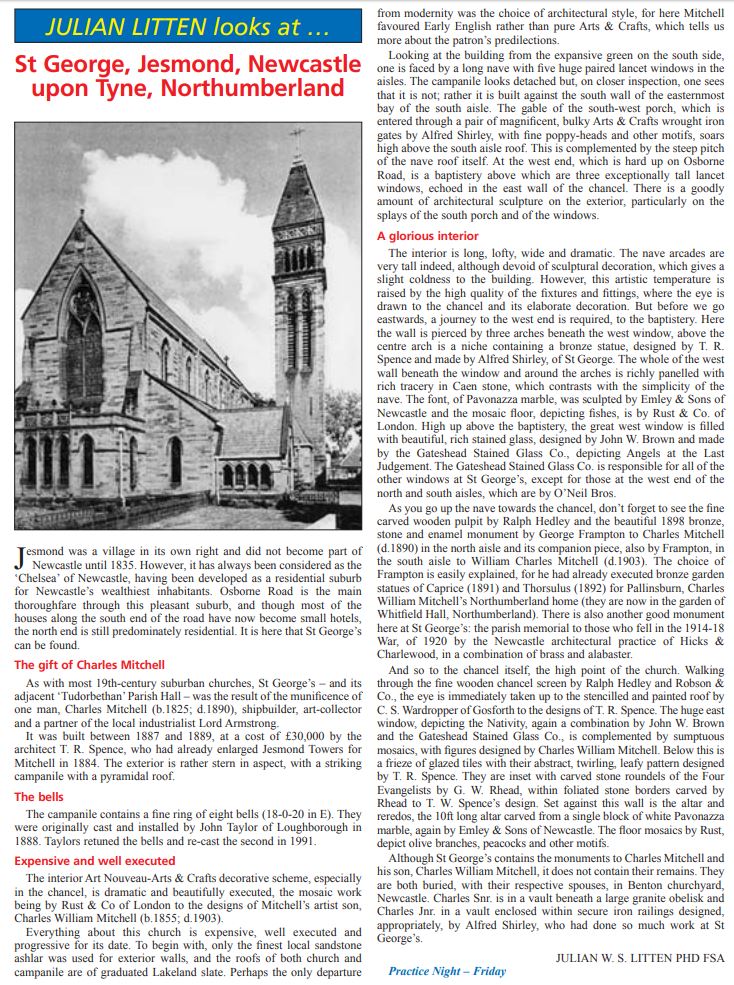
An article about the church by Julian Little was published in The Ringing World of May 23rd 2008.
1 4-0-8 26.50″ 1888 John Taylor & Co 1322.0Hz E+5c
2 5-0-19 27.56″ 1991 John Taylor Bellfounders Ltd 1243.0Hz D#-2c
3 4-3-21 31.50″ 1888 John Taylor & Co 1112.0Hz C#+5c
4 6-0-22 31.88″ 1888 John Taylor & Co 986.0Hz B-3c
5 7-3-12 35.13″ 1888 John Taylor & Co 885.0Hz A+10c
6 9-2-20 36.75″ 1885 John Taylor & Co 836.0Hz G#+11c
7 12-2-18 41.13″ 1888 John Taylor & Co 744.0Hz F#+9c
8 18-0-20 46.63″ 1888 John Taylor & Co 662.0Hz E+7c
 |
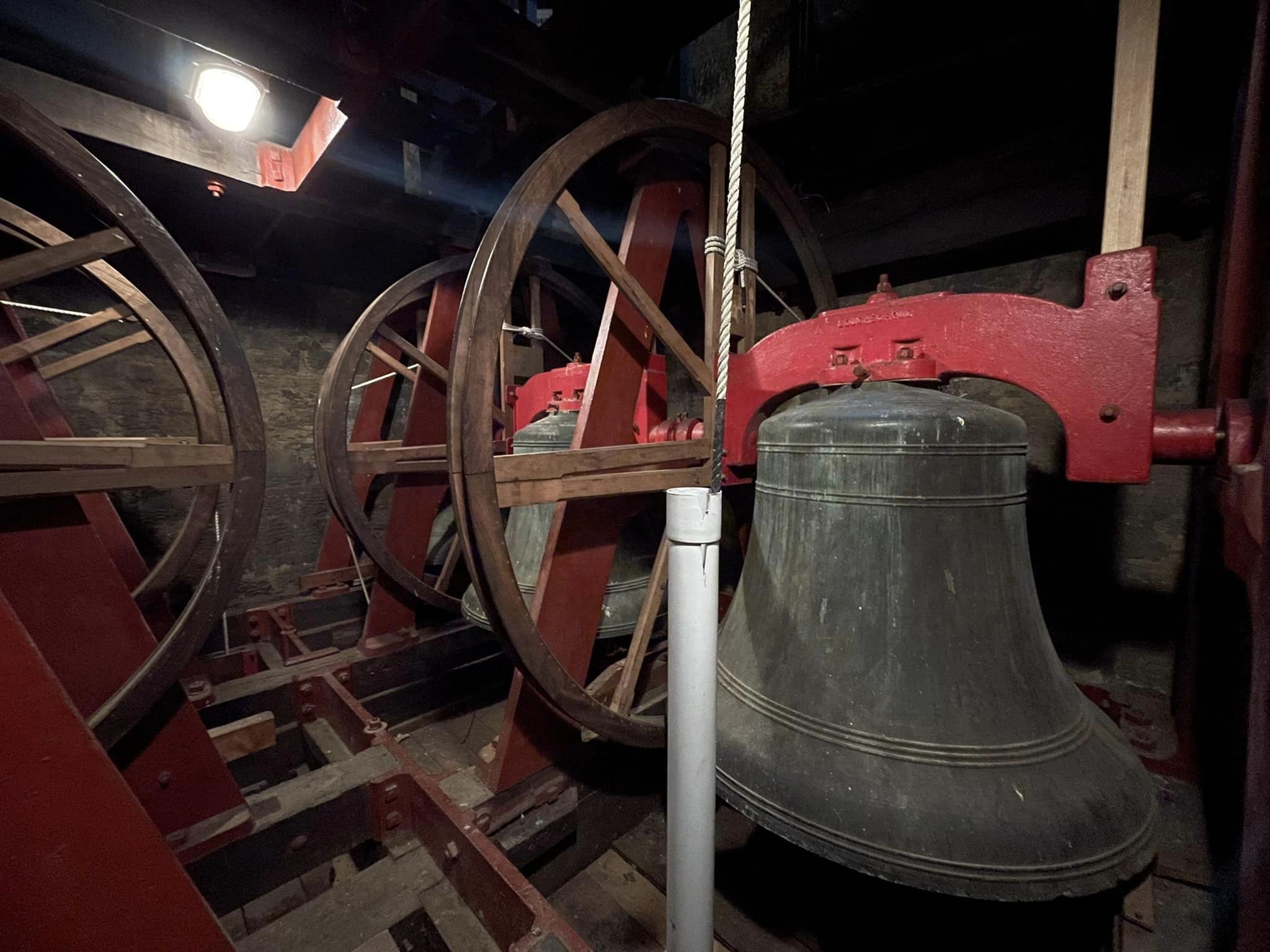 |
| The Upper Frame – Bells 1 & 2 | The Lower Frame – Bells 6, 7 & 8 to the Right |
 |
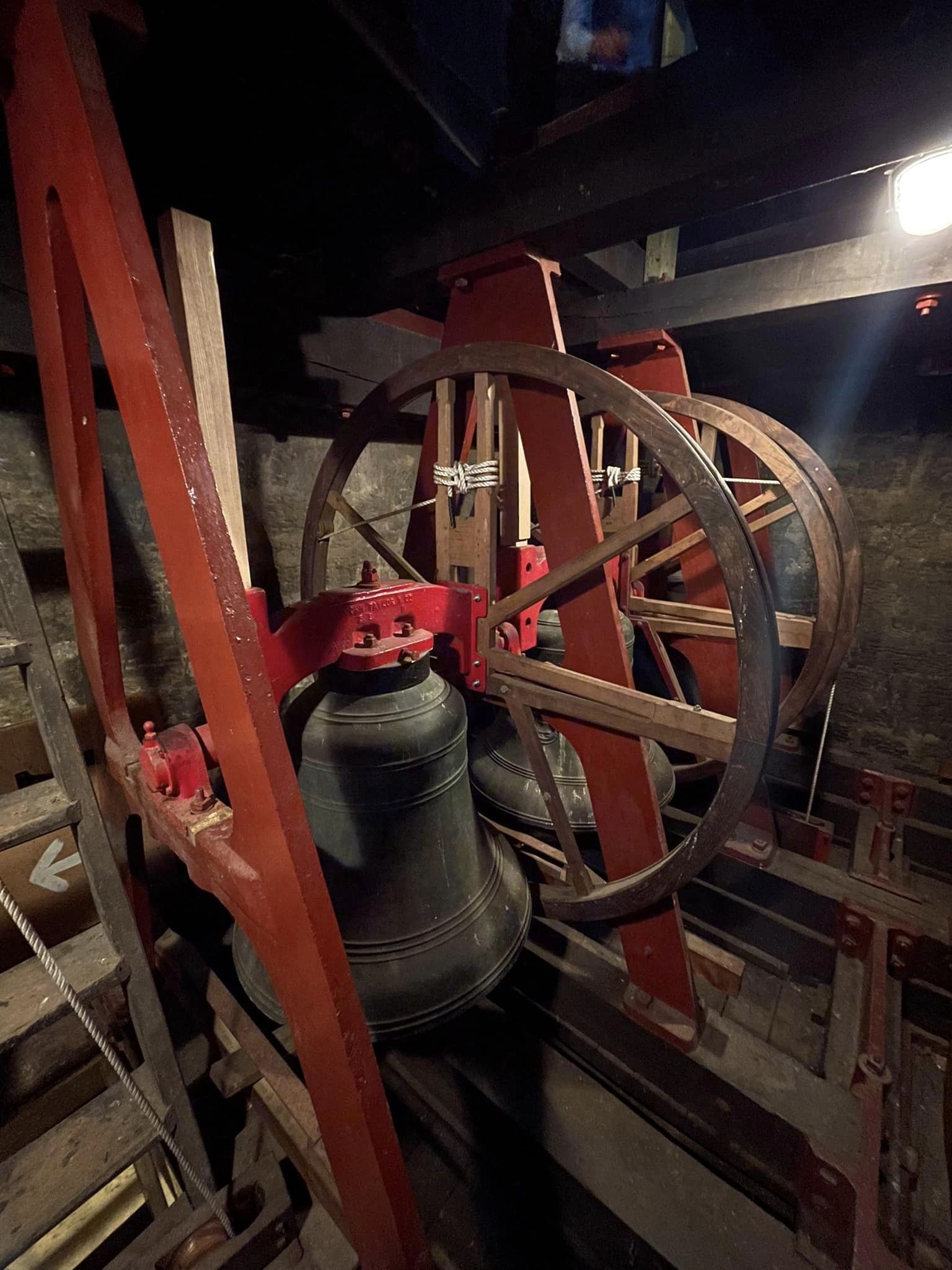 |
| Inside the Tower | The Lower Frame – Bells 3, 4 & 5 |
 |
Photos ©Jack Hanlon |
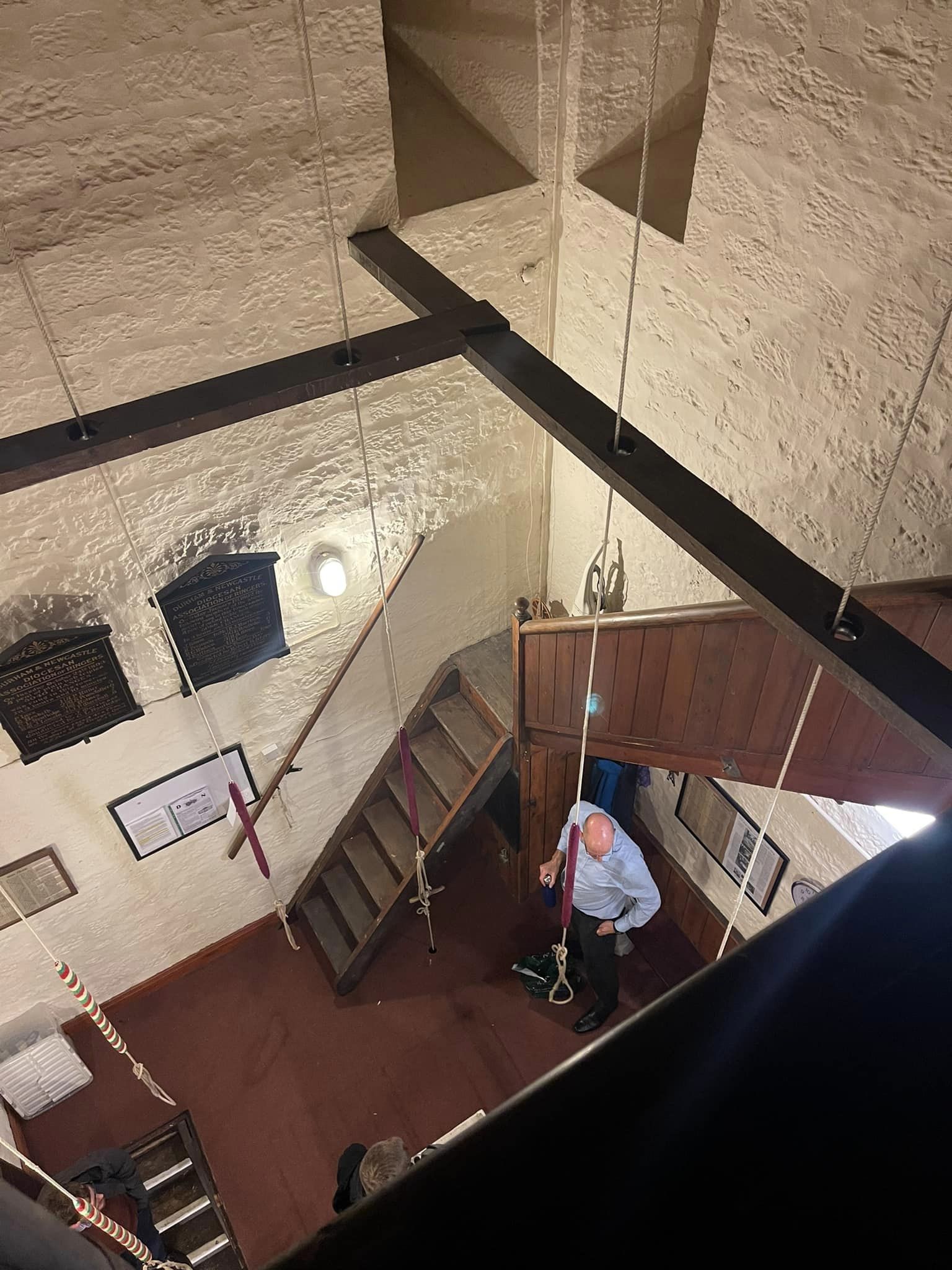
| The Ringing Chamber | |
 |
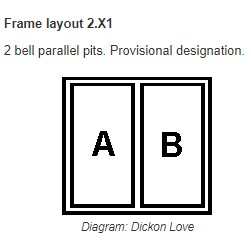 |
| The layout of the lower frame | The layout of the upper frame |