Berwick upon Tweed, Town Hall 8: 20-3-14 in Eb MAP
 Ringing:
Sunday: 17:15 to 18:00.
Practice Thursday 19:00 to 20:30
History
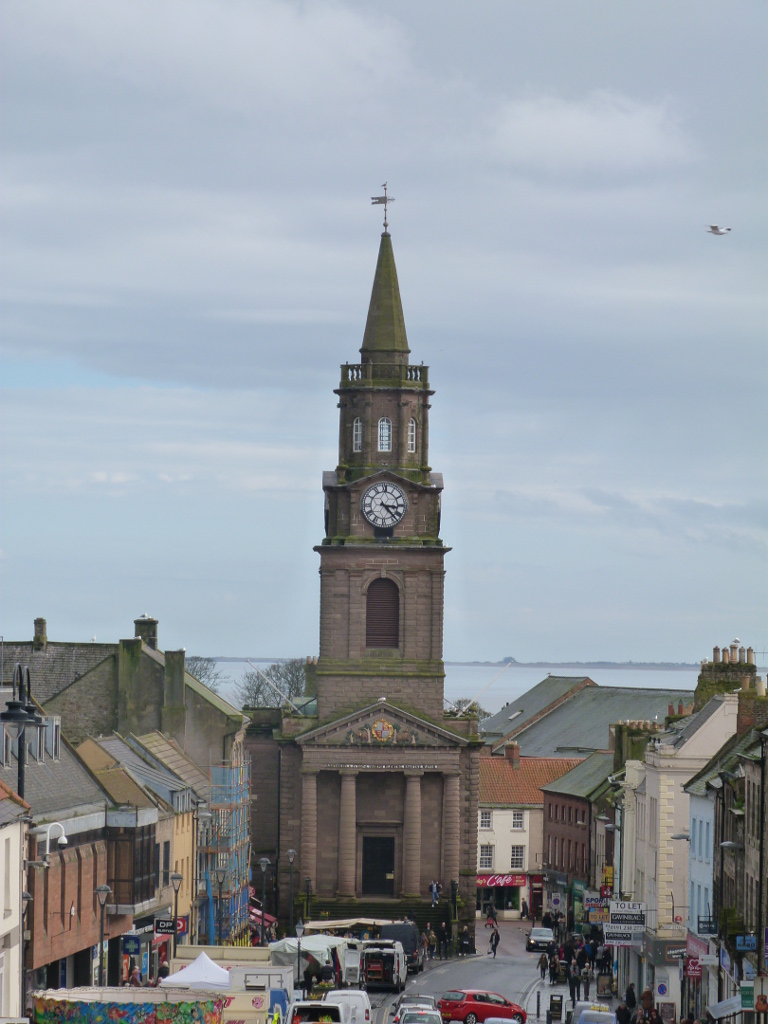
The Parish Church in Berwick was built during the Commonwealth. It was not provided with a tower, allegedly at the direction of Cromwell himself. The bells are rung for services there. As the Town Hall looks a like a large 18th century church, there are stories told of soldiers stationed at the barrack being marched up to it for service on a Sunday by mistake!
The previous Town Hall,or Tollbooth also had bells and they were traded in for the new bells in the new Town Hall in 1754. No details survive and it is not known if they were rung full circle, or merely chimed. They were rung for the visit of Cromwell in 1657, but also on the day of the accession of Charles II in 1660!
By 1747 the Tollbooth was showing signs of decay and the steeple or Bell Tower of the Tollbooth was in a serious condition. It was recorded that this was believed to be the third Tollbooth built on this site. It was decided to build a new Town Hall. A Committee was formed in 1749 to consider the building of a new “Tollbooth, steeple and proper goal”. The Guild ordered that every burgess living within the town who failed to attend the Guild Meeting to discuss this matter was to be fined six shillings and eight pence.
At this time events caught up with the Guild as in December, 1749, the Tollbooth fell down, leaving the Bell Steeple in a dangerous condition. A new Town Hall Committee was formed to erect not only a new steeple and Tollbooth, but also ‘a strong goal for the safe and secure keeping of all malefactors and other offenders’. An additional tax of two shillings per acre was placed on all meadows and it was ordered that all other fields be divided into lots to allow them to be taxed. This was still not enough to build a new town hall and a further £5,000 was raised by two annuities which paid £200 per year. These were taken up by two elderly Freemen living in London. They were raised through the Mayor’s brother, Mr.George Temple, who lived in London. The Corporation debt at this time was paying 5% interest and the capital was offset against the debt until it was required for the new Town Hall.
In July 1750 the old building was authorised to be demolished by Joseph Dods, a local carpenter and member of the Guild. Dods was born in 1716 and served his apprenticeship to his father as a carpenter and builder. He was ordered to recover the bells, the clock and any other material worth saving. At the same time it was decided to have a new peal of bells and a new clock. The old bells were sent to London and recast at a cost of £300.
Local builders and carpenters were asked to take part in a competition to determine a suitable design for the new building. The winning design was submitted by Joseph Dods. The design used the existing building with a new section on the west side. As Dods had no previous experience of the design of major buildings, the Guild sent his plans to architects in London for approval. One of these Architects was Samuel and John Worrall. They submitted their own design with two elevations and one section. They were paid thirty one pounds ten shillings. It would appear that the Architects reflected the ideas contained in a book on classical architecture written by James Gibb, a Scotsman. The Church of St.Martin’s in the Field in London, which was built twenty five years before Berwick Town Hall, reflects these same ideas.
Joseph Dods submitted a new design which showed a remarkable similarity to the design put forward by the Worrals. There were minor modifications and the addition of a portico. Joseph Dods modelled the whole building in wood and this model stood for many years in a garden on the north side of the walls. The Guild chose Joseph Dods as the Architect for the new Tollbooth on 23rd. October, 1750.
The Town Hall is owned by the Berwick-upon-Tweed Corporation (Freemen) Trustees. It occupies a prominent place in the town at the lower end of the High Street facing west. The spire rises to 153 feet and is the main feature an the skyline of Berwick. Construction is of local sandstone and the total length 132 feet (40 metres). The portico is supported by four massive Tuscan columns, 32 ft, (9.75 metres) high by 17ft. 6 ins.(2.9 metres) diameter. These form the entrance to the Guild Hall. On the portico is carved the name of William Temple who was Mayor in 1754 when the first part of the building was completed. Above this is the bell tower, the clock tower, the octagonal cupola and the spire, which is roofed with timber, covered by slate and lead and enclosed in a balustrade. This is topped by the weather vane.
Considerable weathering takes place of the sandstone blocks which comprise the outside of the building. Sandstone from Wooperton Quarry have been used to replace some blocks. In 2005 part of a block fell off. Emergency repairs of the outside were completed of 2005/6
The ground floor originally contained shops and some cells, with an open market to the east, which was called the Exchange. This was the location at which the hiring of servants took place and was also a market for poultry and dairy products. The ground floor has been substantially restored in the early 1970s with the original cells at the west end made. into a coffee house and gift shop. The east end is now referred to as the Buttermarket.
Source: https://freemenofberwick.org.uk/town-hall/
The Bells
The bells were initially a complete eight from the Whitechapel foundry of Lester & Pack in 1754. They were installed when the Town Hall was rebuilt in 1750-54. There were 5 bells with a tenor of 14cwt in the old Town Hall. Four were sent to London: “largest 14-1-14, second 9-3-11, third 7-1-13 and first 4-3-26” – making 36-2-8 in total for which the founder allowed 36-1-8 after the deduction of “the old staples etc”. The other bell was retained to be used until the new ring arrived. The new ring was hung by William Lawrence of Thame, Oxfordshire.
The Newcastle Society of Antiquaries reported on 25/3/1891 about the bells:
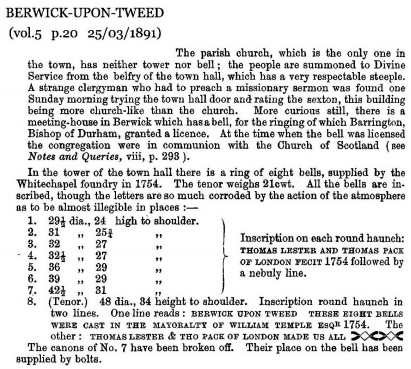
The bells were in a very poor state and unringable for many years, before being rehung in time for the millennium. At least one bell was cracked. The 2nd, 6th and 7th bells were replaced by bells that were removed from Stourbridge, St Thomas, which became available when they were replaced by new bells that were cast for Stourbridge by Taylors. The curfew bell is from the same source.
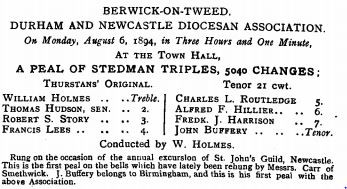
One peal was rung on the “old” bells; Stedman Triples in 1894, shortly after the bells had been rehung by Carrs of Smethwick.
The opening of the bells was “fully”(!) reported in “Bell News and Ringers’ Record” in the edition of May 5th 1894.
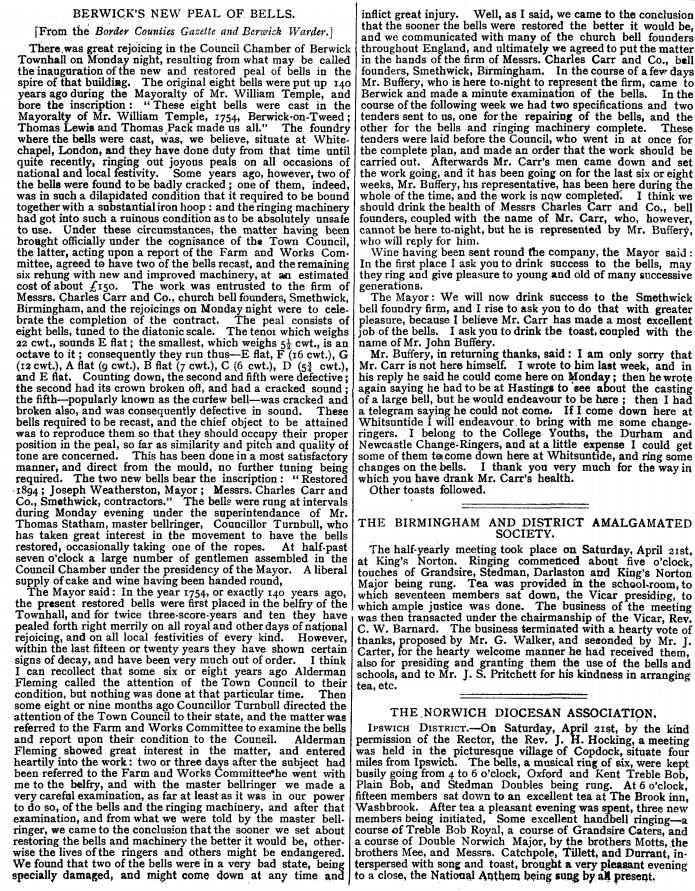
(Click to enlarge)
Kenneth Arthur, a ringer at Fenham, posted a report about the bells in The Ringing World of November 15th 1946. He was somewhat uncomplimentary about the state of the bells:
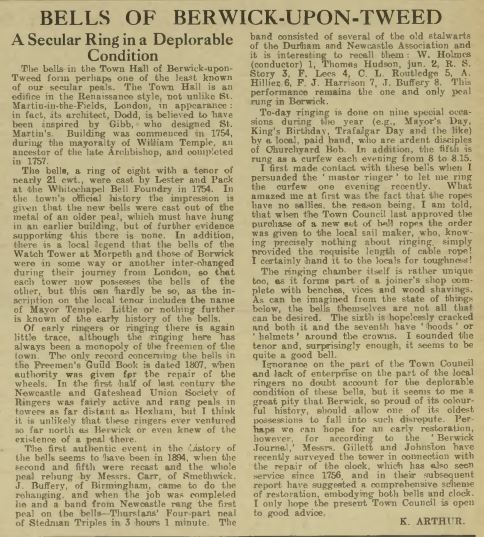
A note about a district outing in The Ringing World of July 8th 1955 tells us that the D&N certainly regarded the bells as being unringable by this time. A note by Kenneth Arthur in 1956 tells us that: “they were rung by occasional visiting bands until just before the last war”.
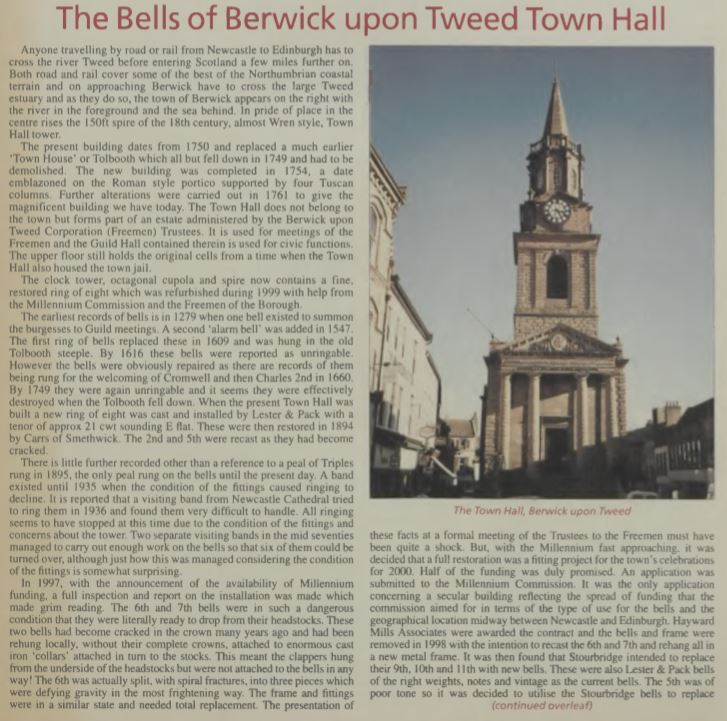
The restarting of ringing after the 1999 rehang was reported in The Ringing World of January 7th 2000:
“The Berwick on Tweed Town Hall bells were rung on the morning of 23rd December 1999 at 11am attended by various council officials, local press, TV etc. This is the first time for 61 years that all eight have been rung. They are an old style ring but go beautifully. The old Stourbridge bells blend perfectly with the other five bells. The new local band trained at Bamburgh will commence a regular practice when the finishing has been done and visitors will be welcome to join them by previous arrangement. An announcement will be made in due course concerning visiting bands and strictly who to contact when this is made possible. No applications will be acknowledged until this is announced or if made directly to Berwick Council.
DAVID HIRD”
Details of the rehanging scheme itself was published in The Ringing World of April 7th 2000:
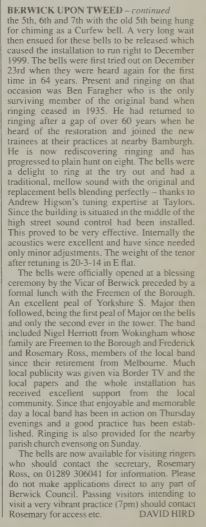
The clappers and crown staples were overhauled by Taylors in November 2020.
The frequencies vary, from just below to just over half way between Eb and F and therefore the notes for each bell are given in relation to the tenor, which is a tiny fraction nearer to Eb than E.
1 6-0-7 29.75″ 1754 Lester & Pack 1277.0 Eb+45c
2 5-2-23 29.75″ 1894 Charles Carr 1191.0 D+24c
3 6-0-13 32.00″ 1754 Lester & Pack 1082.0 C+58c
4 7-1-7 34.00″ 1754 Lester & Pack 963.0 Bb+56c
5 7-3-10 36.25″ 1759 Lester & Pack 856.0 Ab+52c
6 9-1-9 38.50″ 1759 Lester & Pack 808.0 G+52c
7 13-0-8 43.50″ 1901 Mears & Stainbank 720.0 F+53c
8 20-3-14 48.13″ 1754 Lester & Pack 640.0 Eb+49c
Curfew 7-1-10 35.88″ 1894 Charles Carr 843.0 Ab+26c
Inscriptions Prior to 2000
- THOMAS LESTER & THOMAS PACK OF LONDON FECIT 1754
- THOMAS LESTER & THOMAS PACK OF LONDON FECIT 1754
- THOMAS LESTER & THOMAS PACK OF LONDON FECIT 1754
- THOMAS LESTER & THOMAS PACK OF LONDON FECIT 1754
- THOMAS LESTER & THOMAS PACK OF LONDON FECIT 1754
- THOMAS LESTER & THOMAS PACK OF LONDON FECIT 1754
- THOMAS LESTER & THOMAS PACK OF LONDON FECIT 1754
- THESE EIGHT BELLS WERE CAST IN THE MAYORALTY OF WILLIAM TEMPLE, ESQ. 1754. BERWICK UPON TWEED. THOMAS LESTER AND THOMAS PACK MADE US ALL.
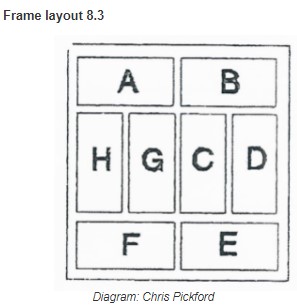
The frame layout