Stockton on Tees, The Parish Church 12: 21-0-11 in Eb MAP
 Ringing:
No Regular Ringing
Church History
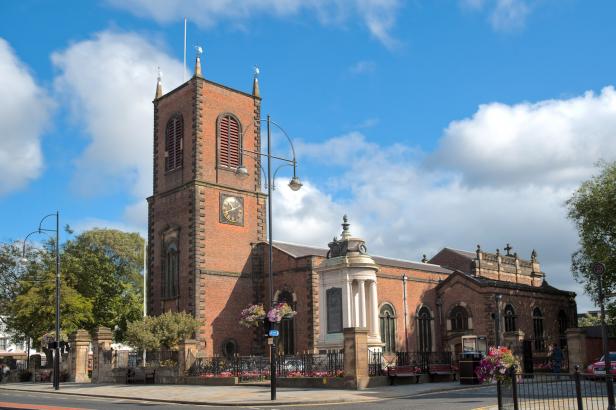
This church replaced a medieval chancery dedicated to St Thomas of Canterbury. Until this point it has been a chapelry of Norton. A new parish was created when it was built in 1710-12, reportedly with advice from Wren, though this is disputed. It was restored 1893 and then re-seated and chancel added by R J Johnson in 1906. The side chapel and choir vestry were added by W D Caröe 1925.
It has a six bay aisled nave with west a tower and a taller three bay chancel (i.e. taller than nave). It is built of brick with stone dressings, quoins, moulded string to parapet and moulded coping. There are round headed windows, each containing a round leaded lancel (original tracery pattern) and with long aprons below. There are lead rainwater heads between most windows, one on north side dated 1712.
There is a low pitched roof (no clerestory) over the nave and aisles with half gables flanking the west tower. The three stage tower has corner pinnacles and round leaded louvre belfry style windows. There is a moulded string over clock stage. The west doorway has been restored and is round headed with segmental pediment open to fanlight, joined by ramped apron to window above which is capped by a pediment. A small version of this on south door segmental eaved architrave with heavy label and shortened window above.
There is a three bay south chapel with a similar door – reused from a position also on south side. There is a taller early 20th century chancel in heavy “Wrenaissance” style. It is brick with brick piers and has stone dressed oeils-de-boeuf windows. Two blocked doorways are to the south. At the east end a large round leaded window with a concave jamb and an armorial cartouche above breaking into open pediment stone balustrade at sides with ball finials to dies; east end pediment has urns at base and cross at apex. Vestries etc, on north side.
Interior: square piers to arcade, composite to rib vaulted south chapel. Top lit aisles, galleries removed. Variety of good carved 19th and 20th bench bench ends to good oak pews (including the Stockton-Darlington railway). There is rich woodwork in chancery and an early 18th century lectern and the upper part of a three deck pulpit. The altar rails are made from drift oak, collected by Captain William Christopher while on Captain Cook’s voyage to Hudson’s Bay. There is a single storey new aisle to south of chancel.
Source: https://historicengland.org.uk/listing/the-list/list-entry/1139977
The Bells
The original ring of six bells consisted of four by Samuel Smith II of York, cast in 1714, and two by Christopher Hodson, dated 1696.
This article appeared in “Bell News and Ringers’ Record” of July 5th 1884:

The following article appeared in Bell News on April 24th 1897:
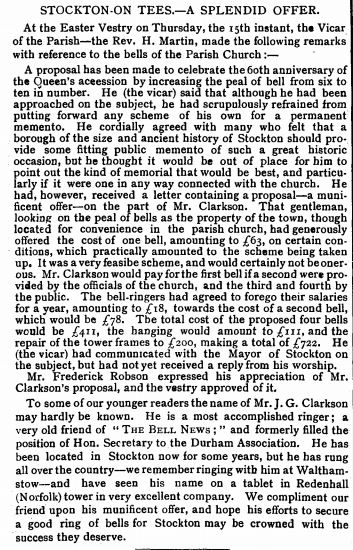
In the June 5th edition the same year this was reported:
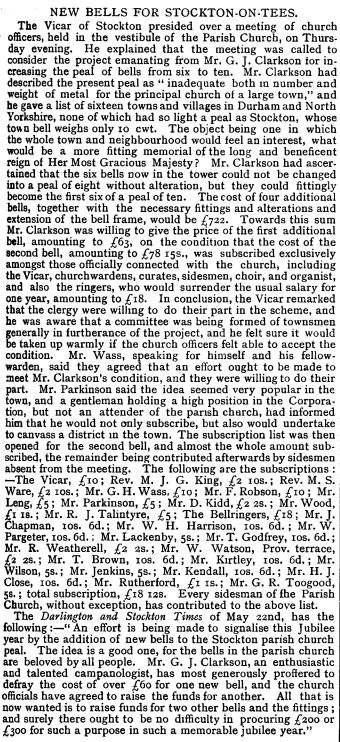
There were other articles in the editions of July 3rd and September 4th 1897, that adds little of interest to most bellringers.
The scheme was indeed successful, four heavier bells, cast by Llewellins and James of Bristol in 1898, were added. The first peal on the 10 being rung 15th April 1902, there being four earlier peals on the ring of 6. The tenor that was noticeably heavier than the current one, at 26-2-10. The cost of this augmentation was £772.
It is interesting to note that work by Llewellins and James is uncommon in this area, there being no extant bells by them in the Durham Diocese and only one small bell of 1895 that is now in Hexham Abbey (ex St Mary) in the Newcastle Diocese. However, immediately below the article above is one about the offer to donate a ring to Thornaby on Tees, just the other side of the River Tees, and therefore in the York Diocese, which went to the same company.
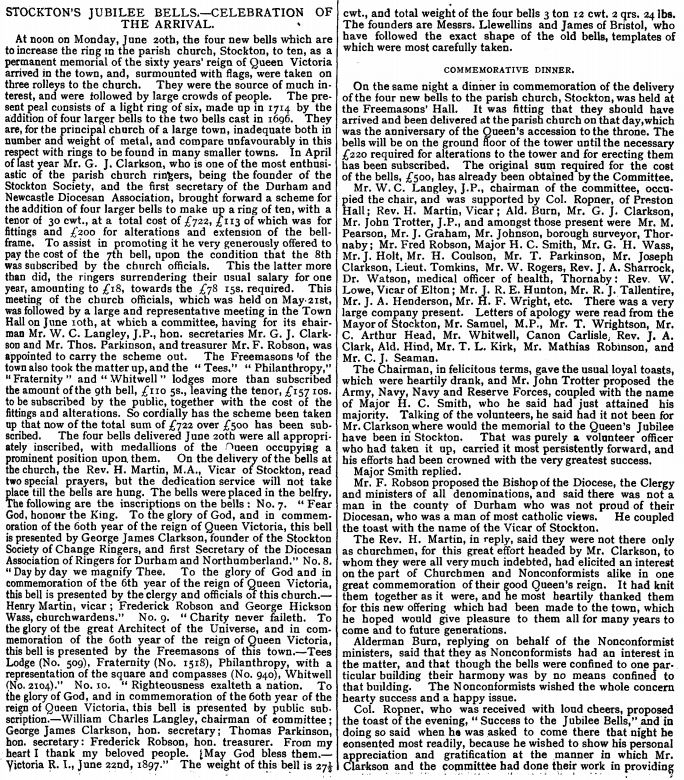
A long article about the arrival of the bells was published in “The Bell News and Ringers’ Record” on July 9th 1898:
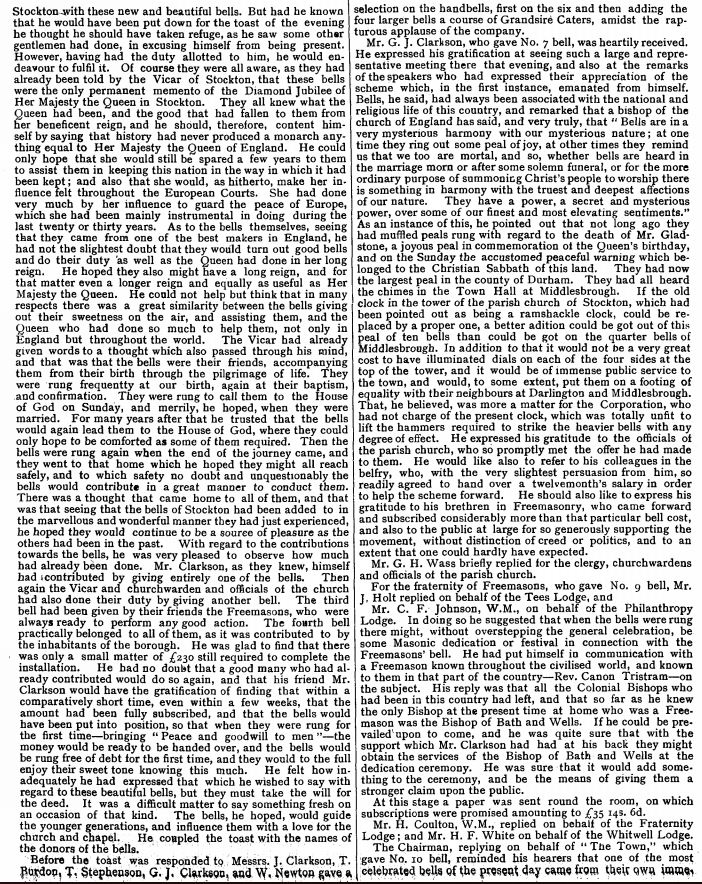
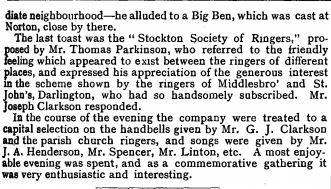
Even so, there was a row played out in the Bell News in 1898 about whether Association ringers would be welcomed and if they actually supported the augmentation project. Mr Clarkson from Stockton said that he had received no support from the D&N, but they said that they never give donations from their funds but had asked members to subscribe to the appear and some had done so liberally.
Also, though the bells were there, they were not yet hung. This appeared in the October 1st 1898 edition:
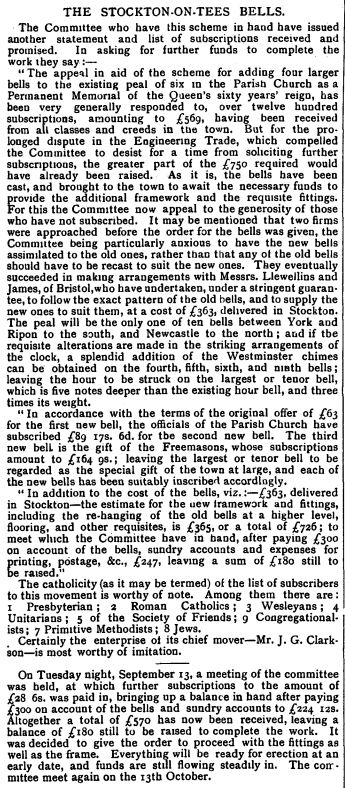
This appeared as a “Current Topic” on October 8th, stating that there was an attempt to ensure that the new bells blended in with the old.
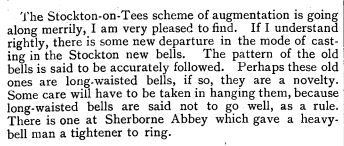
This appeared in the edition of October 29th 1898:
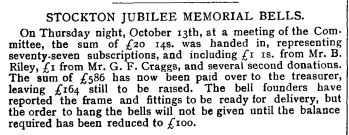
Moving to 1899, the following appeared in Bell News on January 7th:
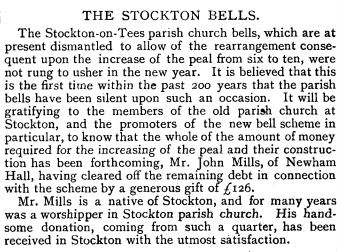
There was yet another report in the edition of January 21st 1899:
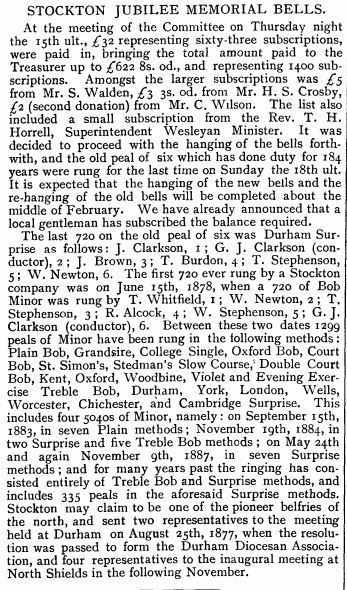
Finally! The report of the dedication of the bells was printed in Bell News in the edition of May 27th 1899:
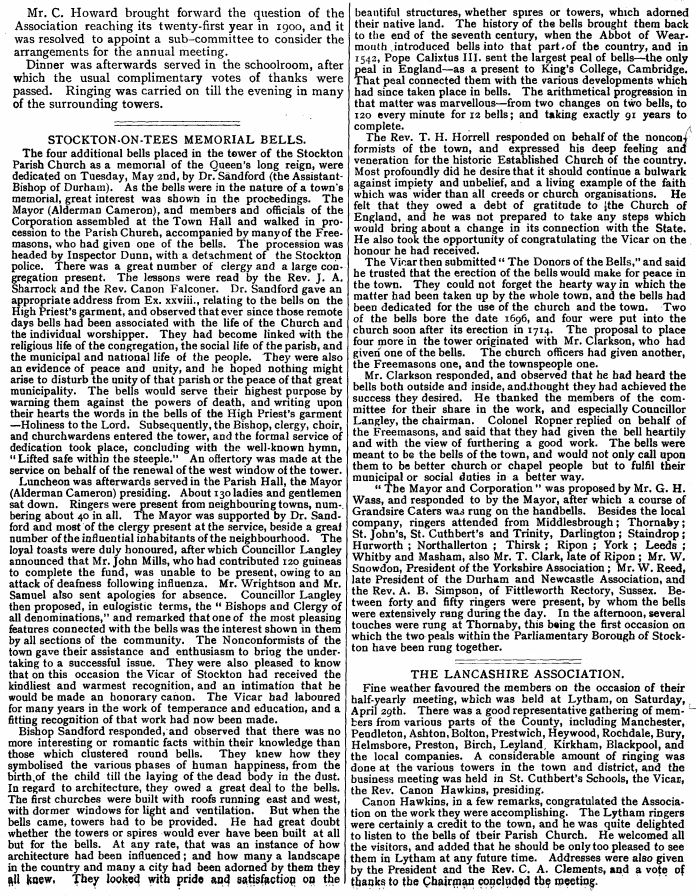
They were apparently unsatisfactory ring of bells, being of indifferent tonal quality. Having said that, 17 peals were rung on these bells, the last being rung on 22nd September 1931.
The following appeared in The Ringing World of January 17th 1947, showing that the ring was not in the best of condition at this point.:
A BOXING DAY TOUR IN THE NORTH EAST
Ringers from Newcastle-on-Tyne and Thornaby-on-Tees joined forces for a busman’s holiday on Teeside during Boxing Day. The rendezvous was the Church of St. Thomas, Stockton, and the bells were raised soon after 10.30 a.m. Stockton bells, a ring of ten with tenor 27½ cwt., have not been rung regularly for many years, and with the inevitable result of neglect have fallen into poor state of repair. Several adjustments, including the freeing of two ropes from the clock works, had to be made before the bells could be raised, but after some valiant efforts touches of Grandsire Triples, Plain Bob and Kent Treble Bob Major were rung.
A completely new ring of bells was cast to replace these by John Taylor of Loughborough in 1953 and hung in a new cast iron frame. Two trebles to complete what is the only ring of 12 in a church the County of Durham, were added in 1983.
The first peal on the bells was rung on the ring of 6 in September 1883.
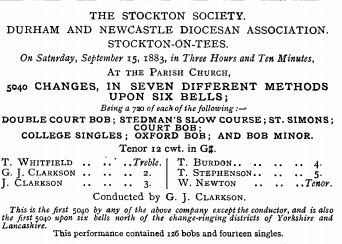
It is noticeable that the ringers were looking at Yorkshire and Lancashire, rather than County Durham in which the church is located. Perhaps the reason is that, for ceremonial purposes, the Borough of Stockton is split between County Durham and North Yorkshire, along the line of the River Tees, with County Durham to the north and North Yorkshire to the south. It is the only council area in England or Wales to be split between two ceremonial counties.
The first peal on the 10 was rung in April 1902, and not by the Durham and Newcastle DA! The details of this peal are:
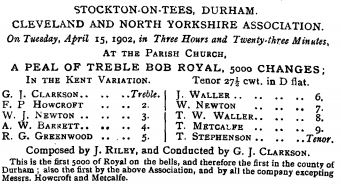
This note appeared in “Bell News and Ringers’ Record” on September 24th 1904:
Stockton-on-Tees (Durham). St. Thomas. Durham and Newcastle Association. Ten bells; treble and 2nd by Hodgson, 1696; 3rd, 4th, 5th and 6th by Smith, 1714; the rest by Llewellins, 1898. Tenor 27 cwt., diameter 4 ft. 7 in. Timber frame. Bells go well. Clocking permitted. Rehung by Llewellins, 1898. Ropes good. Methods : Grandsire, Stedman and Treble Bob. Practice: Tuesday, 7.30
The following appeared in The Ringing World in the edition of July 31st 1953:
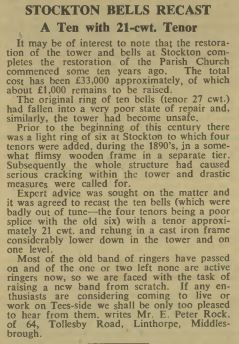
It indicates that the bells was considered to be a “poor splice” and the ring was “badly out of tune” and that the flimsy wooden frame separate to the ring of 6 in which the tenors were hung had caused serious cracking in the tower’s structure.
Then on September 18th 1953:
STOCKTON-ON-TEES PARISH CHURCH. —Civic service of thanksgiving for the restoration of the church and dedication of the recast and rehung ring of 10 bells (John Taylor and Co.) by the Lord Bishop of Durham at 2.45p.m. on Oct. 17th. The bells will be available for all ringers from after tea until 9 p.m. Admission to service by ticket only (free). Tea tickets 3s. 6d. Service and tea tickets available from E. P. Rock, 64, Tollesby Road, Linthorpe, Middlesbrough.
The report of the dedication appeared in the edition of November 6th 1953:
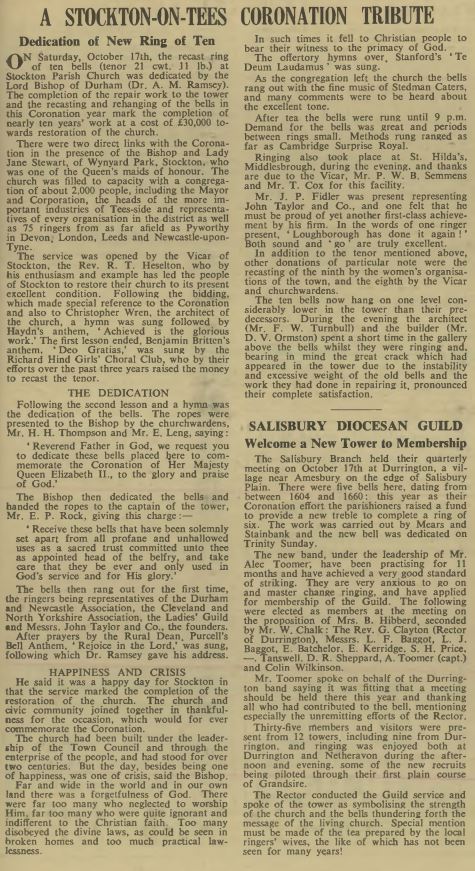
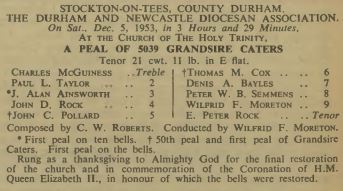
The first peal on the recast 10 was rung, in Coronation year, for the D&N. Details of this peal were published in “The Ringing World”
The bells were overhauled in 1979 and this was reported in The Ringing World on October 26th that year:
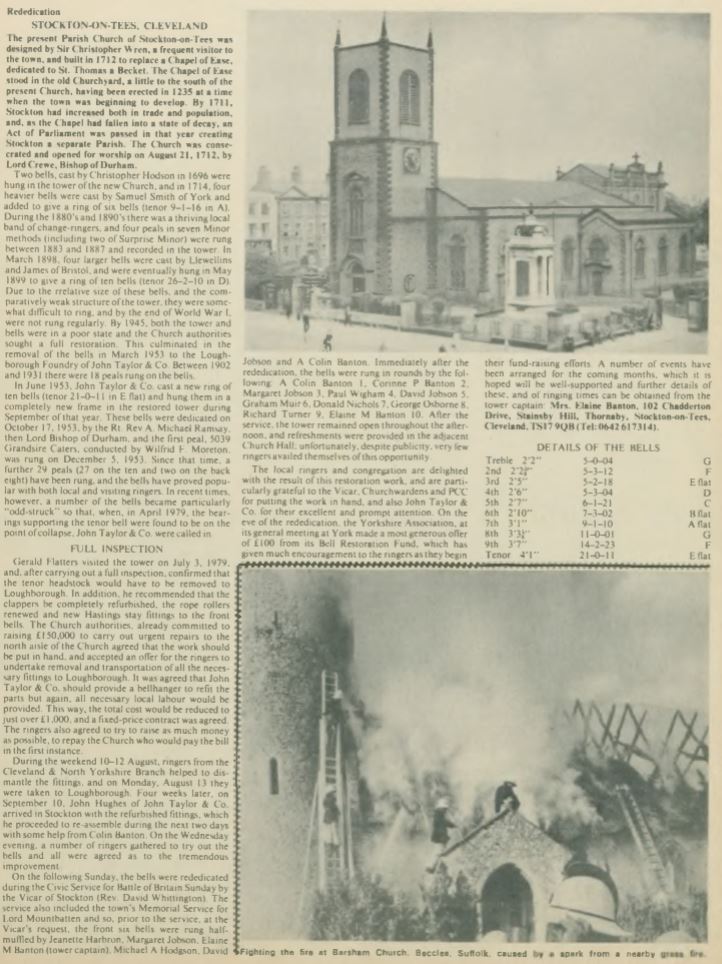
(Click to enlarge)
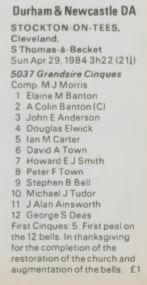
The augmentation to 12 was reported in The Ringing World of October 28th 1984:
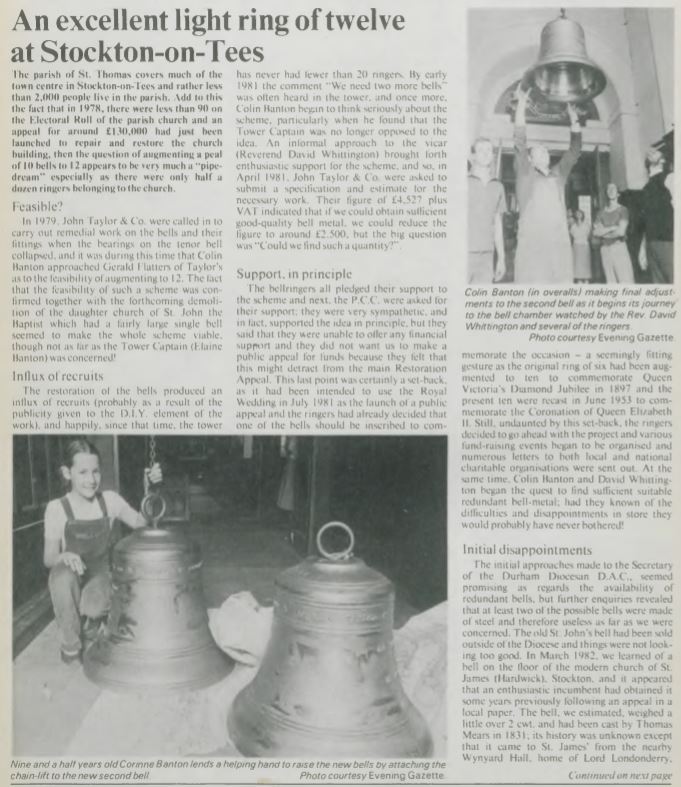
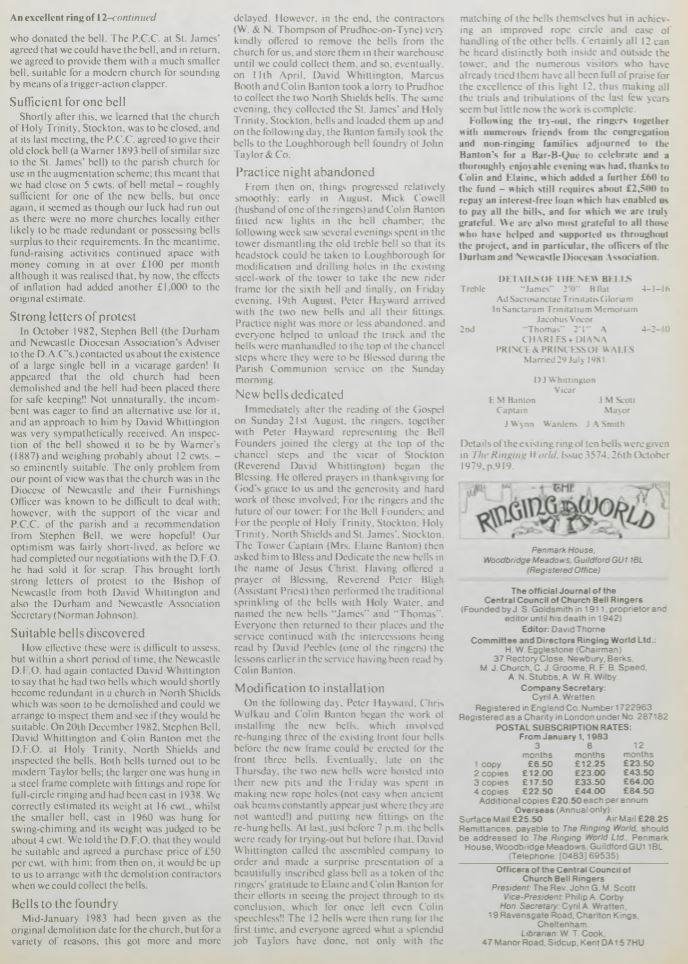
The first peal on the 12 was rung on 29 Apr 1984,
1 4-1-16 24.00″ 1983 John Taylor & Co (Bellfounders) Ltd 1892.0Hz Bb+25c
2 4-2-10 25.00″ 1983 John Taylor & Co (Bellfounders) Ltd 1679.5Hz Ab+19c
3 5-0-4 26.00″ 1953 John Taylor & Co 1582.0Hz G+15c
4 5-3-12 27.38″ 1953 John Taylor & Co 1407.0Hz F+12c
5 5-2-18 29.00″ 1953 John Taylor & Co 1252.0Hz Eb+10c
6 5-3-4 30.00″ 1953 John Taylor & Co 1179.0Hz D+6c
7 6-1-21 31.50″ 1953 John Taylor & Co 1046.0Hz C-1c
8 7-3-2 34.00″ 1953 John Taylor & Co 930.0Hz Bb-4c
9 9-1-10 37.00″ 1953 John Taylor & Co 828.0Hz Ab-5c
10 11-0-1 39.13″ 1953 John Taylor & Co 780.0Hz G-9c
11 14-2-23 43.13″ 1953 John Taylor & Co 693.0Hz F-14c
12 21-0-11 49.00″ 1953 John Taylor & Co 617.0Hz Eb-15c
Inscriptions
- JAMES
AD SACROSANCTAE TRINITATIS GLORIAM
In SANCTARUM TRINITATIUM MEMORIA
- THOMAS
CHARLES + DIANA
PRINCE & PRINCESS OF WALES
MARRIED 29 JULY 1981D J WHITTINGTON
VICAR
E M BANTON J M SCOTT
CAPTAIN MAYOR
J WYNN WARDENS J A SMITH - T.R.W.H.C WARDENS.CHRISTO.HODSON.MADE.ME 1696
- THOMAS.READMAN.WILLIAM HEWLER.CHURCH WARDENS
- TE DEUM LAUDAMUS 1714
(We praise thee, O God) - CANTATE DOMINO CANTICUM NOVUM 1714
(Sing to the Lord a new song) - CANTATE DOMINUM CYMBALIS SONORIS 1714
(Sing to the Lord upon the loud cymbals) - GLORIA IN EXCELSIS DEO 1714
(Glory to God in the Highest) - FEAR GOD HONOUR THE KING
- DAY BY DAY WE MAGNIFY THE LORD
- CHARITY NEVER FAILETH
- RIGHTEOUSNESS EXALTETH A NATION


The tenor on the left and 9th on the right- showing that I only have the shoulder inscriptions.
The Previous Ring
1 2-3-23 24.50″ 1696 Christopher Hodson
2 3-1-4 26.50″ 1696 Christopher Hodson
3 5-0-2 30.00″ 1714 Samuel Smith II
4 5-2-13 31.00″ 1714 Samuel Smith II
5 7-0-26 34.50″ 1714 Samuel Smith II
6 9-1-25 38.00″ 1714 Samuel Smith II
7 10-1-13 40.25″ 1898 Llewellins & James
8 13-1-15 41.50″ 1898 Llewellins & James
9 19-0-20 48.75″ 1898 Llewellins & James
10 26-2-10 51.25″ 1898 Llewellins & James
(The “nett weights” of 7-10 at the foundry were: 10-1-3, 13-1-3, 19-0-20, 26-2-10)
The inscriptions of this ring were repeated on the replacement 10, now the back 10 of the 12.