Sunderland, Minster Church of St Michael & All Angels & St Benedict Biscop 10: 12-2-7 in G MAP
 Ringing:
Sunday: By arrangement.
Practice: Monday 19:00 to 21:00 (1st of month – door locked at 7.15pm)
Nearest Metro Station: Sunderland
Church History
A church dedicated to St Michael & All Angels has stood on this site for over a thousand years. For most of that time, it has been known as ‘Bishopwearmouth Parish Church’. (This is the name of one of the original three settlements on the River Wear that eventually became the town, now city, of Sunderland.)
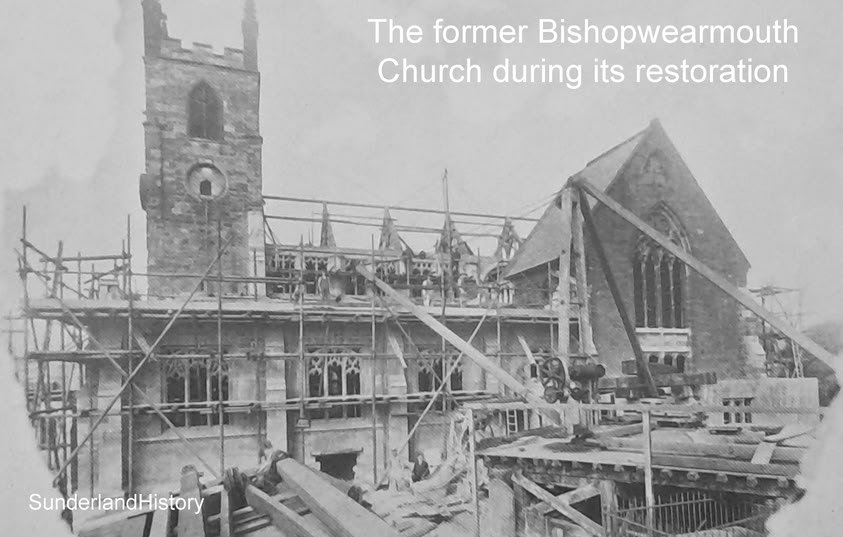
The parish of Bishopwearmouth, south of the River Wear, was founded in around 940AD, with an original stone church being built shortly afterwards. At one time the parish covered some 20 square miles south of the river. The first evidence of a church on the site arose in a 1930s excavation when Saxon stones were found. Due to colliery subsidence, the church was virtually re-built beyond recognition 1932-35, but not all parts of the former church were lost.
In 1998, following the grant of City status, the church was redesignated as ‘Sunderland Minster’: the second Minster church in England since the Reformation (following Dewsbury Minster in West Yorkshire in 1994).
In May 2007, with the adoption of Benedict Biscop as Sunderland’s Patron Saint, the church was redesignated as an Extra Parochial Place with the addition of St Benedict Biscop in its title. This means that is no longer has its own parish, but serves the whole of the city.
It is a Grade II* listed building. It has its own website – its listing states:
The Medieval chancel has largely been reconstructed. The tower is from c.1807; transepts are from 1849-50, by John Dobson. The nave was rebuilt with double aisles in 1933-35 by W.D Caröe. The £35,000 bill was footed by Sir John Priestman, a church-loving shipbuilder who also built St Andrew’s in Roker in honour of his mother. The outer aisles were partitioned and new floors were inserted in 1981 by Ian Curry, to form a community centre.
The church is built from coursed squared sandstone with ashlar dressings, there are ashlar aisles and porches. The church has a Welsh slate roof with stone gable copings. There is an aisled chancel with a north vestry; transepts; a double-aisled nave clasping the west tower. There are north, south and a full-width west porches.
EXTERIOR: There are “Decorated style” transepts and chancel, “Perpendicular” aisles and porches. There is geometric tracery in five-light east and four-light transept windows with roundels in the gable peaks. The buttressed four-bay aisles have three-light windows, and low porches in east bay with boarded doors recessed in elliptical arches. There are paired perpendicular clerestory lights. The west end has wide, buttressed porch with two doors in elliptical-headed arches, flanked by tall two-light windows under a ramped parapet of pent roof. The lower north and south extensions have buttresses on canted corners. The west ends of aisles above have central projecting canopied niches rising through stepped parapets to pinnacles. Two stages of tower above the porch have intersecting tracery below and perpendicular tracery in pointed-arched louvred belfry openings below a stepped battlemented parapet.
INTERIOR: ashlar; plaster aisles with ashlar dressings. The three bay nave has high elliptical arcades with polygonal piers; chancel roof wood barrel vault, nave roof arch-braced trusses. There is a late-13th century style piscina and sedilia. The transepts have high quality wood galleries set in east bays of nave arcade. There is a similar wood screen that has been transferred to the west end. There is a high-quality 20th century carved wood organ case and pulpit with sounding board. There is a Medieval font bowl, a 17th century font with fluted bowl on turned pedestal rising from acanthus leaves, and and an elaborate 19th century font.
MEMORIALS: These include two medieval grave-covers, one with a stepped base to the incised cross and the other with a foliate cross head, both are in the west porch. There is an eroded medieval effigy in the south transept said to be that of Thomas Middleton of Silksworth. There are many 18th and 19th century memorials, including a brass in chancel to William Cockin (d.1889) by Singer and Sons, Frome and London. Also in chancel is a memorial to John Scott (d.1853) by Lewis and Son, Cheltenham. In south transept there is a high relief depicting a grieving woman, for Stephen Pemberton (d.1831) signed David Dunbar. Plaque in west porch commemorates the munificence of Sir John Priestman, (who was also responsible for Roker churc) enabling the restorations of 1933-35 and a marble memorial to Thomas Wilson, one of the proprietors of the Glass Manufactory at Ayres Quay, d.1776. The stained glass includes an east window of 1950 by D.M Grant.
Source: https://historicengland.org.uk/listing/the-list/list-entry/1207993

The church prior to the 1930s restoration
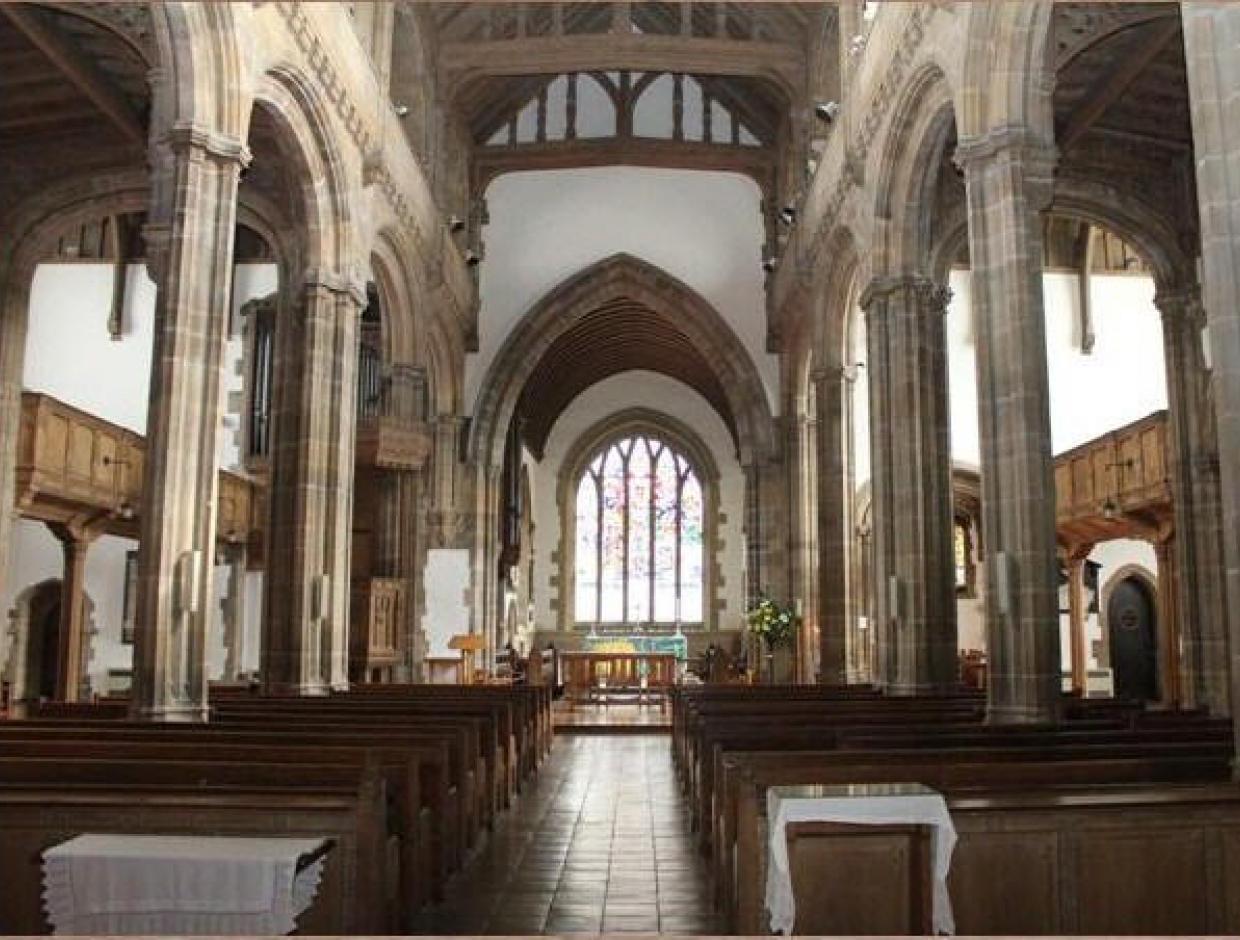
The interior of the church
The Bells
The original ring of six bells by Thomas Mears, cast in 1809, or possibly 1810, were augmented by the addition of two trebles by Warners in 1894. Details are given of the original ring of 6 by “Society of Antiquaries of Newcastle” in their reports:
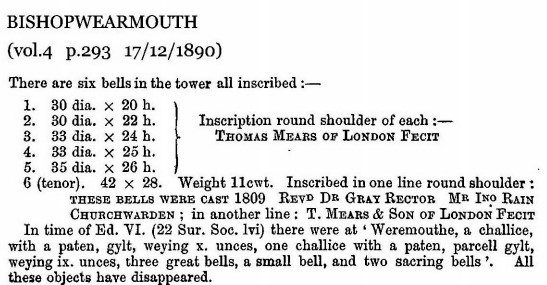
Taylors inspected the bells in 1892, but were not successful in getting the job. John W Taylor Jun noted:
Inspection 22 March 1892. Peal of six, require turning and all new fittings except the wheels which require rims and perhaps a spoke or two. Eight bell frame with two spare pits (sketch plan – layout 8.3). Notes on necessary alterations to the frame. Bells 1. 29”, 2. 30”, 3. 32½”, 4. 33½”, 5. 36¼”, 6. 41” in G.
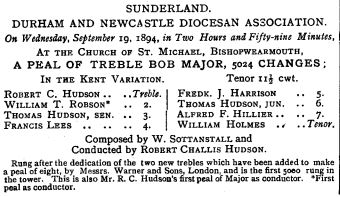
The first peal on the bells was rung soon after the 1894 augmentation to 8. The report of the peal in “Bell News and Ringers’ Record” is:
There was a series of articles about rings of bells published in “Bell News” from 1902 and this is what was said about this church in the edition of June 28th 1902:
Bishopwearmouth (Durham). St. Michael. Durham and Newcastle Association. Eight bells. Treble and 2nd by Warner, 1894; the rest by Mears, 1809. Tenor 11 cwt., diameter 3 ft. 5 in. Timber frame. Bells go well. Rehung with new fittings by Warner, 1894. Ropes new 1894, fair. Methods: Grandsire, Stedman, Plain and Treble Bob, Double Norwich, and Duffield. Sunday ringing ; 10 to 10.30, and 6 to 6.30 ; on first Sunday in month 2.30 to 3 additional. The bells are also rung on Wednesday at 7 for service. Practice : Monday, 7. Change-ringers always welcome.
Sadly, one of the ringers, Major Robert C Hudson, lost his life in the belfry in 1925 due to an accident while working on the bells. He slipped while putting on the muffles and was killed by the 7th bell being overtuned.
The complete ring was recast in 1932 by Mears & Stainbank, but were hung in the pre-existing frame. the following appeared in The Ringing World of October 21st 1932
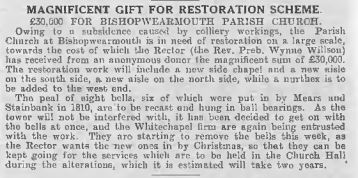
The following then appeared in The Ringing World of January 6th 1933:
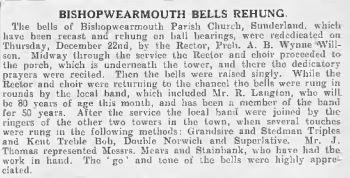
This was printed in the edition of February 3rd 1933:
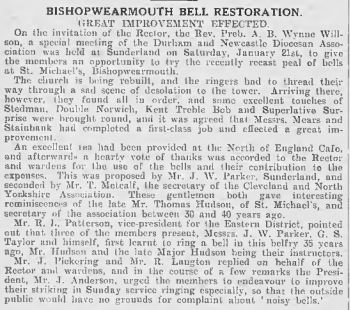
The first peal on the recast bells was rung in 1936, 4 years after the new bells were installed. The delay was at least partly due to the rebuilding work being undertaken on the church. Details as published in “The Ringing World” are:
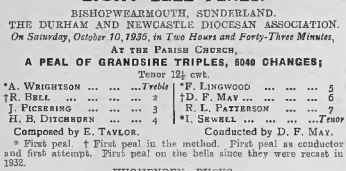
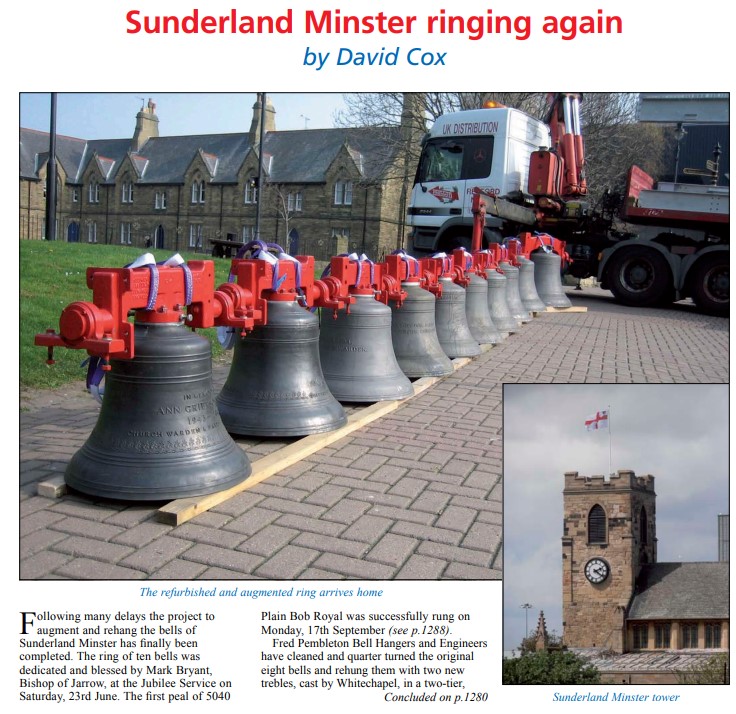
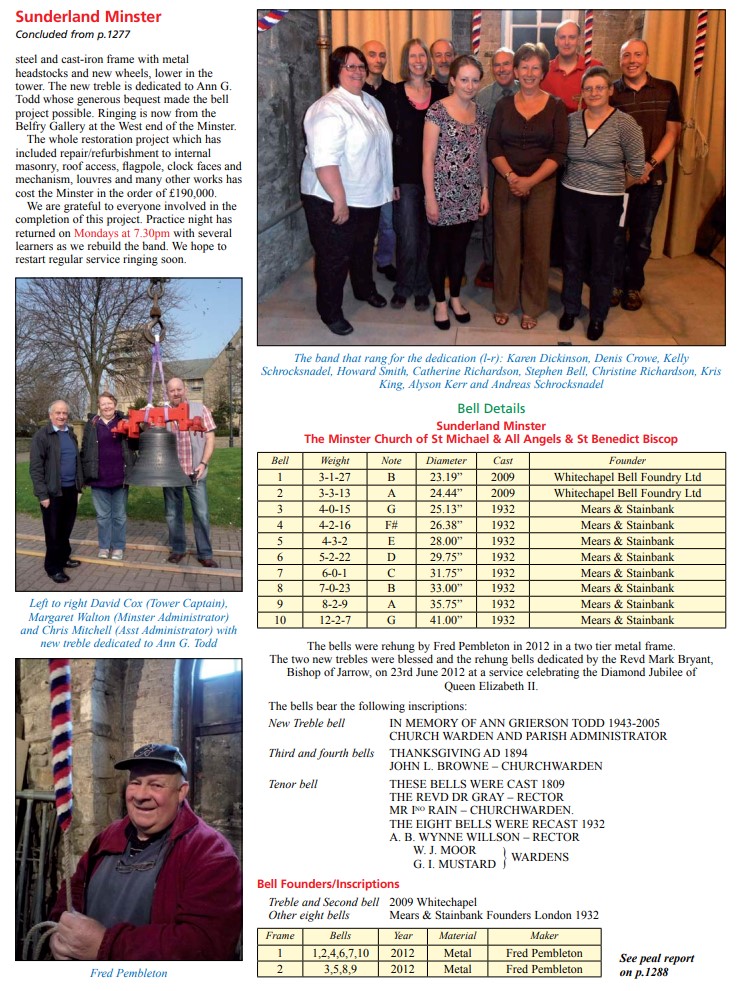
By the early part of this century the frame was causing quite some problems and, as a result, the bells were rehung lower in the tower by Fred Pembleton in 2012, and also augmented to 10. The new trebles were cast by Whitechapel some time before they were actually hung. It is a two-tier metal frame, with bells 3, 5, 8 & 9 hung above the others. At the same time, the ringing chamber was moved lower in the tower, to a balcony that is open to the church. All 10 bells were cast with flat tops and the back 8 of these have been quarter turned.
The rehanging and augmentation to 10 was reported in The Ringing World of December 14th 2012:
| (Click to enlarge images) |
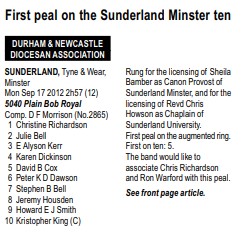
The first peal on the ring of 10 was:
1 3-1-27 23.19″ 2009 Whitechapel Bell Foundry Ltd 1930.4Hz B-40c
2 3-3-13 24.44″ 2009 Whitechapel Bell Foundry Ltd 1736.3Hz A-23c
3 4-0-15 25.13″ 1932 Mears & Stainbank G
4 4-2-16 26.38″ 1932 Mears & Stainbank F#
5 4-3-2 28.00″ 1932 Mears & Stainbank E
6 5-2-22 29.75″ 1932 Mears & Stainbank D
7 6-0-1 31.75″ 1932 Mears & Stainbank C
8 7-0-23 33.00″ 1932 Mears & Stainbank B
9 8-2-9 35.75″ 1932 Mears & Stainbank A
10 12-2-7 41.00″ 1932 Mears & Stainbank 776.0Hz G-18c
Details of the Previous Ring
1 4-3-25 26.50″ 1894 Warner & Sons, London
2 4-3-22 27.50″ 1894 Warner & Sons, London
3 4½cwt 28.25″ 1810 Thomas Mears II, London
4 5cwt 30.00″ 1810 Thomas Mears II, London
5 6cwt 32.50″ 1810 Thomas Mears II, London
6 7cwt 33.75″ 1810 Thomas Mears II, London
7 8cwt 36.25″ 1810 Thomas Mears II, London
8 11cwt 41.00″ 1810 Thomas Mears II, London
(From weight charts in the ringing chamber)
Photographs
 The church looking west, showing the ringing gallery |
|
|
 The east end of the church |
