Billingham, St Cuthbert 3 Bells: 8¼cwt – Unringable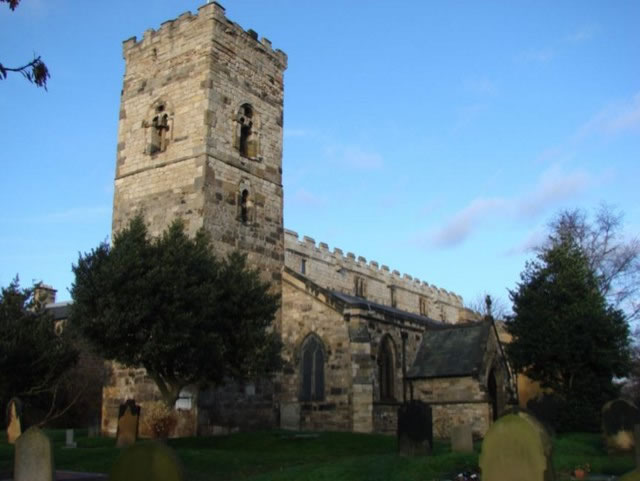
The foundation of this church is Pre-Norman. Symeon record that the church was built by Bishop Ecgred of Lindisfarne (830-46) and even this may have been the rebuilding of an earlier church. The tower was built possibly in the 10th century, the top being added late 14th century. Is shows Saxon features, such as the raised upright bands around the jambs and arches. There is some debate as to whether it is of the period around the Norman Conquest, but built in the Saxon style. Pevsner calls the tower, “The outstanding feature”
The Nave is probably 9th century but with north aisle and clerestory of the late 12th century, south aisle of the 13th century and clerestory of the late 14th century, perhaps at time of addition to tower. It is built of coursed rubble masonry. The nave and tower are battlemented.
Original openings area in the tower; two-light with baluster shaft and pierced spandrel in bell stage. There is a small arch to nave. The Chancel was rebuilt in 1846 and again in 1939, this time by Charlewood of Newcastle. There is an early 17th century screen and font cover; the font being from c.1200..
The Bells
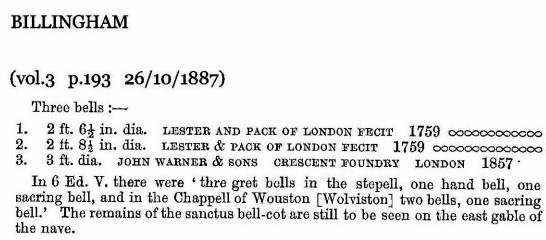
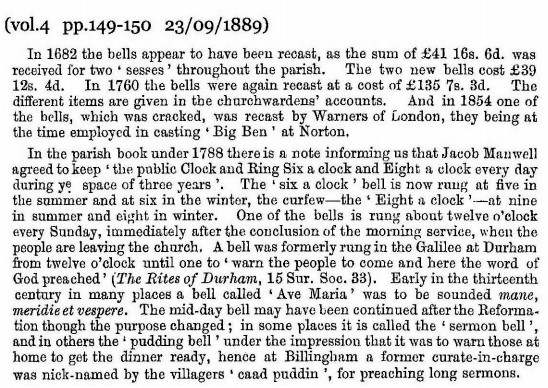
Details of the history of the bells is given in the reports of “Society of Antiquaries of Newcastle”
An archaeological assessment by the Diocese notes:
“The Bell Frames are of wood, and form a simple range of three pits (Pickford frame layout 3.1.) Each truss has sills, king-posts, a long head,, end posts, and pairs of intersecting braces (X braces) between the tops of the posts and the sills (Pickford type 5 Y); the joints are either pegged or secured with tusk tenons, perhaps suggesting as date in the early 19th century. ” It also notes that the tenor is a recast bell, rather than an addition.
Howard Smith states that they are derelict – all three bells have derelict ringing fittings; static electronic chiming apparatus installed in 1969 that will not allow the bells to be swung.
1 6cwt 31.00″ 1759 Lester & Pack
2 6¾cwt 33.5″ 1759 Lester & Pack
3 8¼cwt 36.13″ 1857 John Warner & Sons
The inscriptions are also noted by the “Society of Antiquaries of Newcastle” in their reports: