Sunderland, Holy Trinity 8: 13-2-14 in F
 Ringing:
The church has been converted into “Seventeen Nineteen”, originally to be called, “The Canny Space” The work that has been undertaken has resolved tower issues.
The bells were successfully tried out on 13th June 2019 and became available for ringing again in March 2022, when the building was reopened.
Nearest Metro Station: Sunderland
Church History
In 1712, with the port of Sunderland growing rapidly, the local St. Michael’s church at Bishopwearmouth was rapidly becoming too small to serve the growing population. Some local merchants came together and started an appeal to build a new church in the east end of the city, and a site on the town moor was chosen.
Because of the rapid growth of the population, it was also decided that a new parish should be created, and on 9 March 1719 an act of parliament was passed to create the Parish of Sunderland (thus the church is sometimes referred to as Sunderland Parish Church). The Bishop of Durham of the time, Nathaniel Crew gave his consent, as did Reverend James Bowes D.D.
The architect of the original church is not known for certain, although there are reports of involvement from William Eddy (a well-known local architect) and Daniel Newcombe, who would be appointed the first rector of the church.
The building itself has a Baroque style, brick built and with stone mouldings surrounding the doors and windows. The original building was without apse, although this would later be added (see below), and from the outside is described by Whellan as “plain and unprepossessing”.
Inside, the building is described by Whellan as “handsome”, with the aisles of pews being separated from the central nave by seven pillars on each side, each being capped with a corinthian-style capital. His full description reads:
The interior is handsome, and comprises a nave and chancel, and aisles, the latter of which are separated from the Nave by seven elegant pillars on each side, with Corinthian capitals. The communion table occupies a recess, covered by a dome supported in front by two Corinthian columns. There are galleries on each side, and at the west end of the nave; the front of the latter is charged with the royal arms, and those of Lord Crewe, Bishop of Durham. Above the gallery is a smaller one for the accommodation of the choir.
— William Whellan, History, Topography, and Directory of the County Palpatine of Durham…
Following the start of groundwork in 1718, the church building was completed the next year, such that on 5 September 1719 the consecration of the premises took place; prior to this, however, on 2 June 1719, the first recorded marriage took place at the church, of Jonathan Chambers and Elizabeth Hutchinson.
In 1735, Daniel Newcombe, the rector of the church who almost certainly had been involved in the original design of the building, decided to add an apse to the eastern end. This would give the building a chancel, which it had lacked until this point. The apse was large, near circular, and featuring a large venetian window. Newcombe paid for the extension with his own money.
The church started the nineteenth century with a new roof in 1803, which included its raising so that a new gallery could be added.
Jack Crawford, the “Hero of Camperdown”, was a sailor aboard HMS Venerable in 1797, during the Battle of Camperdown. Venerable took fire damaging its mast, which lowered the flag of Admiral Duncan – recognised as the sign of surrender – so Crawford scaled the remnants of the mast and nailed the Admiral’s flag back to the top.
Crawford was well celebrated for his act of heroism, and the people of Sunderland awarded him a silver star. In the coming years, however, he fell into poverty and was killed by a cholera outbreak in 1831.
In 1888, Holy Trinity Church erected a headstone in its graveyard in his honour.
The sailor who heroically nailed Admiral Duncan’s flag to the main-top-callant-mast of H.M.S. Venerable, after it had been shot away, in the glorious action off Camperdown, October 11th 1797.
The 1900s started with the church being re-glazed,before community life began to degrade and the number of churchgoers in the east end of Sunderland diminished. As the population in the area gradually decreased, the congregation continued to diminish throughout the 20th century, until on 26 June 1988 the church was forced to close, and transferred to the Redundant Churches Fund (now known as the Churches Conservation Trust). The building itself needed extensive and costly repairs.
No longer in use as a place of worship, due to the depopulation of the area, the building these days goes by the name of “Seventeen Nineteen“, (formerly “The Canny Space”), a community venue and cultural arts centre. Restoration work is still underway, with most of the money being fundraised; as of 2015, £1,341,014 had been raised towards the project. It is expected to open in the Autumn of 2021. There has been a tremendous amount of work undertaken on the church and high quality repairs have been completed.
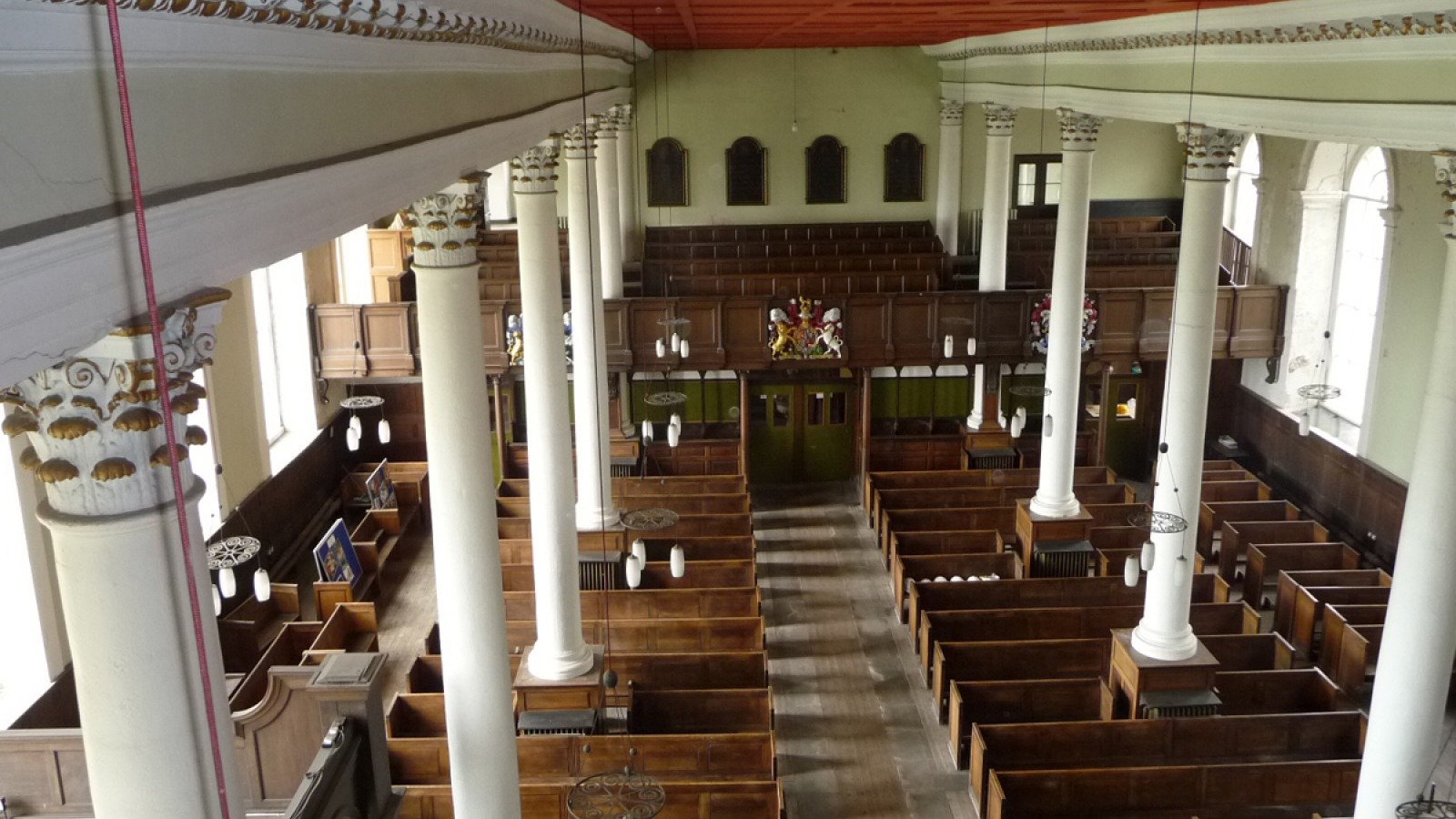
The interior of the church. Source: Lincoln Conservation
The Bells
These are a ring of 8 by Thomas Mears II of London, 1829. “The peal of eight bells, recently placed in the belfry of Sunderland church, was rung for the first time on New Year’s Eve, by the Gateshead Union Society of Change Ringers. The harmony produced by the fine tones of the bells, gave great satisfaction to the parishioners. Weight of the tenor 14 cwt. (Durham County Advertiser, Sat. 9 Jan. 1830)”
In 1951 the two trebles were recast at the same foundry and the ring rehung. The timber frame is by Mears and Stainbank, 1900. Work was undertaken on the bells by Llewellins & James of Bristol, the tower being mentioned in their catalogue, probably before the 1900 rehang.
The first peal on the bells was almost certainly rung on 4th March 1845, being one of Grandsire Triples. For many years this was said to have been rung at St Mary’s, Hylton, but this is impossible. The churches on this site have never had a ring of bells. The current church had a chime (q.v.) installed in two sets of 4 at a much later date. The details given are a much better fit for Holy Trinity.
The first peal that is absolutely certain to have taken place was rung on 26th December 1881 and was also one of Grandsire Triples. This is reported in “Church Bells” in the edition of December 31st 1881:
At Holy Trinity, Sunderland.
On Monday, the 26th inst., eight members of the North Shields Branch of the Durham Association rang a peal of 5040 Grandsire Triples in 2 hrs. 45 mins. C. Boss, 1; B. Smith, 2 ; J. Rossiter, 3 ; W. Waugh, 4; B. Wignell, 5 ; W. Beed, Esq. (conductor), 6 ; J. Hern, 7 ; S. Nott, 8. Tenor, 14 cwt., in F. The peal is in six parts, a composition of W. Taylor, and is the first peal ever rung on the above bells.
In the report of the 1899 D&N AGM it is noted that: “The Rev. Dr. Randell responded, and greatly interested his hearers by telling them of the success that was attending his efforts to restore the bells of Sunderland Parish Church, of which he is Rector. There appears every prospect of this being carried out in a thoroughly efficient manner.” (Bell News Nov 4 1899). Later in the same edition there is an appeal for funds, mentioning that the eight ringers had given up their pay for the year to help fund the rehanging – an average of £3 per man.
In the report of the 1900 D&N AGM in Bell News of November 3rd 1900, it is noted: “The committee were glad to announce that the efforts of the Rector and his ringers at Sunderland parish church had been crowned with success, and their bells rehung and the belfry put in perfect order. This was a case in which the advice of the President had been sought, and the work done under his supervision.” In the Bell News of March 16th 1901, as part of a long article on the opening of the bells, it is is noted, A thorough rehanging of the bells in the tower of Holy Trinity church, Sunderland, has been done by Messrs. Mears and Stainbank, of the Whitechapel foundry. The bells have been quarter-turned, new frames, stocks and wheels provided, new ropes, and the bells now go beautifully, consequent on everything being done in a workmanlike manner.
The full article can be read here:
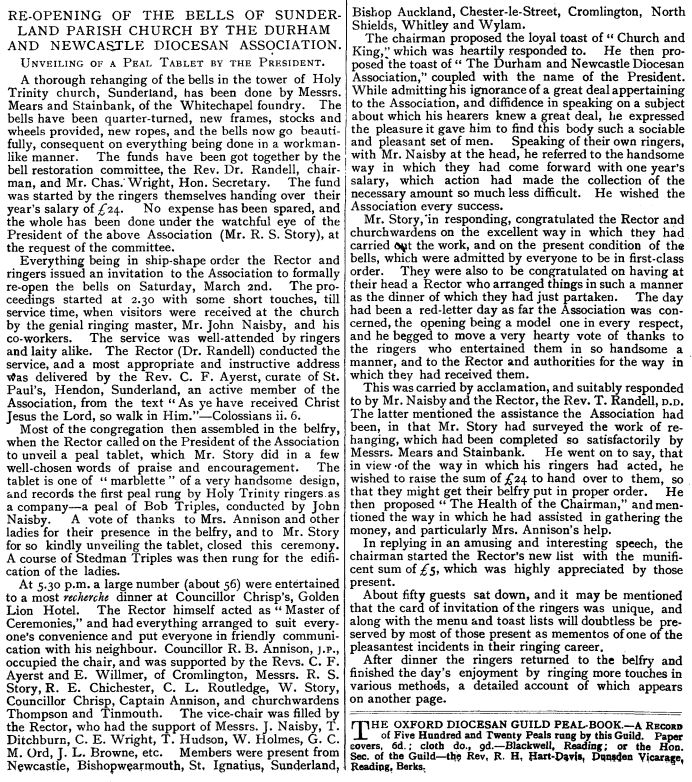
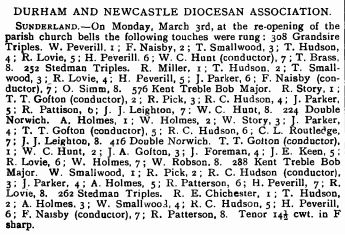
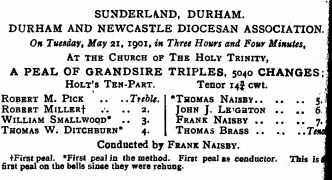
The first peal after the rehanging of the bells was rung in May that year:
Bell News of October 22nd 1904 reports:
“Sunderland (Durham ). Holy Trinity. Durham and Newcastle Association . Eight bells ; all by Mears 1829. Tenor 14 cwt, diameter 3 ft. 7 in. Timber frame. Bells go well. No repairs for thirty years past. Steps now being taken to rehang. Ropes new 1894 good. Methods : Grandsire, Stedman, Darlaston Bob and Treble Bob. Sunday ringing; 10 to 10.30, and 6 to 6.30. Practice : Tuesday, 7.30″
(The series of articles took some years to publish. I assume that the data was supplied before the rehang took place)
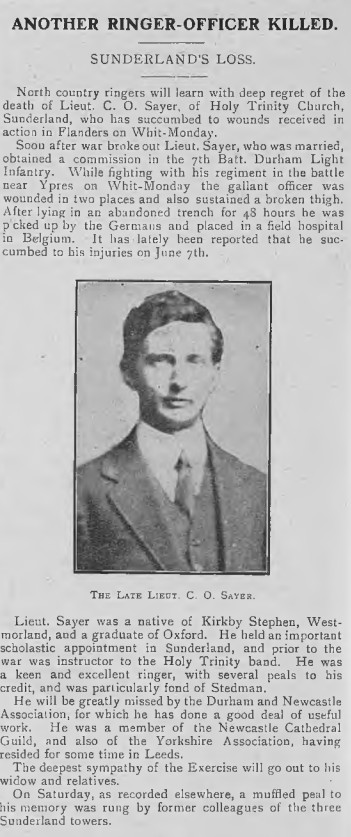
One of the ringers death in WWI was reported in The Ringing World on August 20th 1915:
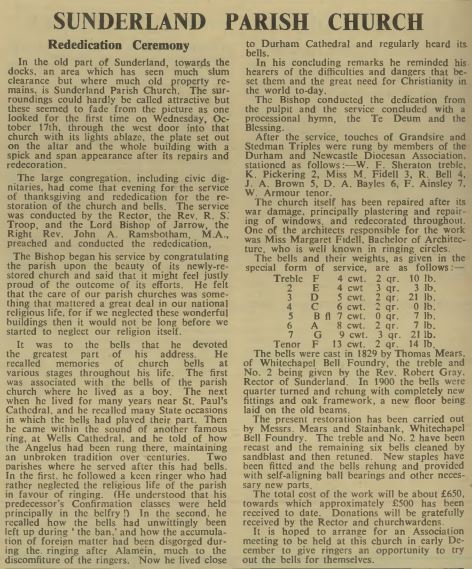
The Ringing World of November 2nd 1951 reported the re-dedication of the bells after the two trebles had been recast, the others cleaned and retuned, new crown staples provided and the bells hung on ball bearings. The full article can be read here:
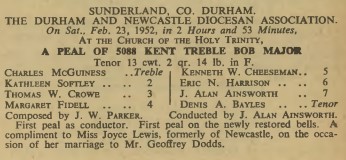
The first peal since rehanging was rung in February of 1952
(Until January 2023 the weight of the 7th was shown on Dove as 9-3-2)
1 4-2-10 27.00″ 1951 Mears & Stainbank 1361.0Hz F-45c (4-2-10)
2 4-3-3 28.00″ 1951 Mears & Stainbank 1292.0Hz E-35c (4-3-10)
3 5-2-21 30.50″ 1829 Thomas II Mears 1152.0Hz D-34c (5-3-4)
4 6-2-0 32.25″ 1829 Thomas II Mears 1037.0Hz C-16c (6-1-18)
5 7-0-7 34.13″ 1829 Thomas II Mears 912.0Hz Bb-38c (7-0-8)
6 8-2-7 37.00″ 1829 Thomas II Mears 855.5Hz A-49c (8-3-23)
7 9-3-21 38.38″ 1829 Thomas II Mears 772.0Hz G-27c (10-0-2)
8 13-2-14 43.63″ 1829 Thomas II Mears 687.5Hz F-27c (14-1-6)
(The figures in brackets are the weights of the bells as given by Revd. F. E. Robinson, who visited in February 1906)
Inscriptions
- T. MEARS OF LONDON FECIT 1829
- T. MEARS OF LONDON FECIT 1829
- T. MEARS OF LONDON FECIT 1829
- T. MEARS OF LONDON FECIT 1829
- T. MEARS OF LONDON FECIT 1829
- T. MEARS OF LONDON FECIT 1829
- T. MEARS OF LONDON FECIT 1829
- T. MEARS OF LONDON FECIT 1829
THE REVD ROBT GRAY RECTOR
THOMAS WOOD
ROBT YOUNG CHURCHWARDENS
THOMAS HODGE
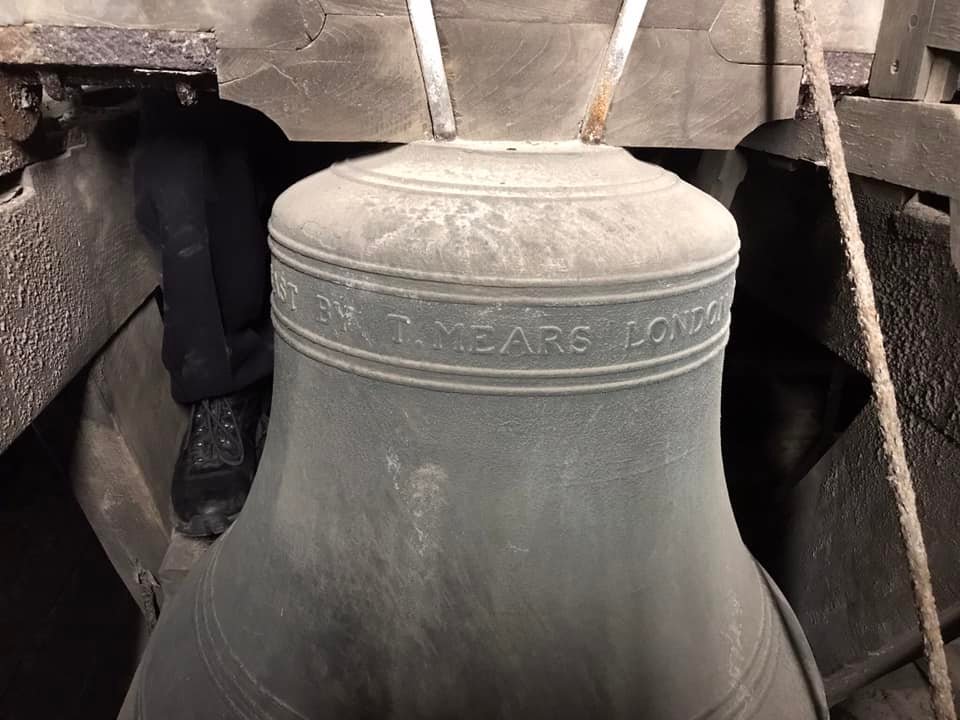

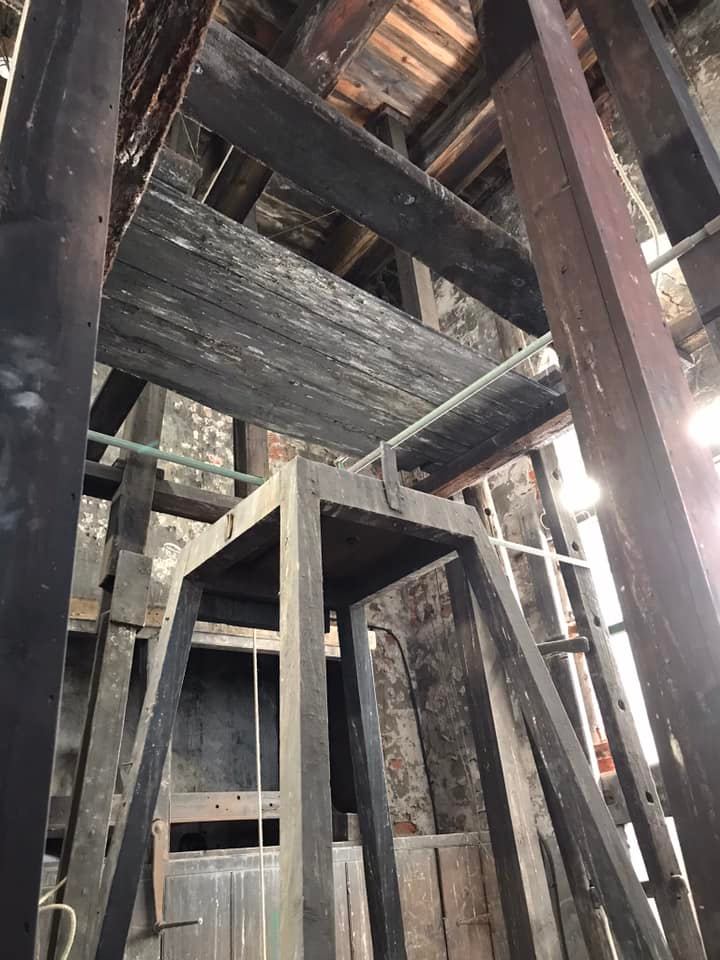
Images of the bells and the Intermediate Chamber.
Source: Christine Richardson.