Heworth, St Mary 6: 6-0-16 in A MAP
 Ringing:
No Regular Ringing
Nearest Metro Station: Heworth
Church History
St Mary’s is the Anglican parish church for Heworth, Pelaw, Bill Quay and Wardley, to the east of Gateshead, located on Shields Road, near Heworth Metro. The church was built in 1822 by John Stokoek , on the site of an ancient church. The 92 men and boys who died in the 1812 disaster at Felling Colliery are buried in the churchyard at St Mary’s. The Church of St Mary is a Grade II Listed building.
Source: https://co-curate.ncl.ac.uk/church-of-st-mary-heworth/
The listing states:
Parish Church; 1822 by John Stokoek, in consultation with the rector, John Hodgson. It is built from coursed squared sandstone with ashlar dressings. There is a graduated Westmorland slate roof with stone gable coping to chancel and to nave parapets. The building consist of a west tower; nave; north and south transepts chancel and narrower sanctuary and is of the “Early English” style.
The tower, of 3 stages, has north a door; traceried 2-light west window; clock under 2-light round-headed belfry openings; pinnacled battlements. There is a3-bay nave, 2-bay-deep transepts. The 2-bay chancel and sanctuary have 2-light windows, some blind. There are north and south doors in transepts, flanked by mullioned-and-transomed 2-light windows with cusped arches to transoms. There are blind roundels in the gable peaks and an inscription in south transept gable commemorating foundation of first church on site and rebuilding of 1822.
The interior is plastered with ashlar dressings. There is a double-chamfered moulded chancel arch on half-octagonal pilasters and a square-panelled plastered ceiling, flat in chancel. The chancel has 4 sedilia on the north, older double piscina and 2 sedilia on the south. There is a Gothic-arcaded reredos, with 1922 painted panels. The octagonal font is in south transept, with a late 19th century Gothic-style font at west end. There are memorials to members of Brandling family, Russell family and to Richard Dawes, classical style, by Jopling of Gateshead. The glass in the north transept is by Ballantine.
Sources: J. Raine; A. Memoir of the Rev. John Hodgson, 1857 (2 vols); Taylor, The Parish Church of St. Mary Heworth; Gateshead 1922.
Source: https://historicengland.org.uk/listing/the-list/list-entry/1025183
The Bells
These bells were formerly hung in St Peter’s Church, in Jarrow. After some time stored at a local factory, they were rescued by the D&N and installed here in a new metal frame for 8 by Eayre and Smith in 1986. They were dedicated by the Bishop of Jarrow on Sunday, December 21st 1986. They are a complete ring of 6, cast by Warners in 1880.
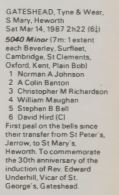
The first peal on the bells in their present location was rung on 14th March 1987.
1 3-1-25 25.25″ 1880 John Warner & Sons 1541.0Hz G-30c
2 3-1-19 26.06″ 1880 John Warner & Sons 1372.0Hz F-31c
3 3-3-19 27.75″ 1880 John Warner & Sons 1220.0Hz Eb-34c
4 4-1-12 28.50″ 1880 John Warner & Sons 1153.0Hz D-32c
5 5-0-17 31.00″ 1880 John Warner & Sons 1030.0Hz C-28c
6 6-0-16 34.00″ 1880 John Warner & Sons 915.0Hz Bb-32c
(Frequencies as when at Jarrow in 1920 – source: Chris Pickford.
Note that the bells are in the key of Bb, not A as is usually stated prior to Feb 2021)
Before the present bells were hung there were three bells. The Newcastle Society of Antiquaries (1887/88) gives the following though that on the second was effectively illegible:
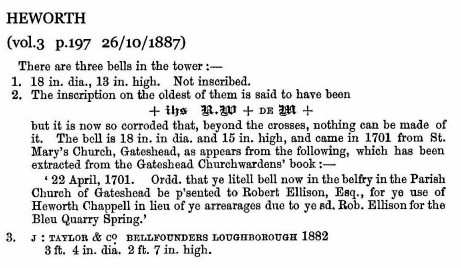
Information from Norman Johnson indicated that by the 1970s only the second bell was still there. Notes from George Elphick suggest that there were still three bells there in 1971.
The addition of the Taylor bell was reported in “Bell News” in their edition of November 17th 1883
HEWORTH-ON-TYNE PARISH CHURCH,
NORTHUMBERLAND. (sic)
The dedication of the new bell cast for the parish church by Messrs. John Taylor and Co., of Loughborough, took place last week. The vicar, churchwardens, and all the principal residents of the district were at the service. After the service, Mrs. Steele, wife of the vicar, started the splendid new clock which strikes the hours and quarter-hours, and shows the time on three illuminated dials. The clock was made by Messrs. Wm. Potts and Sons, of Leeds. Besides striking the hours on the new large bell, the clock will strike the ding-dong quarters on the two smaller bells, one of which is one of the oldest known bells in the county, having been at Heworth for the last 200 years, and 700 years before that in the neighbouring parish of Gateshead. After the service, the inhabitants adjourned to the schoolroom, where a bazaar was being held for the clock and bells. A substantial tea was partaken of in the room below, given by a few friends in aid of the above.
The Taylor bell was 38.38″ in diameter, weighed 10-0-21 and was hung for ringing in a deal frame. The bell was actually cast for Blisworth in 1882, but came out too flat and was sold to Heworth in 1883 for £60.19.0, including a 5% discount! Fittings were £16.0.0. Carriage $4.9.0 and fares £3.1.11, giving a total of £84.9.11. Howard Smith notes that this bell was sent to Africa on the installation of the Jarrow bells, this going against what was previously said about the number of bells in the tower.
The second bell was retained as a chiming bell and was kept in its original fittings. It was hung in a small pit of to the side of the frame when the Jarrow bells were installed in the tower. (Information from Andreas Schrocksnadel)