 Heighington, St Michael 6: 15-1-23 in G (GF) MAP

Ringing:
Sunday: 09:00 to 09:30.
Practice: Wednesday 19:30 to 21:00.
Church History
The church has, possibly, a pre-Conquest tower, nave and chancel, In c.1160-1170 the chancel was rebuilt and third stage of tower added. The vestry is possibly from the 13th century, as it chantry chapel, which was extended in 14th century to form south aisle. The 15th century tower parapet was added. Pevsner calls the tower “The best Norman tower in the county”.
There was a restoration in c.1840 restoration. The north aisle, south porch and organ chamber date from 1872-5 by Ewan Christian; built from coursed squared stone, snecked The 1872 additions have green slate roofs. The building now consists of a west tower, an aisled nave with south porch; chancel (comprising presbytery and sanctuary) with north vestry and organ chamber.
The 3-stage tower has what is probably a 19th century south doorway and has small round-headed windows on south and west. There are twin bell openings on third stage; an embattled parapet with gargoyles.
The 3-bay nave has a round-arched south doorway with zigzag and billet mouldings (moved from north wall 1875) and a relief of a King and a Bishop above door and a steeply-pitched roof. The south aisle has restored 2 and 3-light square-headed windows. There is a 18th centeury wall sundial; a moulded parapet. There is a lancet on west return and 3 stepped lancets on east return. There is also a gabled porch incorporating sculptural fragments.
The north aisle has 3-light windows and tall gabled east bay. There is a 2-bay presbytery and a taller narrower one-bay sanctuary. There is a restored Priest’s door and flanking 19th century windows on the south; with 10th-11 century round-headed window on north. There are 19th century sanctuary windows and 2 strings on south and a 3-light east window of 1872. There is a continuous steeply-pitched chancel roof. There is a one-bay organ chamber with reused lancet; vestry with tall stack.
The interior is plastered. There are c.1160 round 3-order tower and chancel arches, the latter on half-pier responds with scallop capitals. There is a double-chamfered, pointed 3-bay south arcade on octagonal piers and a similar 19th century north arcade on round piers. There is a Piscina at east end of south aisle.
In the tower is a 14th century octagonal font, cross slab with sword and 2 worn 13th century female effigies. There is a large slab and wood donation plaque to John March died 1590. There are 5 hatchments (including two from the 17th century) around tower arch and a wall monument to George Crossyer, died 1669, south of chancel arch. The wooden pulpit is a restored one from the early-16th century. There are chancel stalls with some 16th century poppyheads. On the chancel’s north wall are 2 grave slabs; armorial brass to Sir Anthony Byerley died 1667; wall monument with naval trophies by I. Ternouth of Pimlico to Capt. William Pryce Cumby, hero of Trafalgar, died 1837. The stone reredos is from 1899. Teh stained glass is by Clayton and Bell 1875, by Heaton, Butler and Bayne, aslo 1875, and by Wailes and Strang in 1908.
(Rev. J.F. Hodgson, Church of St. Michael,Heighington, Transactions of the Architectural and Archaeological Society of Durham and Northumberland, Volume V, 1905)
Source: https://historicengland.org.uk/listing/the-list/list-entry/1322953
On 20 March 1967, the church was designated a Grade I listed building.
The Bells
These hold the distinction of being the only ground floor ring in the whole of the counties of Durham, Tyne & Wear and Northumberland that is not housed in a pub! (q.v. Frosterley).
They are an ancient set of three bells, to which Taylors added three tenors in 1883. They were overhauled by Hayward Mills Associates in 2005. Interestingly, the tenor is now heavier that previously reported, it being said to be 15-1-6 in F# prior to this. The canons have been removed from all the bells. The timber frame installed in 1883 is layout 6.1.
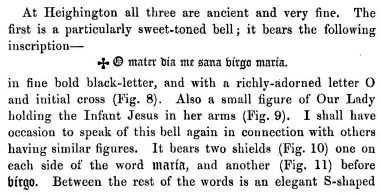
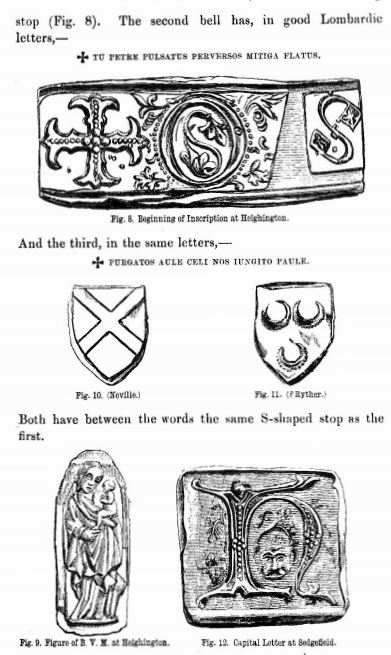
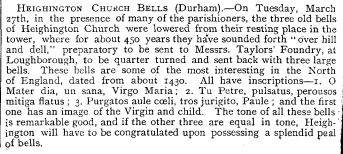
Rev J. T. Fowler gave some details of the then three bells in his pamphlet “On Some Church Bells in the City and Neighbourhood of Durham, at Newcastle-on-Tyne, &C”, (1865):
The start of the project was noted in Bell News in 1883
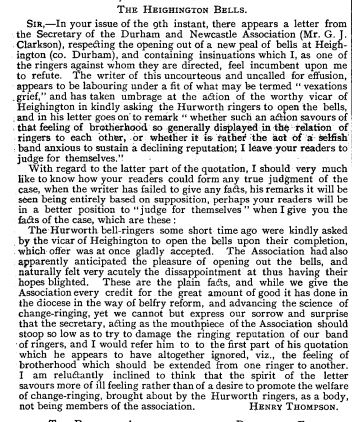
Then there was a row! In the edition of June 9th, this appeared
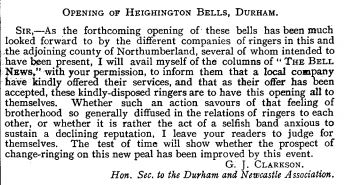
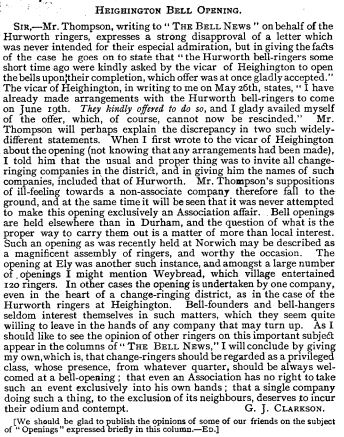
This elicited a response on June 23rd:
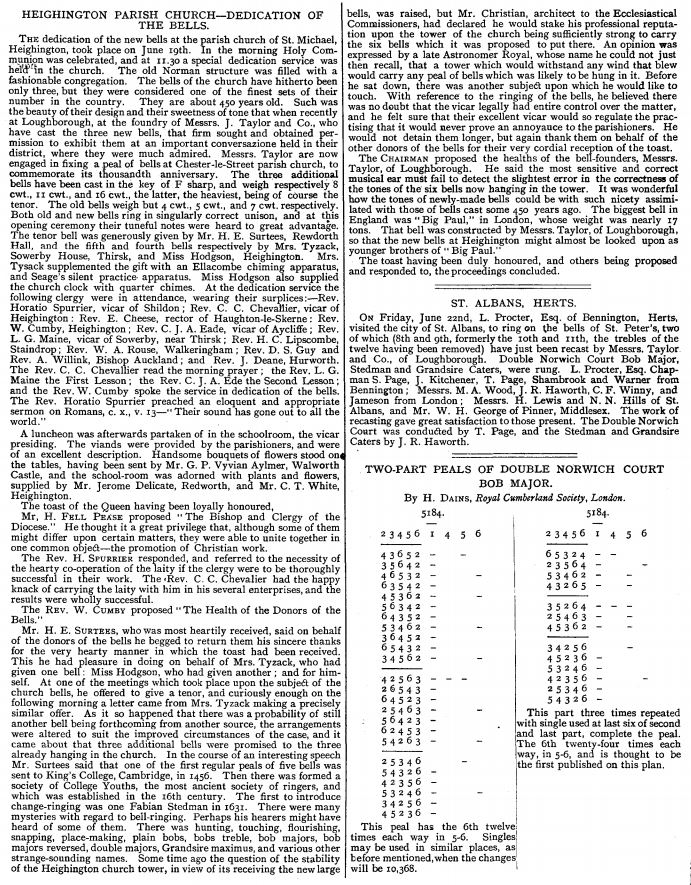
The next thing we read of is a report of the dedication of the bells in the edition of June 30th 1883:
We then return to the row! In the same edition, a few pages later, the following appeared:
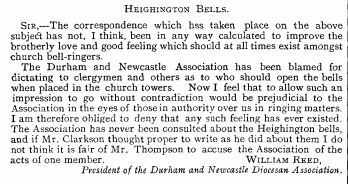
The Association President then had his say, in the edition of July 21st:
Immediately underneath this letter was another and a clarification by the Editor!:
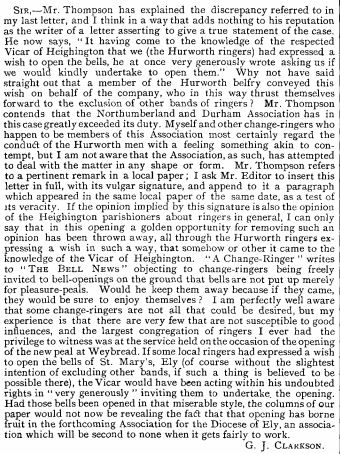
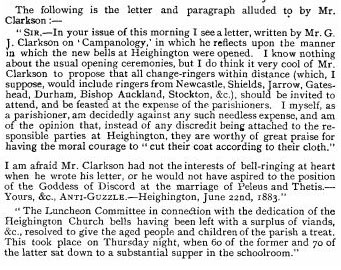
Mr Clarkson was not finished!! He wrote another letter and this appeared in the edition of August 18th 1883:
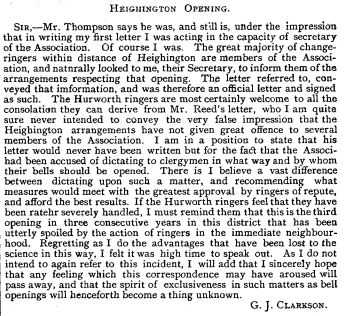
This was the last we heard of the matter!
A note about a forthcoming meeting in The Ringing World of November 9th 1956 notes that the bells had recently been repaired. The report of the meeting on December 14th tells us that the bells had been rehung on ball bearing. There is no other information that I can find at present.
There is a “Seage Apparatus”, which allowed the clappers to be tied and a small bell sounded behind each ringer at the time that the bell would have sounded, in reasonable condition here. This allowed for bands to practice at any time of the day or night and not to disturb the neighbourhood. These were popular from about the mid-Victorian times, but largely fell out of use in the early part of the 20th century – with a brief revival during the ban on ringing during WWII.
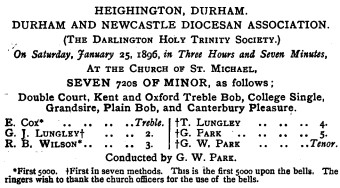
The first peal on the bells was rung in January of 1896 and was reported in “Bell News and Ringers’ Record” thus:
1 3-3-14 27.00″ c1450† York foundry E
2 4-3-22 30.00″ c1450† York foundry D
3 6-2-23 33.38″ c1450† York foundry C
4 8-2-0 34.75″ 1883 John Taylor & Co B
5 10-3-7 38.63″ 1883 John Taylor & Co A
6 15-1-23 43.75″ 1883 John Taylor & Co 764.0Hz G-45c
Inscriptions
The back three are inscribed: J TAYLOR AND CO FOUNDERS LOUGHBOROUGH, additionally:
- PURGATOS NOW IUNGITOS AULE CELI PAULI
- TU PETRE PULSATUS PERVERSOS MITIGA FLATUS
- O MATER DIA NE SAMA VIRGO MARIA
- FAITH. THE GIFT OF ELEANOR HODGSON IN MEMORY OF HER PARENTS THOMAS AND JANE HODGSON MDCCCLXXXIII
- HOPE. THE GIFT OF SARAH SPENCE TYZACK IN MEMORY OF HER PARENTS GEORGE WILLIAM AND SARAH LONGRIDGE MDCCCLXXXIII
- CHARITY, THE GIFT OF HENRY EDWARD SURTEES OF REDWORTH MDCCCLXXXIII
The Newcastle Society of Antiquaries have photographs of two images on one of the old bells, presumably the 3rd, in their reports of 30/5/1907
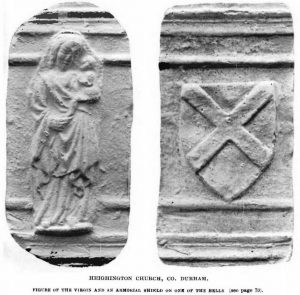
George Dawson has attributed the three trebles as being cast by John Bery of York, whose working dates are 1455-1480.