Hartlepool, All Saints, Stranton 8: 11-2-15 in F MAP
 Ringing:
Sunday: 10:15 to 11:00 (alt with St Aidan).
Practice: 2nd & 4th Wednesday 19:15 to 21:00
Church History
No-one knows for sure how old Stranton Church is. The central part of the present building dates back to around the twelfth century. It is highly likely that there was a previous building on the site, and a recent archaeological survey concluded that large stones in the wall of the nave are Saxon in origin.
In medieval times, the historic parish of Stranton covered almost the whole of what is now Hartlepool, except for the old town of Hartlepool on the headland (St Hilda’s parish) and the village of Hart to the north-west.
The church stands on this ancient site on a hill easily seen by anyone traveling north into Hartlepool on the A689. Stranton (‘the town on the shore’) was the old Saxon village where, until the mid nineteenth century, white-washed cottages surrounded a green. There was a pond, a vicarage, and mill with the church on the hill. The sea – much nearer in those days – washed the shore to the east.
Robert de Brus granted Stranton’s patronage to Gisborough Priory about 1120. The vicarage was ordained before 1234 and Stranton appropriated the Priory. This meant the tithes [or income] went to them. After the Dissolution of the Monasteries, in 1536, Henry VIII took over the patronage for the crown which it retained until 1607 [James 1] when Philip Chewte and Richard Moors were granted the Rectory. Later still it became the gift of the White Ridleys, then Mr. Tom Robinson. It is now in the gift of St. John’s College, Durham.
There is a vicars’ board on the north wall of the nave. The first name on the list is Richard de Topcliffe, 1312, but there were others before him whose names are not recorded. The present incumbent is the Rev Dr Norman Shave, who arrived in 2012.
Like many English churches Stranton is a mixture of styles and stonework. Apart from the Saxon stonework in the nave, the oldest part of the building is the twelfth-century semi-circular arch in the east wall behind the Communion table. About 1280, a north aisle was added; the tower arch and a north arcade were built. Then in the fourteenth century, the chancel was reconstructed, the south aisle added, the tower remodelled and the upper part built.
In the fifteenth century, a chapel, now called the Fulthorpe Chapel, was added to the north side of the chancel. The whole north wall of the chancel was taken down and two arches inserted. At the same time a new chancel arch was added and the clerestory and the porch were built. The next transformation took place in the eighteenth century. A gallery was put above the north aisle and the nave was completely altered on that side. The north clerestory was removed, the aisle wall raised and a new roof of a flatter pitch put over the nave on the north side. The south clerestory was left as it was. The Fulthorpe Chapel roof was altered in pitch and the side walls raised. The chapel was converted into a school which meant resulted in the arches being bricked up. The walls and stonework were whitewashed and the paintings, which used to adorn the walls, were covered over. In Victorian times, two vestries were added to the north side of the building: one is now the choir vestry and the other the kitchen. The organ chamber was also built to house the fine Abbott and Smith organ (1889).
The building has continued to develop in recent years. In the 1980s, the Fulthorpe Chapel was screened off from the chancel and has become a well-loved place for meetings. The vicar’s vestry is now under the tower where it was placed in the early 1990’s at the time when the gallery was built in the tower. It now doubles as a creche – a sign of the way this ancient building continues to evolve to meet new needs.
Source: http://www.stranton-church.org.uk/history.html

The interior of the church. Source: Hartlepool History Then and Now
“The Causeway” on Elwick Road, just to the south of the church, serves cask ale with the biggest head on it I have ever seen! Worth a visit just for this.
The Bells
The bells after restoration
Prior to the installation of the ring of 8, there were 3 bells here. Two were incorporated into the new ring. These were the 4th, cast by Samuel Smith, and the sixth, cast by an unknown medieval founder. The other bell, Smith of York 1699, had been recast in 1898. Therefore, there have been bells in the tower since at least the early part of the 17th century.
The Smith bell was again recast, becoming the 7th, and five others added to make up the ring of 8, all by Mears and Stainbank, all the work taking place in 1907. The canons were removed from the old bells. They were hung in a iron frame on steel girders. They were rehung by the same firm in 1951, when the bells were put onto ball races.
The Whitechapel daybook in March 1908 notes – old bell 9-0-21 nett (9-1-21 gross), and two sound bells for tuning 5-0-27 and 6-3-21; daybook 10 June 1908 (p.30) – The Committee of Stranton Church, West Hartlepool, per Rev. J. Bennett, Vicar. To taking down the 3 old bells & sending them to our works, clearing tower of old framework, providing & fixing 4 steel joists, recasting largest bell into Tenor of new peal and adding 5 bells to complete the octave. Eight sets of new fittings (excepting 3 old wheels brought into use again) and wheel braces for the same. New Bellframe of wrought steel made in sections & firmly secured with angles & bolts. Erecting frame in tower, fitting & hanging 8 bells ready for ringing. Carriage & fixing as agreed £460. Chiming apparatus & bracket with doors & lock £24. Credit by difference between estimated weights and actual weights 1-0-8 £7.10.0, less £2.10.0. for providing & fixing extra girder, £5.0.0., total £479.
The following notice appeared in “Bell News and Ringers’ Record” in the edition of May 23rd 1908
Durham and Newcastle Association
Saturday, June 6th, at 3 p.m., special service for dedication of belts at Stranton, West
Hartlepool. Tea after.
The dedication was reported on July 4th:
STRANTON , WEST HARTLEPOOL .
On Saturday, June 6th, the new bells at the above church were dedicated by Archdeacon Price of Auckland. The church, which is dedicated to All Saints, and dates from the thirteenth century, is the. mother church of West Hartlepool, and possessed three bell^, the smallest dated 1664, the 2nd a pre-Reformation bell, and the largest (about 9½ cwt.) a recast in 1898 of the old bell dated 1699. This bell has again been recast and six new ones added, making a very musical ring of eight, tenor 13 cwt. in F. The two remaining old bells take their place as the 4th and 6th in the new peal, which has been hung in new wrought steel framework on steel girders.
The bells were opened by members of the Durham and Newcastle Diocesan Association, and among those present were Mr. G. T . Potter (president of the association), Messrs. R . S. Story and C. L . Routledge (of Newcastle), Mr. T. Metcalfe (of North Ormesby), and ringers from St. Oswald’s, West Hartlepool, and neighbouring towers. Touches of Kent Treble Bob, and Stedman and Grandsire Triples were rung, and the go and tone of the bells, which were cast and erected by Mears and Stainbank, of the famous Whitechapel bell foundry, were pronounced as excellent.
A number of ringers remained in the town over the week-end, in preparation for the meeting at Stockton-on-Tees on Whit-Monday, the bells being rung at both the morning and evening services on Sunday.
The church has already secured an enthusiastic band of ringers, who have made excellent progress, and who hope to become affiliated to the Durham Association at the next annual meeting.
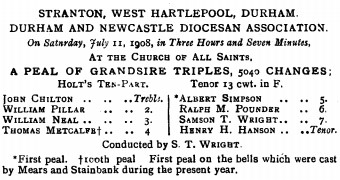
The first peal on the bells was quickly rung, in July of 1908, and was reported in “Bell News and Ringer’s Record” thus:
Very little work on the bells has been done over the years, except replacing the bearings in 1953 and replacing the clappers in 1972.
Taylor’s were employed in 2022 to replace all fittings, tune the bells and to clean and paint the frame. In May of that year this appeared on the foundry’s website
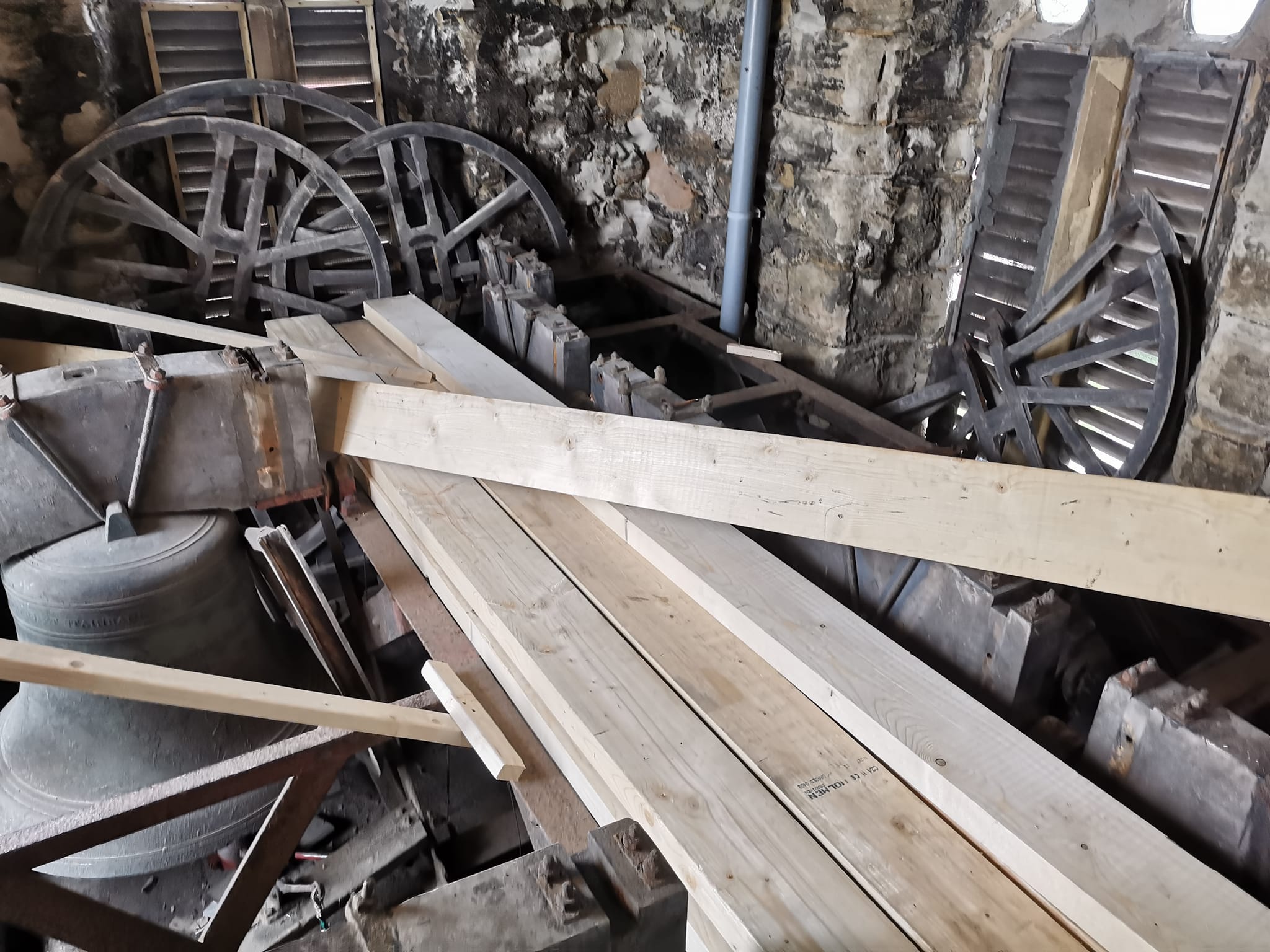
“The 13 cwt ring of eight at this church, with the exception of the 6th bell, is the work of Mears & Stainbank of the Whitechapel Bell Foundry and dates from 1907. The 6th bell was cast in 1599 by Samuel I Smith of York. The bells are to be removed from the tower through the louvres and brought to the Foundry for cleaning, conservation and tuning. All new ringing fittings will be manufactured for all the bells. The 1907 Whitechapel iron bell frame will be cleaned and be re-painted before the bells are rehung.”
This article appeared in ©The Ringing World in the edition of June 24th 2022:

The bells were removed from the tower on July 14th 2022 and will be back later in the year. When the 6th was examined at the foundry, it was discovered that it was cast at the Seliok foundry, based in Nottingham, around 1520. It was previously unknown who cast it and could only be dated to some time in the 16th century. In October 2022, after tonal analysis, the old 4th bell was found to be untuneable and was spoiling the musicality of the ring. It was therefore decided to replace this bell with a new stock bell and to hang the old 4th dead above the ringing peal. The inscription on the “new” fourth is inscribed.
All the pre-restoration bells have had their canons removed and the replacement 4th was cast with a flat head. The frame is of wrought iron, with a mixture of 8.1.B.a and 8.1.C trusses. The frame layout is “non-standard”. The previous 4th is in a steel girder frame above the others.
The bells, recorded individually in the tower prior to their removal.
1 3-2-1 (4-0-0) 25.63″ 1907 Mears & Stainbank F
2 3-3-4 (4-0-13) 27.00″ 1907 Mears & Stainbank E
3 4-1-10 (4-3-9) 29.13″ 1907 Mears & Stainbank D
4 5-0-4 29.75″ 2010 John Taylor & Co 1036.3 C-17C
5 5-3-6 (6-1-22) 33.75″ 1907 Mears & Stainbank Bb
6 6-2-12 (6-3-21) 35.25″ 1520† Seliok (generic) A
7 8-3-0 (9-2-21) 38.63″ 1907 Mears & Stainbank G
8 11-2-15 (12-3-4) 43.13″ 1907 Mears & Stainbank F
X4 4-3-16 (5-0-27) 31.00″ 1664 Samuel I Smith C
(Weights in brackets are pre-2022 restoration weights)
Inscriptions
The inscription on the 7th bell is that of the previous middle bell of 3. All, except 4 & 6 are inscribed:
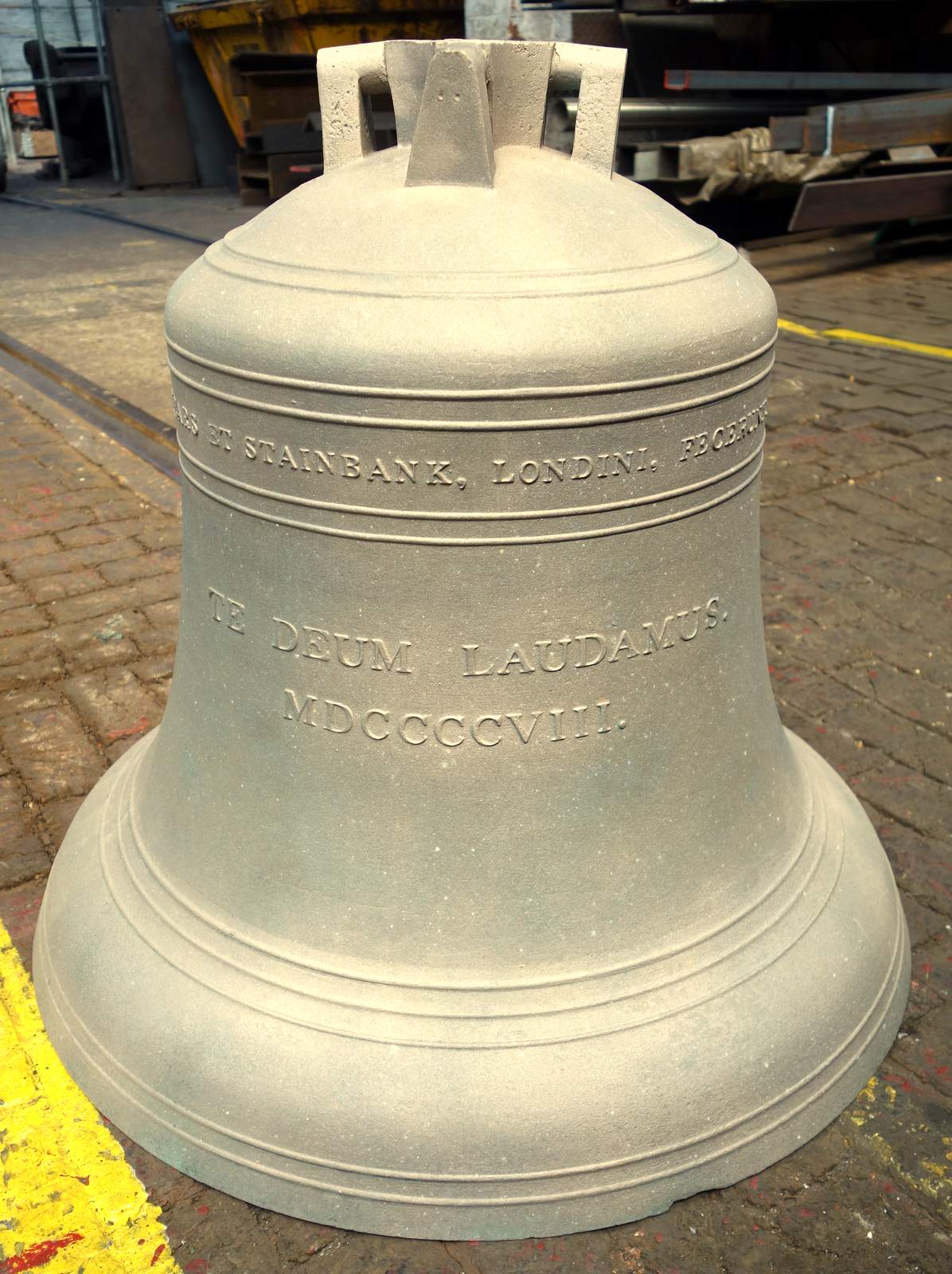
MEARS ET STAINBANK, LONDINI, FECERUNT MDCCCVII
also:
- HORA FUGIT ORA
(The Hours Files – Pray) - TE DEUM LAUDAMUS
(We Praise The, P God) - BENEDICITE OMNI OPERA
All Ye Works, Bless Ye The Lord) - AILSA ROBINSON
IONA, CLOE & LARA ROBINSON-KAYE
BELLRINGERSRING OUT IN MEMORY OF
ANDREW KAYE
1967 – 2022
(Other Side)
JIM CROWTHER
BELLRINGER - MAGNIFICAT ANIMA MEA DOMINUM
(My Soul Doth Magnify the Lord) - SCA MARIA ORA PRO NOBIS
(Holy Mary, Pray For Us) - CLANGORE DULCI SONO PSALLUM TIBI DEUS 1699
(Let us Sing a Psalm Unto Thee, O God, With a Sweet Sound) - VIVOS VOCO, MORTUAS PLANGO
I Call the Living, I Mourn for the Dead)
Ex-4th
VENITE EXULTEMUS DOMINO S S 1664
(O Come Let Us Sing Unto the Lord)
 |
 |
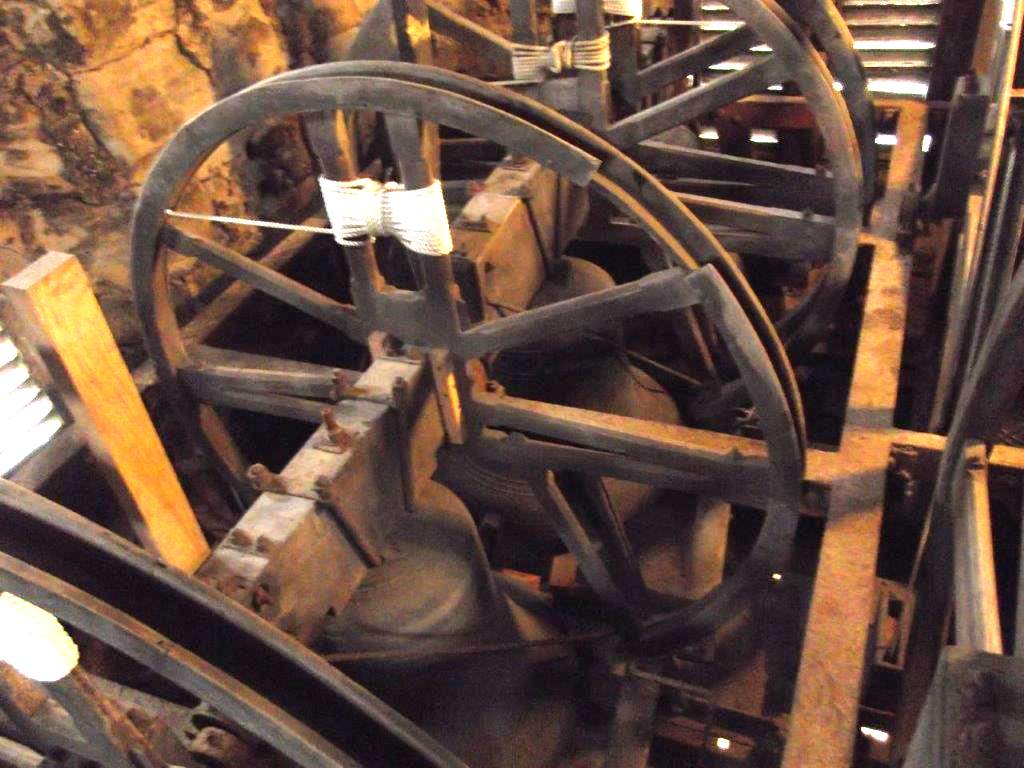 |
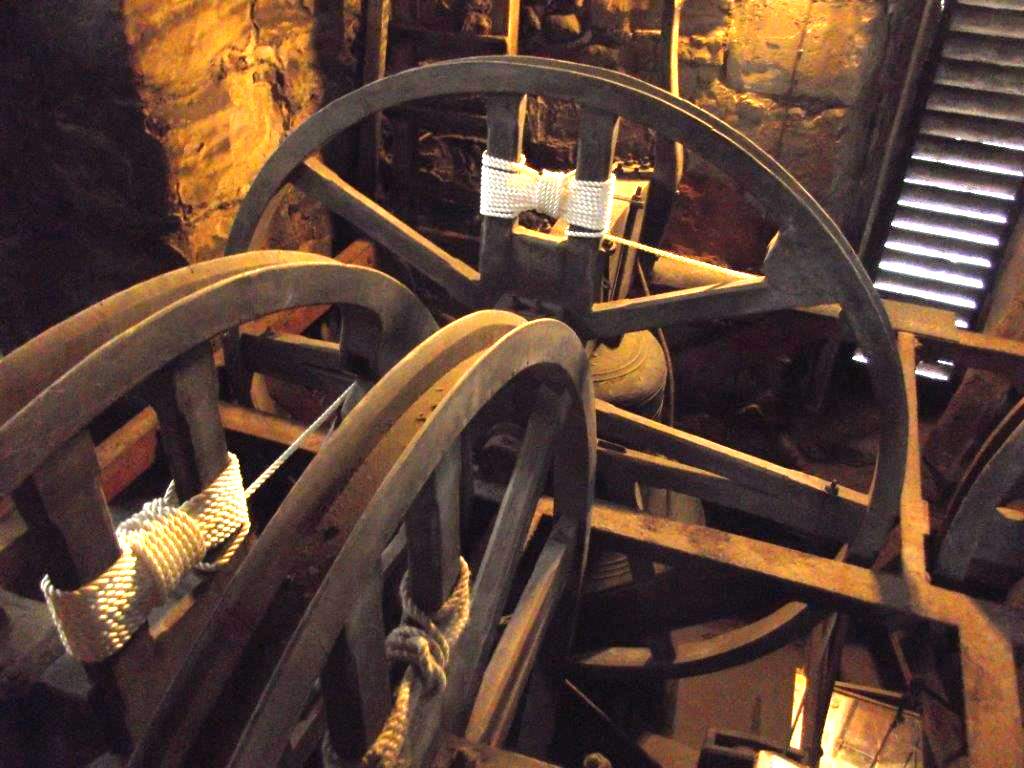
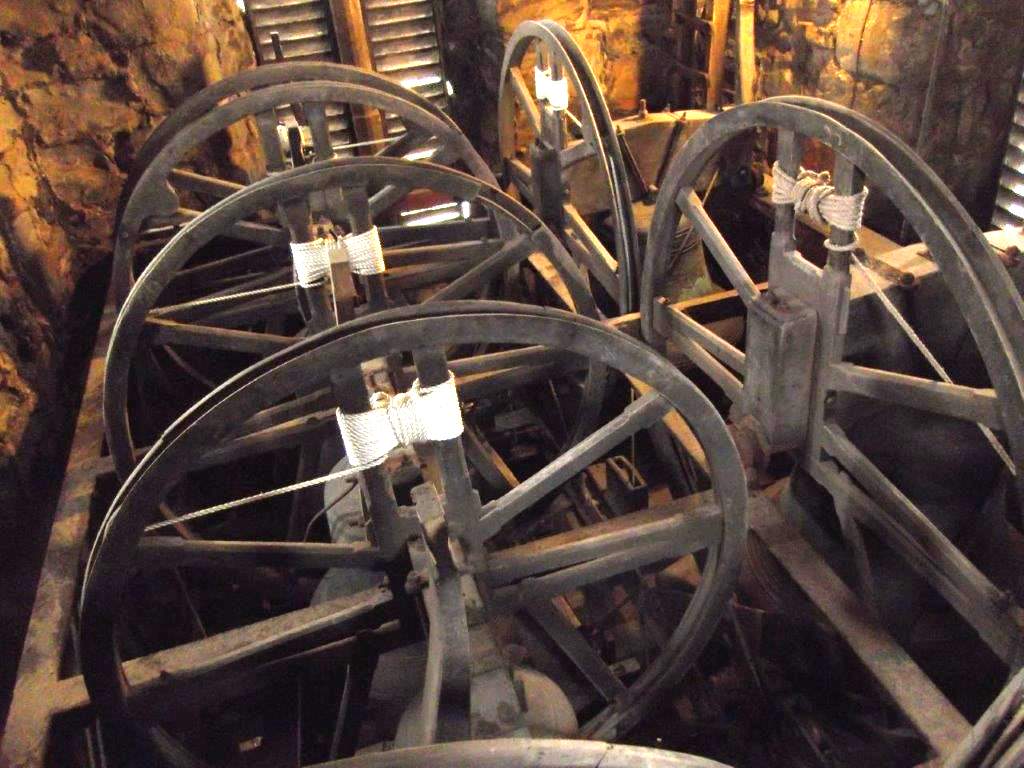
Views of the Bells. ©Taylors of Loughborough |
 |
 |
| A view of all 8 bells. | The start of the dismantling, June 2022 |
 |
 |
| The bells ready for removal ©Jack Hanlon |
The bells arrive at the foundry |
 |
 |
| The bells at the foundry ©Taylors | |
 |
 |
| The second bell following sandblasting ©Taylors |
The frame – repainted while the bells are at the foundry ©Taylors |
 |
 |
| Six of the bells with their new headstocks ©Taylors |
The bells as rehanging is near completion ©Jack Hanlon |