 Gateshead, St Mary 8: 15cwt in F MAP
Nearest Metro Station: Gateshead
Church History
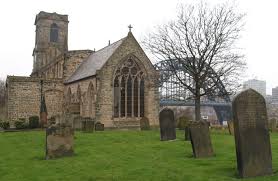
St Mary’s Church has a long and exciting history. Standing high above Gateshead Quayside, this fine example of a medieval town church is a riverside landmark. Dating back to the late 13th century, the Church of St Mary the Virgin was the ‘mother church’ of Gateshead and was the only church in the town until St John’s was built at Sheriff Hill in 1825.
Whilst the church has had a long history, this has not always been particularly peaceful. Damaged by cannon balls during the English Civil War, it has been nearly destroyed by fire on 3 separate occasions – in 1854, 1979 and again in 1983.
The Church closed in 1979. The 1979 fire caused only superficial damage to the bells but that of 1983 caused major damage. Some bells were stolen from the church and the remainder were removed to the diocesan store from where more were stolen. The remaining bells, the two trebles, were sold for scrap and the funds used for the augmentation at St. Mary’s, Whickham.
Although restored, the building has never been used as a church again. Having had several uses it is now open as a heritage centre.
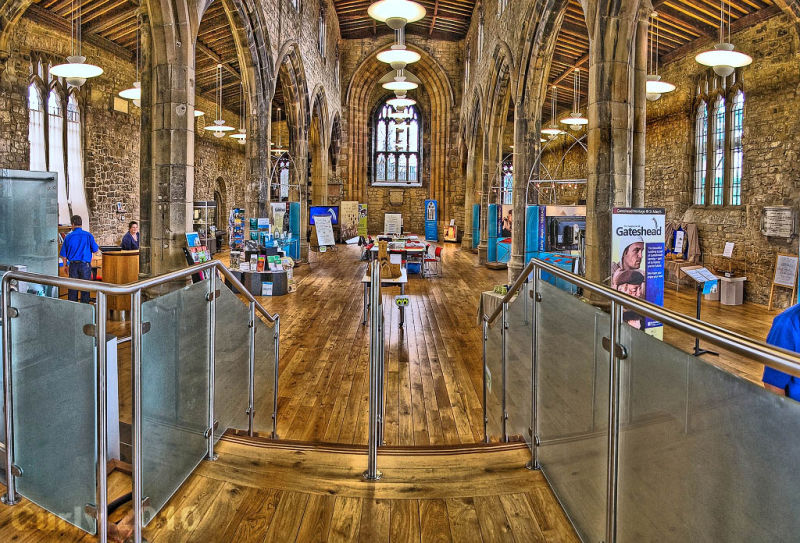
The interior of the Heritage Centre
The Bells
In 1730 six bells were installed, partly at the expense of Trinity House, Newcastle, and Newcastle Corporation, but no details seem to have survived. A still earlier bell at Heworth Parish Church inscribe +IHS R.W+DEM + is said to have been sent there from Gateshead in payment for a debt in 1701. This is said to be because the church could not pay its water rates! (RW 6/2/31).
In “Order and Disorder in the Eighteenth Century”, compiled by John Eisel, it is reported in local newspapers that:
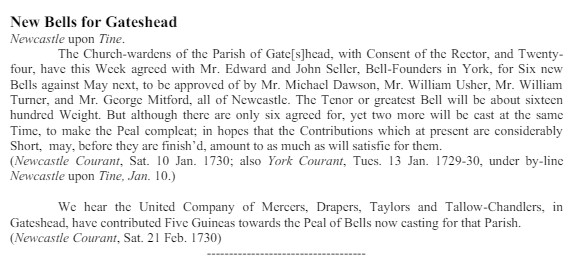
Only 6 bells were hung, they being rehung in 1773. The tower was demolished and rebuilt in 1740. (HEJS)
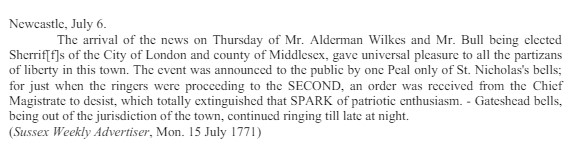
An amusing report of ringing in 1771 was reported in a Sussex newspaper!
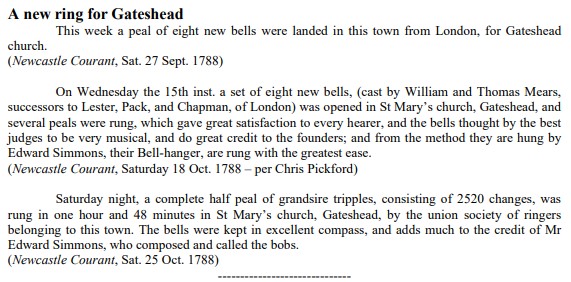
Within 60 years the bells were a complete William & Thomas Mears of Whitechapel ring, 1788, hung by Edward Simmons, with the 7th being recast at Whitechapel in 1976. The 7th was cracked in a peal attempt more than 10 years previously.
The new ring was reported in the Newcastle Courant:
A peal of Grandsire Triples in 1790 was reported in the local paper.

They must not have been in a good state by the 1890s, as this is reported in “Bell News and Ringers’ Record”:
Gateshead.—On Thursday night, February 11th , the members of St. John’s Guild, Newcastle, visited St. Mary’s church, and rang a 518 Grandsire Triples (first part of Holt’s 10-part peal). J. Simn, 1; H. Ferguson, 2 ; F. Lees, 3; H. Lindsey, 4; W. Holmes, 5; A. F. Hillier, 6; C. L. Routledge (conductor), 7 ; J. Alderson, 8. As the authorities will not allow the tenor to be raised, she was ” clocked ‘ in this touch. Tenor 15 cwt. This is the first change-ringing on the bells for over twelve years.
However, a peal was rung in 1901:
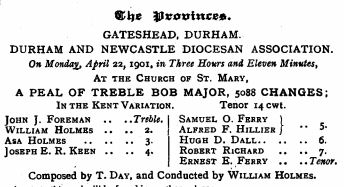
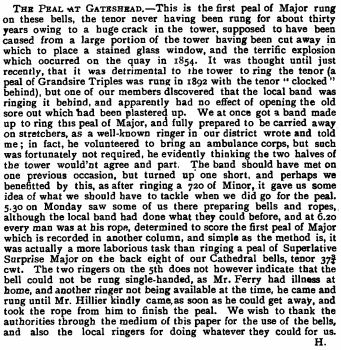
The bells were rehung and quarter-turned by Mears and Stainbank in 1902, 13 members then joined the D&N – the first ever from the tower. They were dedicated on November 1st and it is noted that it was the first time in over 100 years that they had been rehung. A peal was not long in coming!
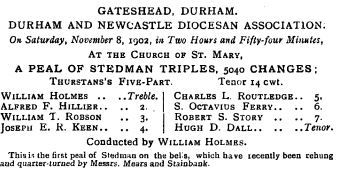
This appeared in Bell News on January 10th 1903:
Gateshead (Durham). St. Mary. Durham and Newcastle Association. Eight bells. All by Mears, 1788. Tenor 14 cwt., diameter 3 ft. 4 in. Timber frame. Bells go well. Recently quarter-turned and rehung with new fittings by Mears. Ropes recently renewed. Method: Plain Bob. No Sunday ringing mentioned. Practice ; Tuesday, 7.
On March 23rd of the same year, there was a report of the Gateshead Society’s Annual Meeting and Dinner. In this it noted:
Our own ringers are progressing favourably in change-ringing under the tuition of Mr.
Hillier, to whom our best thanks are due. It is with gratitude and pleasure that we record the constant attendance of our members at Divine Service. As long as our ringers recognise in this way that as churchworkers they must also be God-worshippers, we have no fear for the future of our belfry.”
This appeared in The Ringing World of April 1st 1921 about the band’s annual dinner – the date not being significant!
In accordance with the spirit of the times, it was decided to open the belfry to ladies. Mr. Stuart would be very glad to hear of churchmen or churchwomen who would like to learn the ancient craft of ringing. The present peal of bells dates from 1788, and replaced an older one.
They were quarter turned and put onto ball bearings by Gillett & Johnston in 1927, being re-opened on the 10th September that year, being reported in the edition of September 23rd:
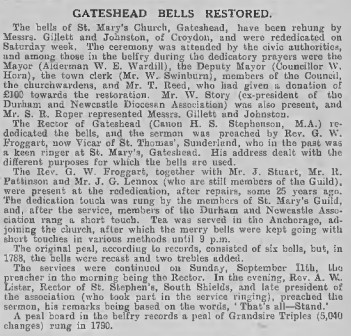
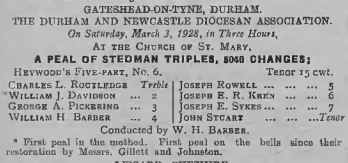
the first peal on the rehung bells followed shortly afterwards:
In a report about the D&N in the January 5th 1940 edition of The Ringing World it was noted, “Arising out of the minutes, it was revealed that the bells of St. Mary, Gateshead, appeared to be quite satisfactory after rehanging, although only limited opportunities for ringing had so far been available.” “Belfry Gossip” of December 22nd 1939 had noted: “Messrs. Mears and Stainbank have just completed the rehanging of the eight bells at. St. Mary’s, Gateshead, in new framework.” Why the bells needed rehanging so soon after the 1927 rehang, I don’t know. Was a new frame required?
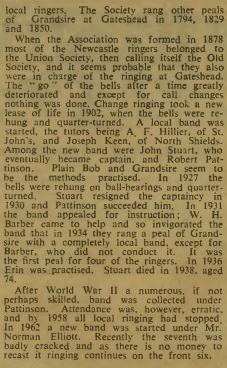
There was a series of articles about ringing in the area that were published in early 1966 and this is the report for Gateshead:
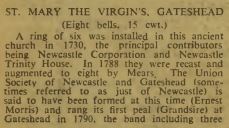
On the same page is found this:
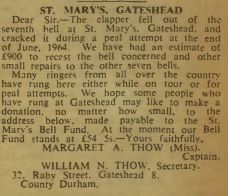
The bell, which had a large crack caused by the incident with the clapper, was not recast for a further ten years
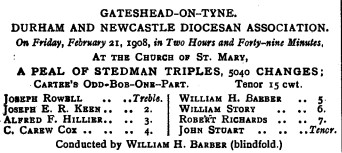
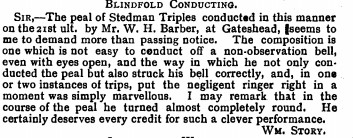
One of the greatest feats of conducting took place here in 1908, when William H. Barber conducted a peal of Stedman Triples, using the complicated “Carter’s Odd-Bob-One-Part” composition, while blindfolded!
 |
 |
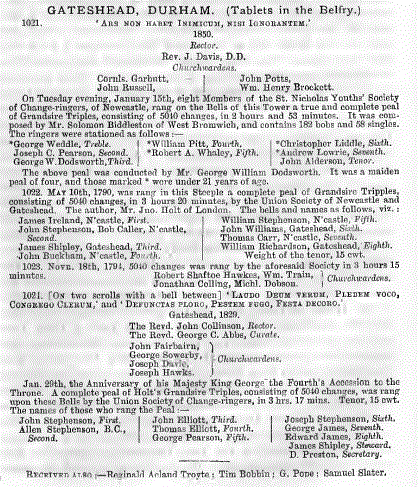
There were 130 peals rung on the bells, the first being in 1790 and the last in 1979.
The first peal was reported thus:

Another peal was similarly recorded in 1794

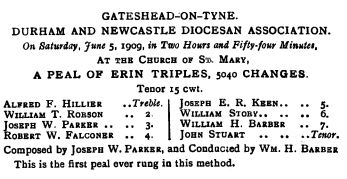
The first ever peal of Erin Triples was rung here in 1907:
In The Ringing World of January 23rd 1963 there was an article detailing the first 100 peals on the bells – the 101st being rung on the same day as the 100th; 29th December 1962:
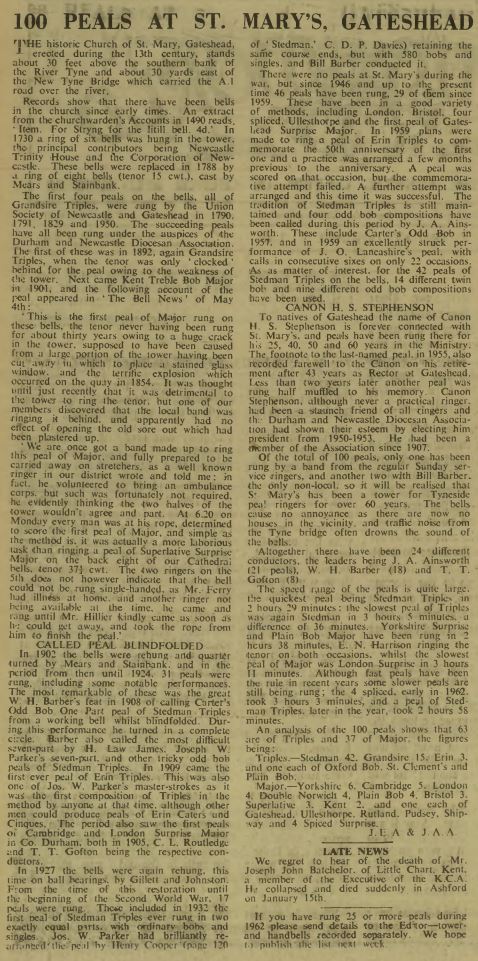
(Click to enlarge)
1 5-0-15 28.00″ 1788 W & T Mears, London
2 5-0-24 29.00″ 1788 W & T Mears, London
3 6-0-2 31.00″ 1788 W & T Mears, London
4 6-3-7 33.00″ 1788 W & T Mears, London
5 8-0-15 35.75″ 1788 W & T Mears, London
6 9-1-6 37.75″ 1788 W & T Mears, London
7 10-3-25 40.38″ 1976 Whitechapel Bell Foundry Ltd, London 764.0Hz G-45c
8 14-0-1 44.50″ 1788 W & T Mears, London
These are the weights as given in c.1790 by “Hedderly” and subsequent work may have altered weights, etc.
The front 6 bells were inscribed “W. & T. MEARS LATE LESTER PACK AND CHAPMAN OF LONDON FECIT 1788”. The 7th also had, “RECAST 1976 WHITECHAPEL”
The tenor was inscribed:
R. THORP RECTOR (incised)
THOS PATTEN JNO BOWELT WM MARRAS ROBT HARRIS CHURCHWARDENS
W. & T. MEARS OF LONDON FECIT 1788
The Ring of 6
1 1730 Edward & John Sellar
2 1730 Edward & John Sellar
3 1730 Edward & John Sellar
4 1730 Edward & John Sellar
5 1730 Edward & John Sellar
6 1730 Edward & John Sellar
In the edition of the magazine “Church Bells” of August 17th 1878, there is a record of peal boards that were in the ringing chamber at that time: