Durham, St Margaret 3 Bells 
St Margaret’s is one of the oldest churches in the City of Durham, dating from the mid-12th century. The first church, of c.1150, may have comprised a nave with clerestory above, south aisle, chancel and possibly a low western tower. The south aisle arcade of this church still survives. The north aisle was added c.1195 in a much lighter and more graceful Norman architecture, anticipating the coming Gothic style, but still with many traditional 12th-century details. The south aisle was rebuilt in 1343 and in the 15th century the church was greatly improved with a new tower, clerestory and chancel chapels.
Population increases during later centuries were accommodated in galleries, all swept away in Victorian restorations (1865 and 1877-80). Many of the early church furnishings may have disappeared at this time, although the font survives, of 12th-century date and made of Frosterley marble.
The South Arcade – i.e. the arches and columns on the south side of the Nave – formed part of the original building. The North Arcade was built some forty years after its counterpart on the south, and is quite a bit taller.
The Chancel Arch is also original. It may well have been built by Hugh du Puiset (Bishop of Durham 1153-97), whose arches were notoriously unstable. Certainly it has a rather sunken aspect, and has been strengthened and reinforced at various stages over the centuries.
Either side of the arch are squints, which give people in the aisles a clear view of the altar.
The Font is 12th-century, and may well be contemporary with the original building. It is of Frosterley marble – a local stone containing many fossils.
Two Norman Windows also survive, smaller and narrower than all the others: one on the north wall of the Chancel, the other in the south-west corner of the Nave (the County’s only remaining Norman clerestory window).
The Lady Chapel dates from the 15th century; prior to that date another chapel dedicated to the Blessed Virgin Mary stood on the site, together with a chantry to St Thomas a Becket.
The Tower also dates from the fifteenth century and contains three bells, two of them mediaeval, the other 16th-century. The old wooden bell-frame is still in situ, though the bells are now fixed to a steel joist.
In the centre of the Nave floor is an interesting slab memorial to Sir John Duck (aka “Durham’s Dick Whittington”) and his wife. Duck had arrived in the city penniless, and became a butcher’s apprentice. Over the years he rose to be a successful butcher and coal-owner; in time he married his master’s daughter, became mayor of the city and was eventually knighted by Charles II.
Most of the woodwork in the Church is Victorian though the wood of the pews is older, having been recycled from the ‘box pews’ that formerly filled the Church. The furniture in the Lady Chapel was given in memory of parishioners who fell in the Second World War.
The organ is a fine instrument by the famous Durham firm of Harrison & Harrison, built in 1917 (Arthur Harrison was Churchwarden at the time). Arthur Yockney, the then headmaster of St Margaret’s School, carved the woodwork for the case. There are 1,276 pipes in the organ.
Source: Church Website
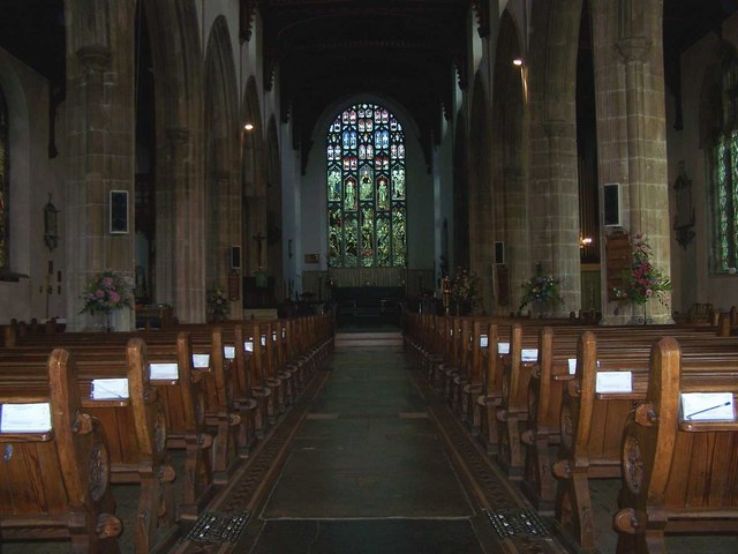
The interior of the church
The Bells
The website notes that the old wooden bellframe is still in situ, but that the bells are now hung on a steel joist. A Diocesan Survey. by Peter Ryder in 2002, notes “The long-headed wooden Bell Frames are of pegged construction; and have three parallel pits set east-west (Pickford type 3.1); the bells are now hung from a recent girder. The main trusses are of Pickford type 6A with sill, end posts, long head and braces from sill to head. The end bays of the return sides each have a single brace from sill to the inner post.”. This indicates that the bells were at one time hung for full-circle ringing. I would appreciate any information about when the bells were last rung and exactly when they were rehung on the joist.
Newcastle Society of Antiquaries give information about the bells in their reports. They note that the stops on bells 1 and 2 appeared to have been created from woodcuts.
 |

All three bells are listed and retain their canons. |
The details of the bells are:
1 5½cwt 30.00″ c1480 John Daniels successor
2 6¼cwt 32.63″ c1480 John Daniels successor
3 9cwt 37.00″ 1624 John Conyers, New Malton