Coniscliffe, St Edwin 3 Bells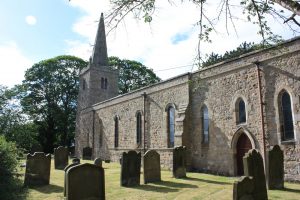
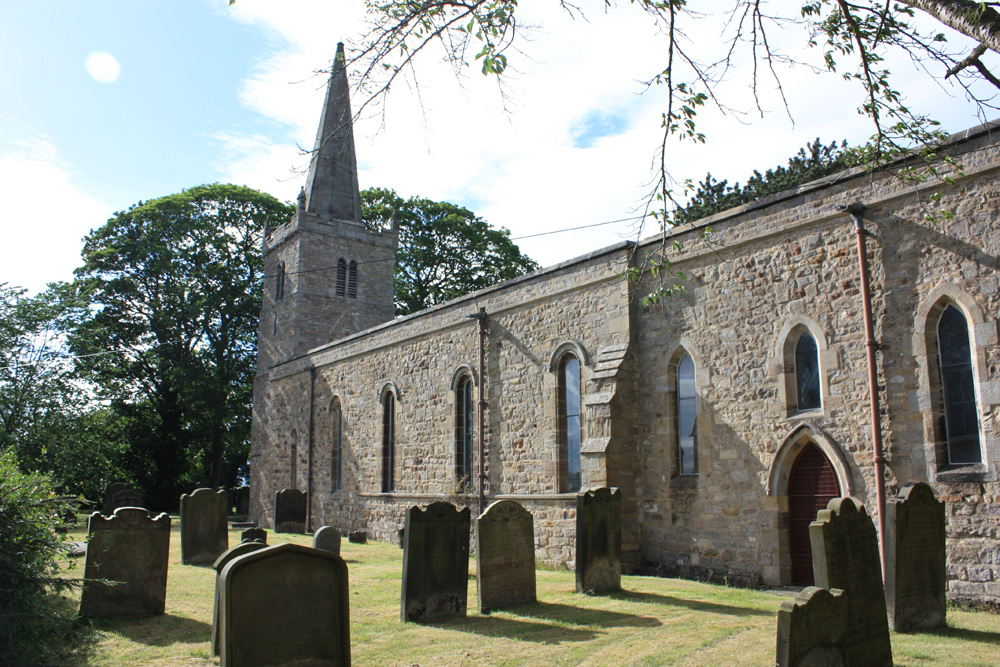
St. Edwin’s Church is a Grade II* listed building, in the village of High Coniscliffe. It occupies a dramatic site on the top of a cliff (Coniscliffe means the King’s Cliff), on the north bank of the River Tees. Parts of the church date from the 12th Century but it was enlarged to its present size in the 13th Century. It is an unusually long and narrow church, essentially in the Early English style.
In the walls there are seven pieces of sculpture dating from before the Norman conquest of 1066. The tower dates from the 13th Century and the spire from the 14th Century. The spire is one of only four octagonal spires in the region. Inside the north porch is a re-set 12th Century arch brought from the south side of the nave. Above the arch is a rectangular carved panel with a carving of the “Agnus Dei”, the Lamb of God. Above are the letters ‘AGNU’, and on either side stand angels in long robes, with outstretched wings, trampling underfoot a pair of serpents. Although sometimes described as a Saxon stone, this may be Roman, from the nearby Roman Fort of Piercebridge. Inside the church there is a beautiful pointed chancel arch of early English or Traditional style, also a very attractive series (‘arcade’) of five arches separating the nave from the north aisle.
The Choir stalls are 15th Century and have good carved “poppy heads”. The vestry was re-built in the 15th Century and probably at this time the upper apartment was added. This higher room was the home of the chantry priest, employed to say prayers for the souls of the dead.
Source: http://www.spiritinstone.co.uk/churches/st-edwins-church&ssid=53
Pevsner states, “The unusually flat roof replaced one of a higher pitch some time before the restoration of 1844-5, by George Pickering. He rebuilt the eastern part of the name, the south wall and renewed most of the windows. In 1890-1 C. H Fowler altered the chancel and added new furnishings”
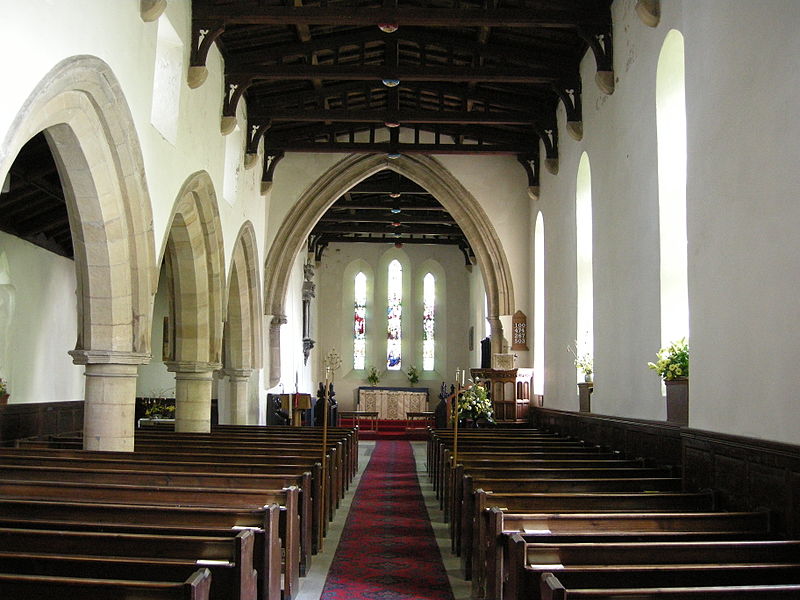
The interior of the church: Source: Linda Spashett
The Bells
A Durham Diocesan Archaeological Survey of the early 21st century notes:
“The Bell Frames have three parallel pits (Pickford frame layout 3:1) and three old shortheaded trusses (a rarity in the North East) survive; these are of Pickford type 3D (sill, kingpost, short head, and braces from the sill jointed to post and head); they seem to have been later converted to a long-headed form. Much more recently, the bells have been re-hung from a girder directly above.”
1 4¾cwt 28.13″ C15th Unknown
2 6¼cwt 32.25″ 1681 Peter Wood
3 6¼cwt 32.38″ 1727 Samuel Smith II
The largest bell, based on bells by the same founder, will be around 6cwt in weight.
When Peter Rivet looked at them in 1974 they were hung for ringing but the wheels were in an advanced state of decay and there was a wooden plank in the way of the treble. He says
“High Coniscliffe (commonly referred to as Coniscliffe), St Edmund (1974) – Bells hung for ringing, but the wheels were in an advanced state of decay . Consequently they were clocked; only two of them were in use, according to the vicar’s wife. Apparently they are not tuned to a musical scale. The inscription on the 1727 tenor is inconsistent with parish records (wrong name for the vicar) so it is likely to be second hand from elsewhere.”
A faculty for “the rehanging of the bells and associated work” was issued on 26th November 2002 and therefore the bells would have been rehung dead shortly after this date.
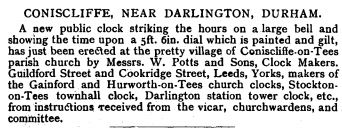
A chiming clock was added in 1892 and this was reported in Bell News in the edition of May 21st:
Inscriptions
The Newcastle Society of Antiquaries (1887/88) gave the inscriptions as:
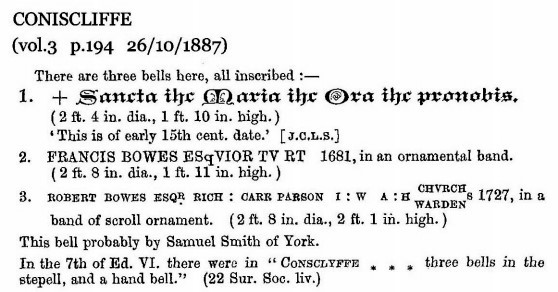
Peter Rivet notes state that there is something of a mystery about the tenor as according to the parish records the Rector in 1727 was not called Richard Carr. Perhaps this bell is second hand from somewhere else?