Chester-le-Street, SS Mary & Cuthbert 8: 19-0-2 in E MAP
 Ringing:
Sunday 09:30 to 10:00 and 17:30 to 18:00.
Practice Friday 19:30 to 21:00 (3rd Friday of month).
Church History
When the Danes drove out the Christian community at Lindisfarne in AD875 the monks too St Cuthbert’s coffin and wandered the area for 7 years, before settling in Chester-le-Street, building a wooden church. This became a cathedral for the area. The monks were again driven out by the Danes in AD 995 and, after first going to Ripon, they settled in Durham.
The oldest parts of the present building that can be dated, to 1056 when a stone church was built to replace the wooden shrine to St Cuthbert, are the walls of the chancel and the two largest pillars now near the centre of the nave. The church then would have been a third shorter and much narrower, as wide as the chancel today. Lewis holes visible in two stones on a front buttress show that Roman stone was used in later construction.
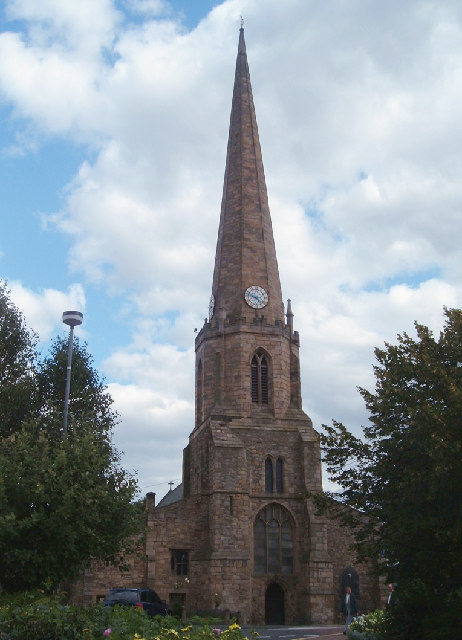
The church was extended around 1267 with the nave, the lower part of the tower and east wall with sedilia all dating from this time. In 1286 it was made a collegiate church,with a dean, seven canons, five chaplains and three deacons, supported by tithes from extensive endowments throughout a large parish. Around 1383 an anchorage was added in one corner of the church, to be used by six (male) anchorites until 1547, when it was extended. It is now the Ankers House Museum. A 158 feet (48 m) spire and belfry and three bells were added in 1409, one of which is still in use.
The collegiate church was dissolved during the reformation and the church became a parish church with reduced wealth and influence. In subsequent years much of the money for building came from donations, with those of the Lumley and Lambton families particularly notable. John Lumley contributed a set of family effigies that now lie along the north wall in 1595. A new south porch was added in 1742, while in 1829 a Lambton family pew by Ignatius Bonomi was added above a new vault (which once held the remains of John Lambton) with an external staircase.[
In 1862 major restorations were undertaken, and the church became a rectory with the installation of an organ in 1865, later restored by Harrison & Harrison.[15] To celebrate the church’s millennium a screen was installed in 1883, along with other alterations. In 1927 a reredos, panelling and a bishop’s throne by Sir Charles Nicholson and three panels, Journey of St Cuthbert’s body, by his brother Archibald Keightley Nicholson were added. The church became a Grade 1 listed building in 1950, and doors were added to the South Porch in 1964.
Source: https://en.wikipedia.org/wiki/St_Mary_and_St_Cuthbert,_Chester-le-Street
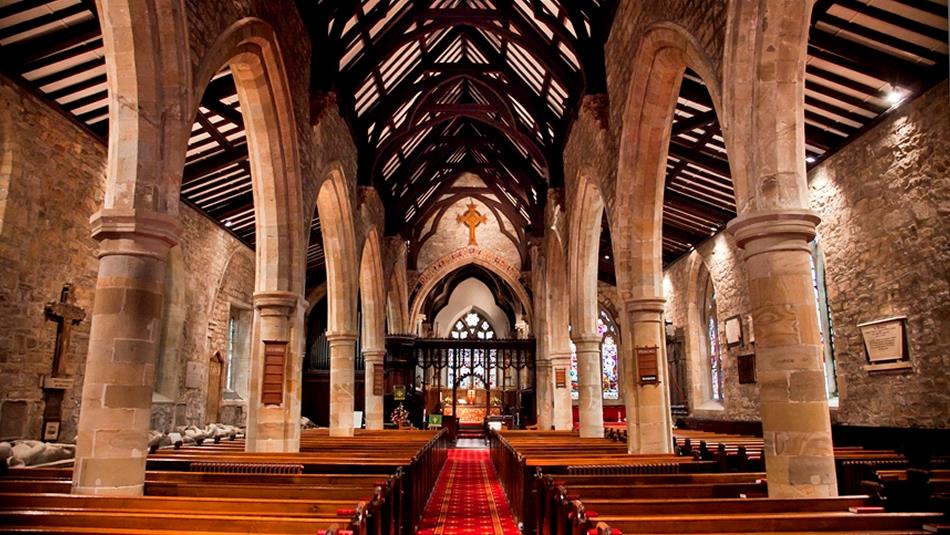
The interior of the church
The Bells
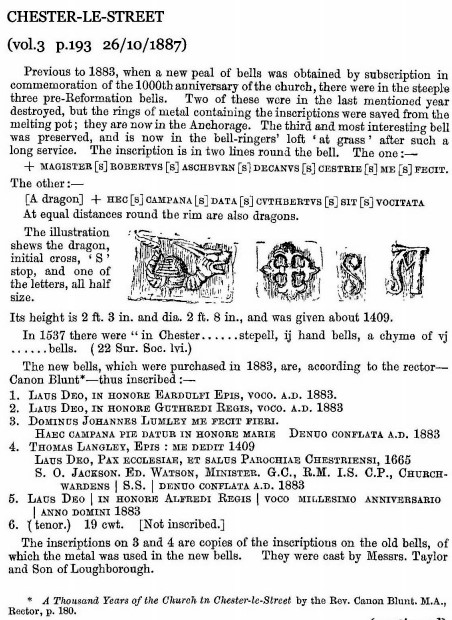
Prior to 1883 there were three bells, two by an unknown founder, one dated 1409, (the treble, which is still used as a service bell), and one other by Samuel Smith I. The inscription bands of the two other bells are in the ringing chamber. The rest of the bells were recast. The metal left over after the inscription bands were cut out was 7-3-13 and 9-2-0 respectively.
A ring of 6 was installed by Taylors in 1883 and the same firm augmented the ring to 8 twenty-five years later. The two trebles were cast with button tops and the two tenors with flat tops. I am not aware of the situation with the middle 4 bells.
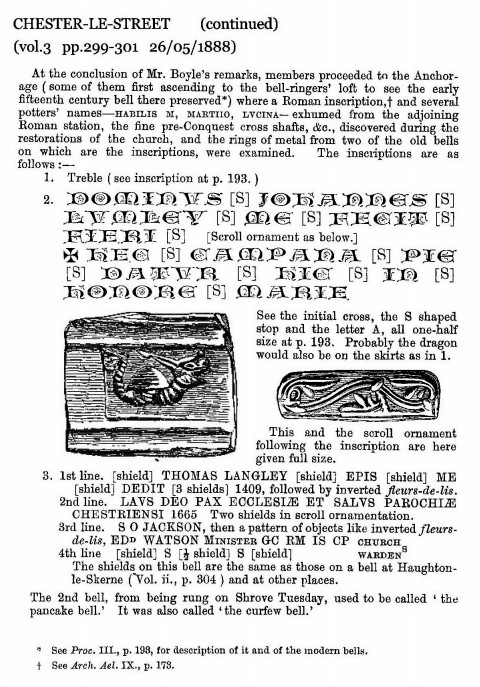
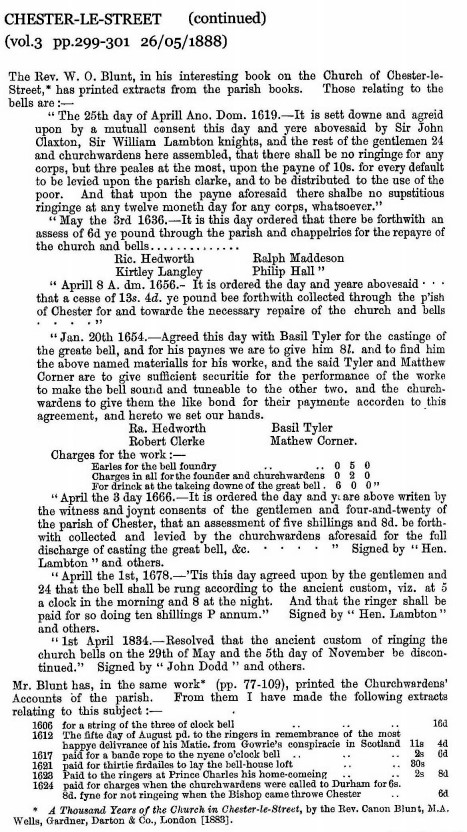
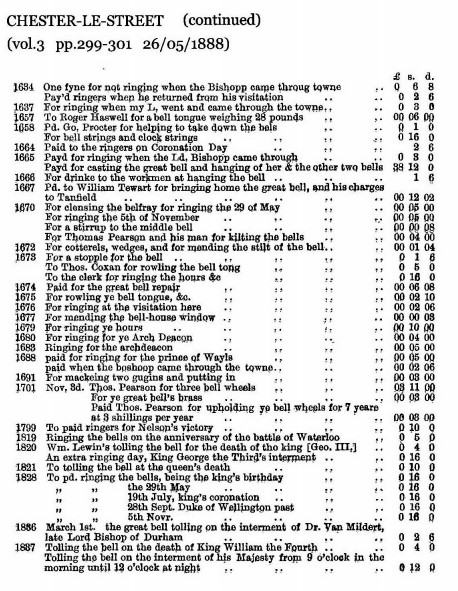
The Society of Antiquaries of Newcastle reported in detail about the bells around this time, giving much historical information
 |
 |
 |
 |
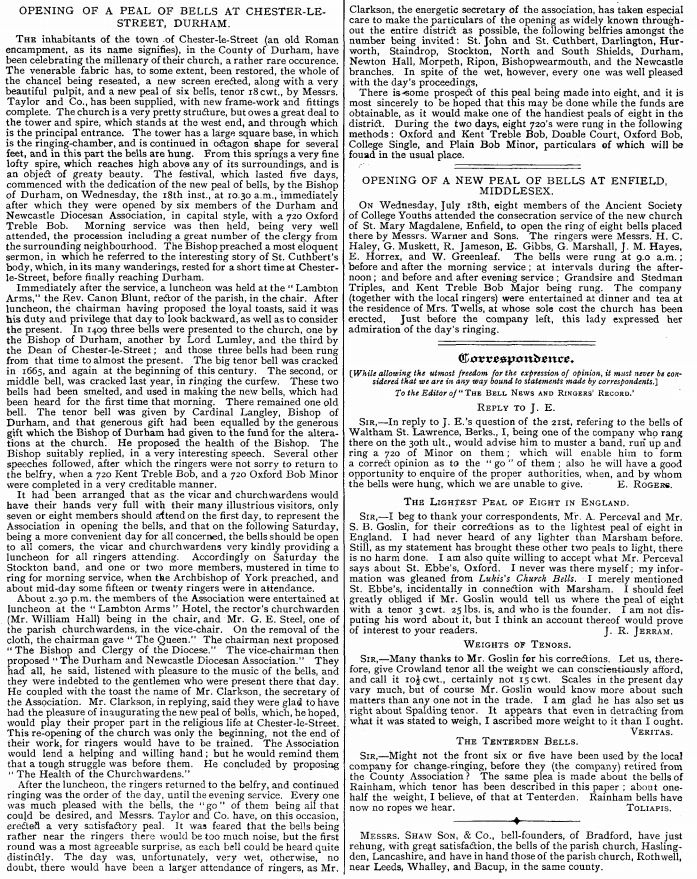
The opening of the bells was reported, in full, in “Bell News and Ringers’ Record” in their edition of July 28th 1883:
Details of the bells as they were at this point in time were published in Bell News of January 24th 1885:
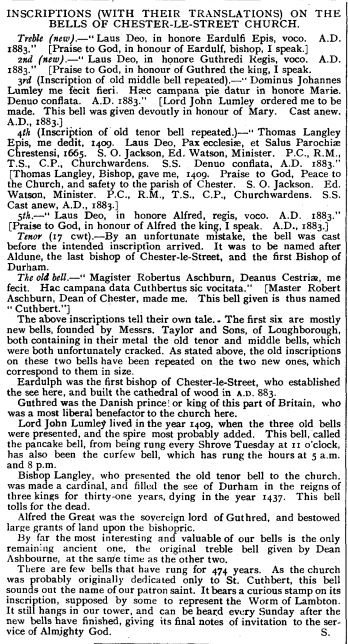
The bells were at this time hung in a wooden frame of the same layout as the present lower cast iron frame.
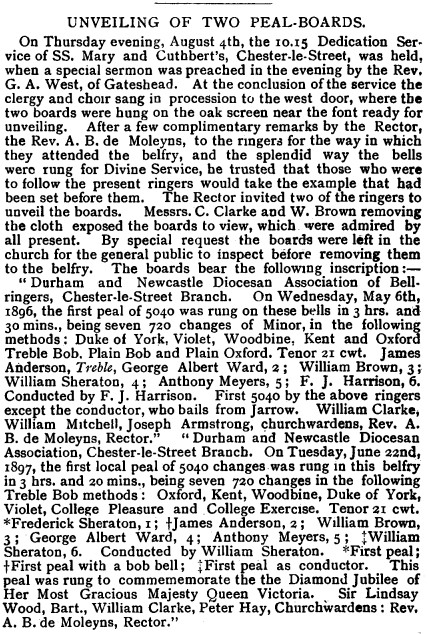
The unveiling of two peal boards was reported in Bell News on September 5th 1898.
The following incident was reported in Bell News on January 28th 1899:
Imprisoned in the Tower
A serious accident, which might have had a fatal termination, occurred last week to Mr G. W. Steele, of Chester-le-Street. It seems that Mr Steele with an assistant proceeded to the clock in the parish church spire in order to examine the striking apparatus, which is situated under the tenor. On going down between the 4th bell and the oak beam on which it rests, he inadvertently placed his foot on the wrong side of the wheel, and the bell being up came over, and wedged him against the frame. The assistant seeing his perilous position, ran at once for help. Fortunately, the sacristan and a company of young men were inspecting the interior of the church, and they proceeded to where Mr Steele was, and succeeded in lifting the bell and releasing him. He was at once taken home, and medical aid summoned. Mr Steele has sustained a severe shock.
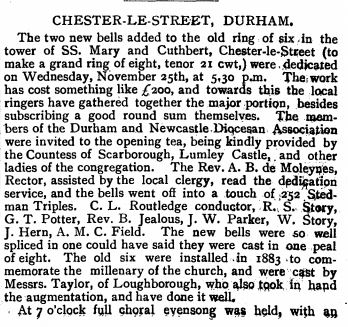
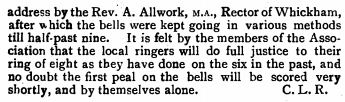
Despite hopes that it might have happened soon after the six were installed, the bells were finally augmented to 8 in 1908, (and the tenor seems to have gained 3cwt!) and their dedication is reported in Bell News on December 5th:
 |
 |
The new trebles were hung above the existing ring of 6 in composite frames.
There were concerns over the stability of the spire and only a few years later, in 1913, the bells were completely rehung in a new two-tier cast iron frame. It houses the back 6 bells in an H-Frame and the two trebles above in lowside frames, giving a truss of 8.3.D.a
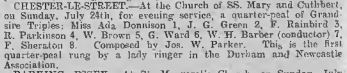
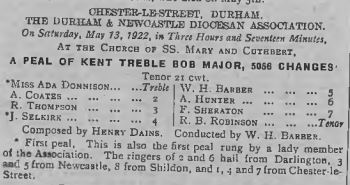
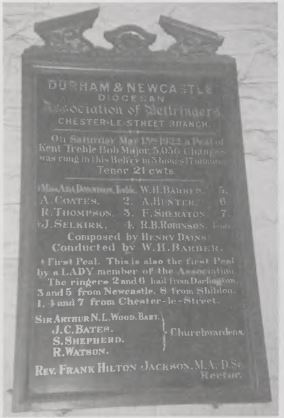
In 1921 this tower broke new ground – the first quarter peal by a lady ringer in the Association. This came a mere 9 years after the first peal by a complete band of ladies at Cubbitt Town in London!
The first peal rung by a lady for the Association was rung here the following year and commemorated by a pealboard:
 |
 |
Despite this rehanging, in 1923 ringing was indeed suspended for a few months during work to the spire (RW 7/9/23).
The trebles were rehung on ball bearings in 1947.
The church was the front page article in The Ringing World of July 20th 1973:
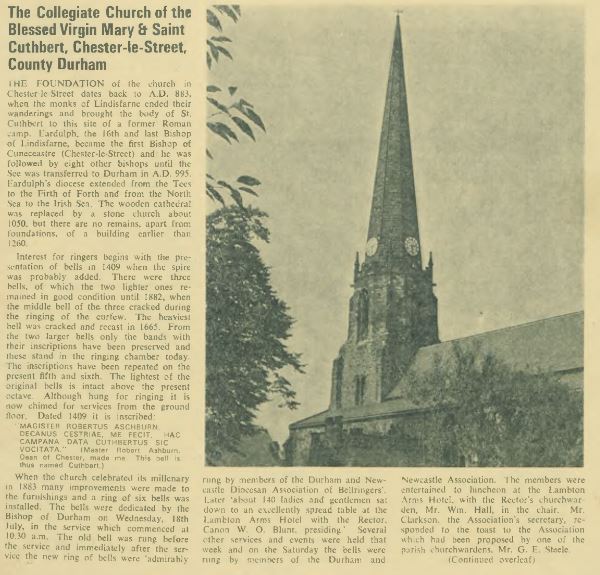
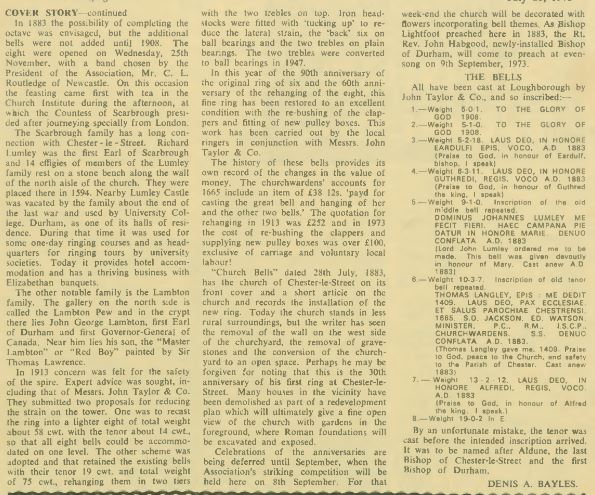
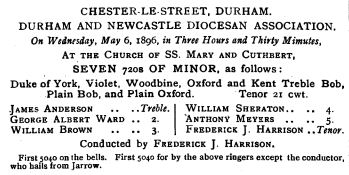
The first peal on the bells was rung in May 1896 – note that the tenor was said to be 21cwt at this time. It was reported in “Bell News and Ringers’ Record” thus:
There were 5 peals rung on the ring of 6, the first on the ring of 8 was rung shortly after the trebles were hung and is recorded thus:
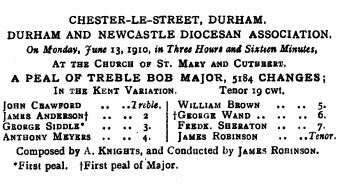
For some reason, they did not put in the footnote that it was the first peal since the bells were augmented.
1 5-0-1 27.50″ 1908 John Taylor & Co 1322.0Hz E+5c
2 5-1-0 28.38″ 1908 John Taylor & Co 1242.0Hz D#-3c
3 5-2-18 30.13″ 1883 John Taylor & Co 1125.0Hz C#+25c
4 6-3-11 32.38″ 1883 John Taylor & Co 1011.0Hz B+40c
5 9-1-0 36.13″ 1883 John Taylor & Co 901.0Hz A+41c
6 10-3-7 38.50″ 1883 John Taylor & Co 838.0Hz G#+15c
7 13-2-12 42.38″ 1883 John Taylor & Co F#
8 19-0-2 47.63″ 1883 John Taylor & Co 659.0Hz E-1c
Unused 13.00″ 1797 Bolton, John
Service 32.00″ c1409 (unidentified)
Inscriptions
The inscriptions of the previous 2nd and tenor bells were repeated on bells 5 and 6 of the ring. Apart from all bearing the founder’s name they are inscribed
- TO THE GLORY OF GOD 1908
- TO THE GLORY OF GOD 1908
- LAUS DEO, IN HONORE EARDULFI EPIS. VOCO 1883
(Praise to God, in honor of Eardulf, Bishop, I speak) - LAUS DEO, IN HONORE GUTHREDI, RIGIS, VOCO 1883
(Praise to God, in honour of Guthred, the King, I speak 1883) - DOMINUS IOHANNES LUMLEY ME FECIT FIERI, HAEC CAMPANA PIE
DATUR IN HONORE MARIE, DENUO CONFLATA AD 1883)
(Lord John Lumley order me to be made.
This bell was given devoutly in honour of Mary. Cast anew AD 1883) - THOMAS LANGLEY, EPIS: ME DIDIT 1409, LAUS DEO, PAX ECCLESIAE, ET SALUE PAROCHIAE CHESTRENSIS, 1885
S. O. JOHNSON, ED. WATSON, MINISTER, PC, RM, ISCP
CHURCHWARDENS. SS DENUO CONFLATA AD 1883
(Thomas Langley gave me, 1409. Praise to God, peal to the Church, and safety to the Parish of Chester, 1665
Cast anew AD 1883) - LAUS DEO, IN HONORE ALFREDI, REGIS, VOCO AD 1883
(Praise to God, in honour of Alfred, the King, I speak, AD 1883) - It was to be name after Aldune, the last Bishop of Chester-le-Street and the first Bishop of Durham, but it was cast by mistake before the inscription arrived.
Service Bell
MAGISTER ROBERTUS ASCHBURN DECANUS CESTRIAE
ME FECIT.
HAC CAMPANA DATA CUTHBERTUS SIC BOCITATA
(Master Robert Ashburn, Dean of Chester, made me.
This bell given is thus named Cuthbert)
| Photographs of the bells ©Stephen Bean | |
 |
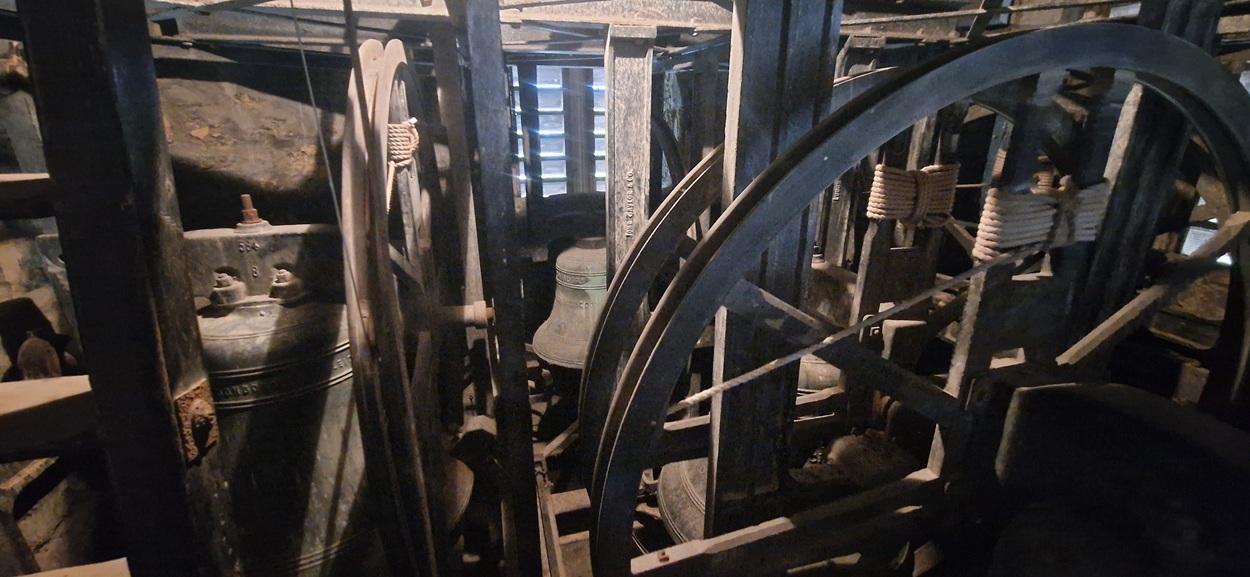 |
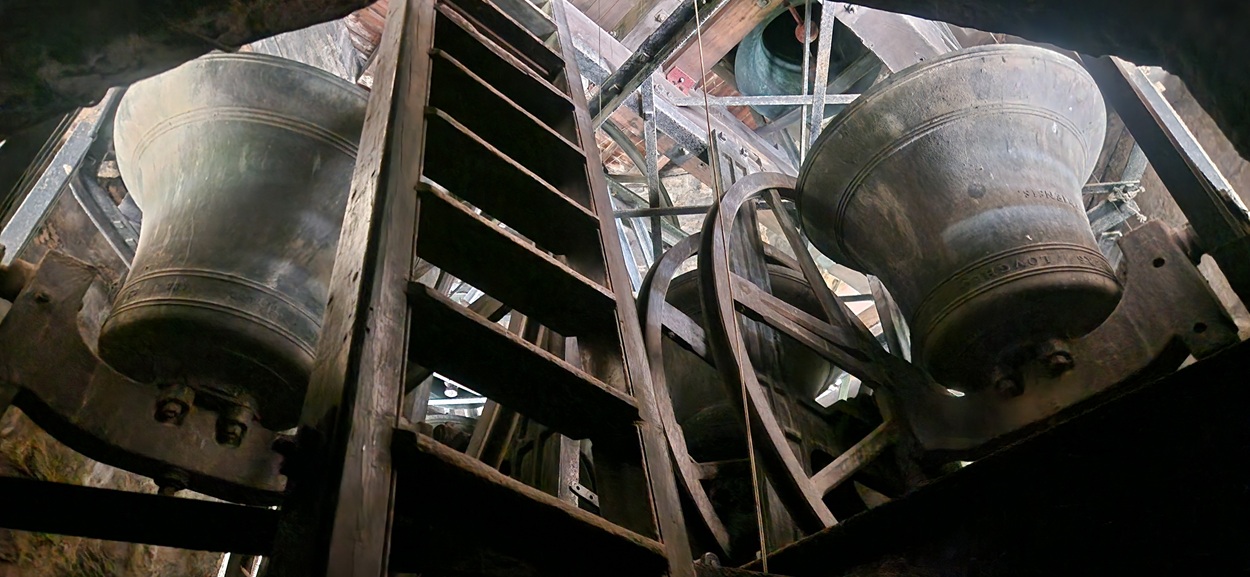
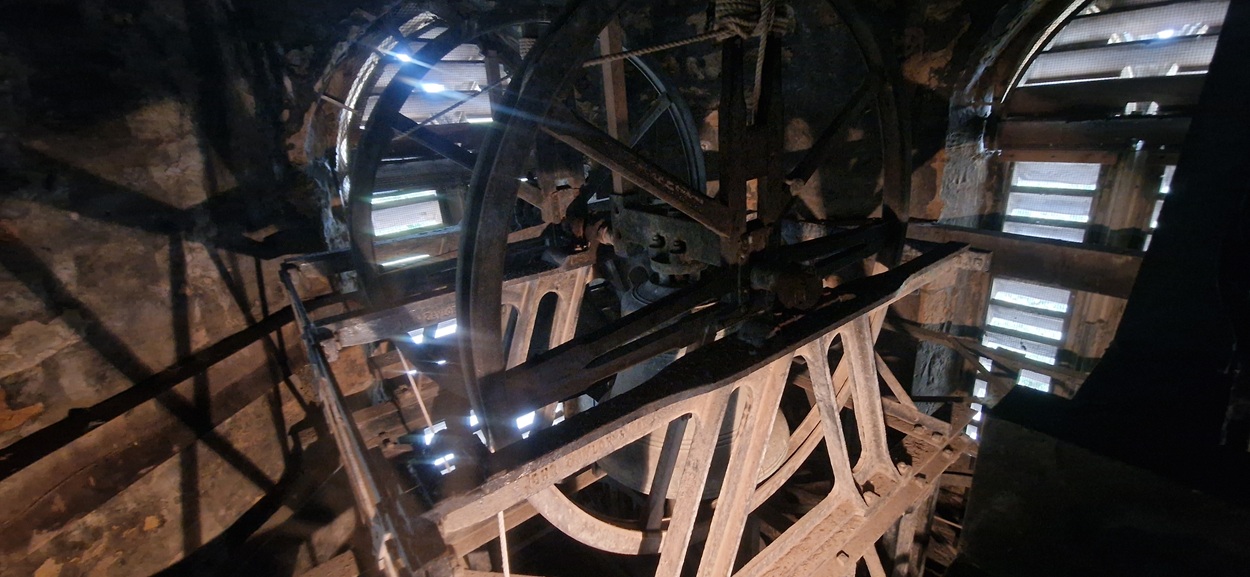
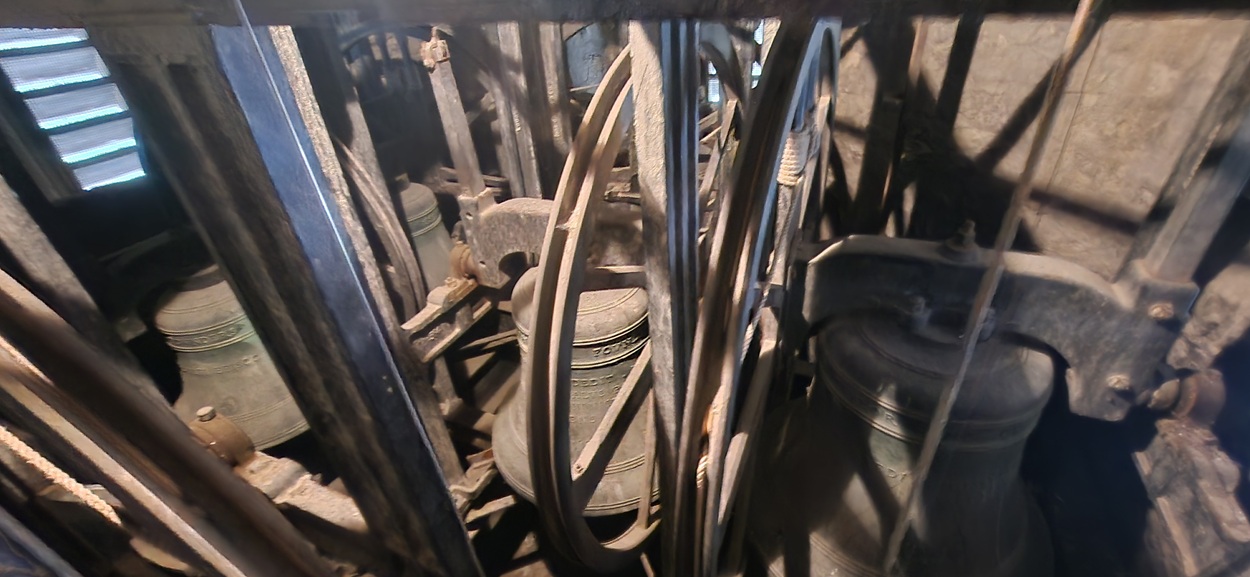
| The view from the belfry access point. Tenor on the left, 7th on the right and the service bell is above | 3rd at the back, tenor in the left and the 6th in the middle |
 |
 |
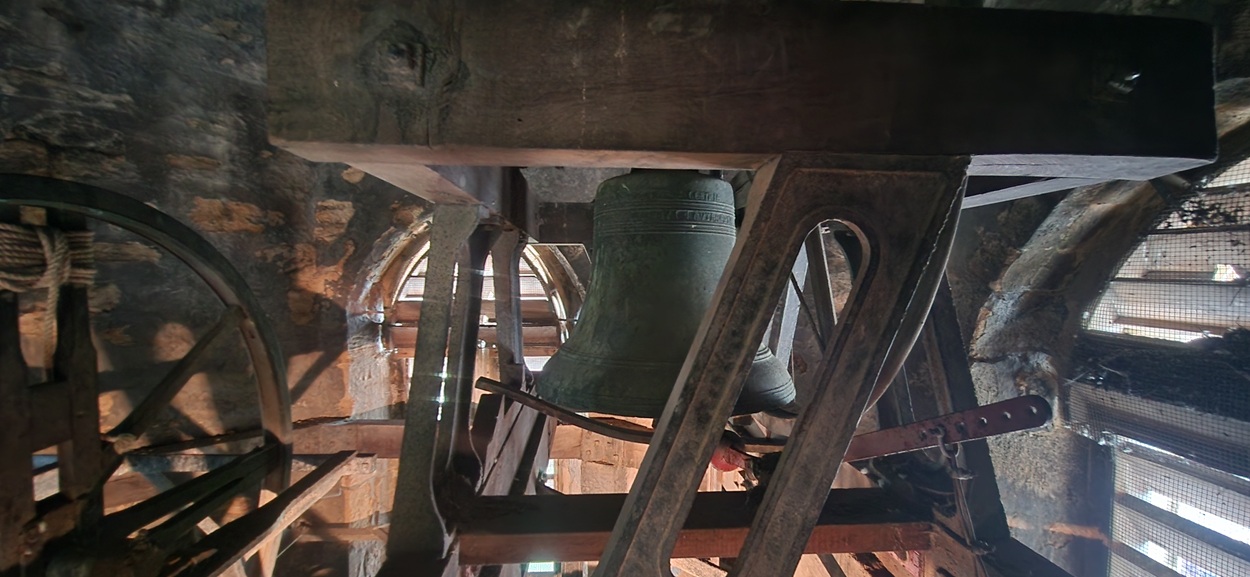
| The two trebles which are hung above bells 3 and 4. | Bells on the lower tier |
 |
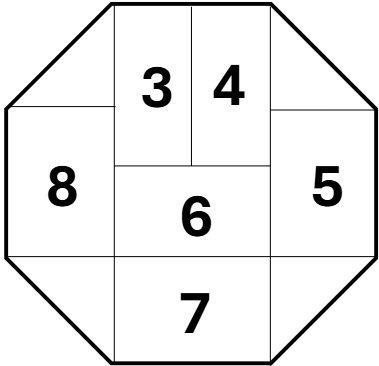 |
| The service bell | The layout of the back 6 bells in the octagonal part of the tower. Layout is Layout 6.12 with Pits A and B rotated at right-angles |