Blackhill, Our Lady Immaculate 8: 15-3-19 in F MAP
No regular ringing

Church History
This is the only ring of bells in a Roman Catholic church in the North-East of England.
In 1849, a young priest named Father Francis Kearney arrived at The Brooms church, outside Leadgate, on horseback, his first parish after being ordained at Ushaw College the previous year. Two years after his arrival at The Brooms, he reported that there were 2,000 Catholics living in the district, most of them ironworkers in Blackhill and Consett, while his tiny chapel a good two miles away from the foundries could only accommodate 240 worshippers at a time.
The resourceful priest hit on a very Victorian solution to the problem. He persuaded Mr Foster, the manager of the Derwent Iron Company, to stop the wages of every Catholic in the ironworks for a day to pay for a new church. In July 1854, he paid landowner John Nicholson, of Shotley Bridge, £480 for three roods of land with a cottage on it at Blackhill, near the company houses built for the immigrant workers.
Designed by architects Weightman, Hadfield and Goldie, the foundation stone was laid on August 24, 1854 by William Hogarth, the first Bishop of Hexham who preferred to live in Darlington. That same year, Pope Pius IX enshrined the dogma of the Immaculate Conception of the Blessed Virgin Mary in church law and the new church was officially named Our Lady Immaculate, Shotley Hill, although by all accounts it was universally known as St Mary’s from the start.
Then, as now, Consett was a windswept place, perched high on the edge of the North Pennines. Late in January 1856, with the new chapel virtually complete, the town was hit by winter rains, which lashed down almost incessantly for a fortnight and, unseen by the builders, seeped into the stonework and weakened the fresh mortar. On the night of February 7, 1856, the rain gave way to a great storm, which brought down ornate monuments in Glasgow’s Necropolis and sunk ships off Great Yarmouth and Pembrokeshire. The storm also brought the church of Our Lady Immaculate crashing to the ground, with only a fragment of the nave and chancel remaining intact. The following morning the congregation gathered amid the debris and stoically began the work all over again.
Perhaps unsurprisingly, a new architect was chosen for the rebuilding. Archibald Matthias Dunn, born in Wylam and educated at Ushaw College, was an inexperienced 24-year-old when he was commissioned, but he went on to become one of the North’s greatest architects, his most famous buildings include the Mining Institute in Newcastle’s Westgate Road and the spire of St Mary’s Cathedral, as well as alterations to Pugin’s masterpiece chapel at Ushaw College.
St Mary’s, in Blackhill, was his first commission, heavily influenced by the Gothic revival, with a tower, complete with gargoyles, that dominated the skyline above the squat two-up, two-downs of the infant iron town. Capable of holding 800 parishioners at a time, it was opened in July 1857, with a Pontifical High Mass celebrated by Bishop Hogarth. Mozart’s Mass Number Seven was performed, while an offertory, taken by Catholic gentry Henry Silvertop, Matthew Kearney and George Gunn, collected 64 shillings.
However, the church was an empty shell. There were no pews and members of the congregation brought chairs from their humble homes on Saturday night to be in place for Sunday Mass. The only light through the dark winter was from candles. Nevertheless, thousands of the faithful came each week, up the steep hill from Shotley Bridge and down from the ironworks at Consett.
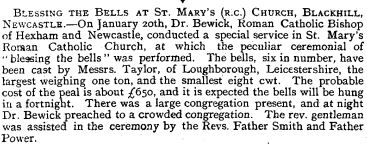
Finally, in January 1884, the clock tower was completed with a spire and belfry with six bells, the largest weighing 22 hundredweight. The bells were blessed by Bishop Bewick and almost tolled for disaster on their first day. The bells were designed to swing in four directions, north, south, east and west, but were initially installed by parishioners who set them to all swing in the same direction, which would have been enough momentum to bring the tower down.
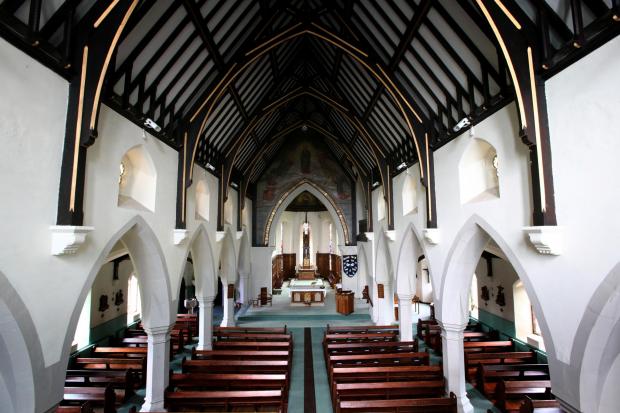
The interior of the church
Source https://www.thenorthernecho.co.uk/history/13981978.stormy-start-for-st-marys/
The Bells
The present bells are a complete ring of 8 by Taylors of Loughborough and were cast in 1947. They were all cast with flat heads and hung in a cast iron frame. They remain much as they were installed and none have been turned.
They replaced a Taylors of Loughborough ring of 6 that had a tenor weight of 22cwt. The two tenors were cast without canons. These bells were hung in a two tier frame, bells 1, 2 & 4 above and 3, 5 & 6 below. They were two separate 3 bell frames, “Pickford Plan” 3.3. The frames were indeed made locally, to Taylor’s drawings. The Job Book at Taylors also contains the settings for 2 trebles, though these were never supplied. The Taylor ring in turn replaced an old bell, unknown founder; 32.0”, 7-0-10 in D. Taylors supplied a chiming apparatus in March of 1909. (CJP) No peals were rung on the ring of 6. The clock and bells were installed at a cost of c.£600.
The following notice appears in “Bell News and Ringers’ Record” in the edition of 9th February 1884:
The D&N visited the area on Boxing Day of 1885, ringing here, at Consett and at Benfieldside. In the “Bell News and Ringer’s Record” in their edition of January 9th 1886 reported:
DURHAM AND NEWCASTLE DIOCESAN ASSOCIATION.
On Bank Holiday, Saturday, 26th, seven members of this Association journeyed by rail to the Consett district of Durham, for a day’s outing. After a little refreshment at the house of Mr. Sloane, of Blackhill, a move was made to St. Mary’s Roman Catholic Church in that village, where some six scores of Plain Bob and Grandsire Doubles were rung by Edward Sloane (Blackhill), 1 ; H. Ferguson, 2; C. L. Routledge (conductor), 3 ; R. S. Story, 4 ; S. Power, 5 ; E. Wallis, 6 ; which was followed by a 720 of Kent Treble Bob Minor, in 29 mins., by C. L . Routledge, 1 ; W . Reed (conductor), 2; R. S. Story, 3 ; W. Story, 4; S. Power, 5 ; E. Wallis, 6. This is the first 720 on the bells with the tenor single-handed.
There is also a report of a meeting of the ringers at the church in the edition of July 10th 1886 and of a ringers’ outing in that of October 2nd of the same year. In the edition of June 25th 1887:
Blackhill (Durham).—The ringing at St. Mary’s (r .c .) church on Jubilee Day consisted of firing royal salutes and several six-scores of Grandsire Doubles at intervals from 6 a.m to 1 pm. by the following : J. Moore, C. McElrue, J. McPhillips, J. Moore, B. King, M. Rodgers, E. J. Sloane, J. T. Dobson, and A. Nichols, conducted respectively by J. Moore, A. Nichols and J. T. Dobson. A 720 of Oxford TB Minor was rung by a visiting band on August 1st 1887 and other 720s are reported in the following years. The report of a 720 that was rung on January 1st 1898 states that “A movement is on foot for the addition of two new bells to this peal.”
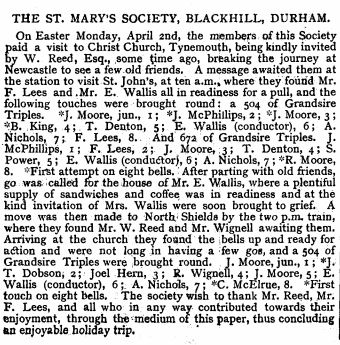
A report in Bell News on April 7th 1888 gives the names of the local ringers and also shows that they were skilled enough to be ringing methods on 8 bells:
There are several reports of 720s being rung here until about 1901. Things seem to have gone quiet for quite a while and the next published ringing on the bells I can find at the moment was at an Association meeting on Whit Monday 1924. I don’t know if there was a local band between these times.
In The Ringing World of August 7th 1931, as part of a meeting report it is stated:
An invitation had been received to try the six bells of the Blackhill Roman Catholic Church, and most of the party accepted it, but, with a tenor of 22 cwt. and the bells very hard going, the striking was far from perfect. The belfry contains a board and several cards recording 720’s rung in different methods. These are all called ‘peals.’
A branch meeting was held here on 16th November 1935, so the bells were still ringable at this stage.
As already stated, the heavy six was replaced by a fine, if lighter, ring of 8 by Taylors in 1947. There is no mention of the recasting or dedication of the bells in The Ringing World that I can find, only note when the first peal on them was rung.
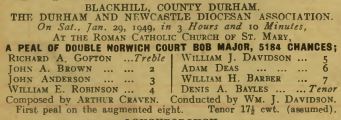
The first peal on the New Taylor 8, and hence in the tower, was rung in January 1949.
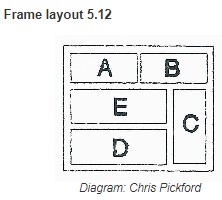
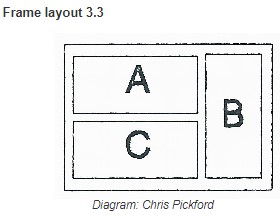
Bells 1, 2, 4, 5 and 7 are hung in cast iron lowside frames, above 3, 6 and 8, which are in cast iron “H-frames”. The bells were all cast with flat heads and none have been turned.
The upper frame layout:
The lower frame layout is approximately:
There was an issue with the tower in 1966, a peal attempt being cancelled was reported in The Ringing World on November 18th 1966 – what it was, and for how long it lasted, I have not yet ascertained. the next peal was on 22nd April 1967, so it seems that the issue was not too serious.
Current Bells
1 4-1-23 26.63″ 1947 John Taylor & Co 1384.0Hz F-16c
2 4-2-24 27.63″ 1947 John Taylor & Co 1306.0Hz E-17c
3 5-1-2 29.00″ 1947 John Taylor & Co 1162.0Hz D-19c
4 6-0-7 31.13″ 1947 John Taylor & Co 1036.0Hz C-17c
5 7-0-24 33.50″ 1947 John Taylor & Co 922.0Hz Bb-19c
6 8-0-24 35.50″ 1947 John Taylor & Co 871.0Hz A-18c
7 11-0-6 39.13″ 1947 John Taylor & Co 777.0Hz G-16c
8 15-3-19 44.25″ 1947 John Taylor & Co 692.0Hz F-16c
Inscriptions
Each bell is inscribed with the name of a saint, followed by “PRAY FOR US”:
- ST OSWALD
- ST AIDAN
- ST JOSEPH
- ST BEDE
- ST THOMAS
- ST CUTHBERT
- ST PALRISH
- OUR LADY IMMACULATE
Previous Bells
1 5-2-4 (5-2-0) 30.5″ 1883 John Taylor & Co 1062.0Hz C+25c
2 7-0-10 (7-0-5) 33.5″ 1883 John Taylor & Co 956.0Hz Bb+43c
3 9-3-20 (9-3-11) 36.75″ 1883 John Taylor & Co 852.0Hz Ab+44c
4 11-3-13 (11-3-8) 39.375″ 1883 John Taylor & Co 798.0Hz G+31c
5 14-3-0 (14-2-24) 43.625″ 1883 John Taylor & Co 716.0Hz F+43c
6 22-0-19 (22-0-15) 49.25″ 1883 John Taylor & Co 639.0Hz Eb+46c
(The figures in brackets are the “as received” weights at Taylors in 1947)